The 11% Win That Wasn't
In Q2 2023, I was proud of a number: an 11% reduction in our PPE spending. I'd achieved it by switching our earplug supplier to a budget option at roughly $0.08 per pair. I presented the savings to our CFO with the confidence of someone who had just found free money.
I've been the procurement manager at a 200-person metal fabrication plant for five years now, managing a safety budget of about $180,000 annually. I track every order in our cost system. I compare vendors quarterly. I calculate total cost of ownership (TCO) for machinery and software contracts without blinking.
But for hearing protection, I only looked at unit price. That was the mistake.
By Q2 2024, my cost-tracking spreadsheet had the receipts—and they were ugly.
What the Shop Floor Taught Me
The problem started quietly. A floor supervisor mentioned that guys on the CNC line were "forgetting" their earplugs at the entrance to the shop floor. A walkthrough showed me why. The budget foam (which, honestly, felt like compressed sandpaper) was stiff and hard to shape. Workers couldn't roll it down to insert it properly. The ones who forced it in complained about pressure pain by hour two.
So they took them out. Or left them in lockers. Or grabbed a fresh pair from the dispenser every shift because the old ones "didn't feel right" (and the plastic-wrapped foam didn't stay clean in a pocket anyway).
The reorder data told the story: we were going through 40% more earplugs per month than our 200-person headcount justified. At the time, I shrugged it off. Foam earplugs are cheap, so the waste was cheap. But the real cost wasn't just the product. It was my assistant spending 2–3 hours a month processing reorders and restocking dispensers. It was supervisor time spent chasing workers who weren't wearing them. And it was the compliance rate itself, which we finally audited at roughly 70%—far below what an effective hearing conservation program should look like.
Here's the question I should have asked in 2023: was I buying earplugs, or was I buying hearing protection? They're not the same thing.
The Real Price of "Cheap"
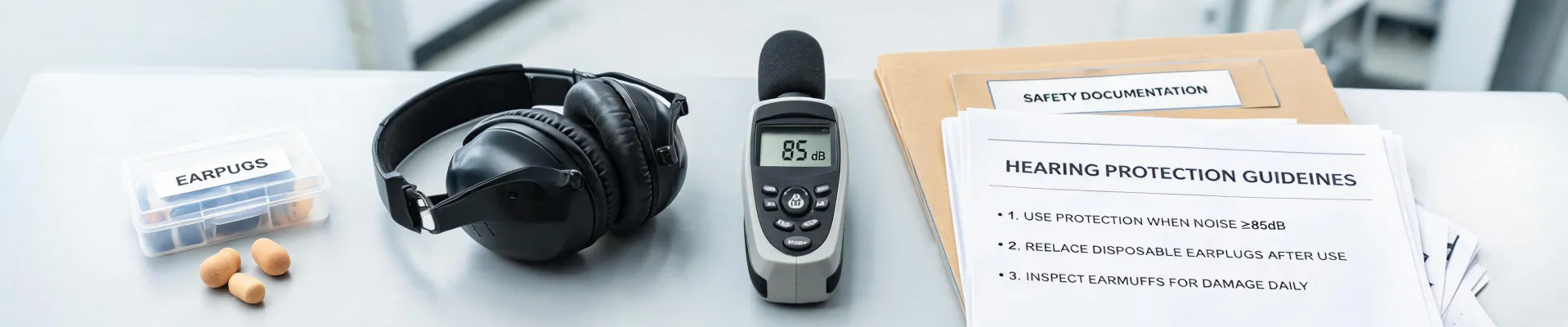
OSHA's hearing conservation standard—29 CFR 1910.95, which as of my last regulatory check in December 2024 remains the governing rule—requires a hearing protection program when noise exposure hits 85 dBA over an 8-hour shift. Effective is the operative word. It doesn't mean "we bought earplugs and put them in a dispenser." It means workers actually wear them.
A plant with a 30% non-wearing rate isn't saving money. It's building a liability. Penalties for hearing protection violations range from a few thousand dollars to $32,000 or more, depending on severity and citation history. I've seen inspection reports for plants in our sector with exactly this pattern: earplugs supplied, compliance assumed, workers not wearing them.
Then there's the worst-case scenario: a workers' compensation claim for noise-induced hearing loss. Average claims run $20,000–$40,000 all-in—sometimes higher. One claim would have erased every dollar we "saved" with the budget earplugs for the entire contract period.
This is what I mean by total cost of ownership: unit price + waste + labor + compliance risk + claim risk. I'd used this framework for years on capital purchases. I just never applied it to PPE.
The Fire Alarm That Explained Everything
Around the same time, our facilities manager was dealing with a recurring headache: the office fire alarm going off randomly, three times in four months. Each false alarm cost $350–$600 in service callouts, plus the productivity loss of evacuating the building. By the third one, our office manager finally typed the inevitable Google search: "why did my fire alarm randomly go off?"
The answer, once we paid a technician to actually diagnose it, was embarrassingly simple: aging detectors past their recommended service life. A $90 sensor replacement per unit, if we'd caught it early, would have prevented $1,800 in callout fees.
Then came the annual fire inspection. Our fire extinguisher inspection tags were out of date on six units. Not because anyone skipped the inspections—but because the inspection logs lived in a binder in the maintenance office, and nobody had cross-checked the tags on the actual extinguishers.
The fine was minor. The reinspection fee wasn't: $2,100.
The pattern was identical to the earplugs: we were so focused on the visible cost—the callout fee, the tag, the $0.08 unit price—that we ignored the systemic costs. Aging equipment, broken processes, and the total cost of compliance done wrong.
What Changed When I Ran the Numbers
I went back to basics and compared three options: the budget earplugs we'd been buying, plus two Howard Leight models (a brand under Honeywell's safety umbrella) that kept surfacing in my research: the Max Lite and the Laser Lite.
The Max Lite is a classic foam cylinder with an NRR of 33—the highest noise reduction rating you can get in a foam earplug. The Laser Lite is tapered, which suits workers with narrower ear canals, and carries an NRR of 32. Both use a slow-expansion foam that seals far more reliably than the stiff budget stuff we'd standardized on.
Instead of trusting spec sheets, I ordered sample boxes, handed them to the CNC crew, and let them decide. They overwhelmingly preferred the Howard Leight options. The Max Lite won with workers who have larger ear canals. The Laser Lite won with the ones who'd always struggled to get a seal from standard cylinders.
Six months of data later:
- Consumption dropped 35% because workers stopped treating earplugs as disposable
- Waste cost fell by roughly 60%
- Compliance audits improved from ~70% to ~95%
- Restocking labor dropped by about 20 hours per year
The unit price was higher—$0.13–$0.14 per pair versus $0.08. But the total cost was dramatically lower. Running the full TCO calculation, including the expected value of compliance and claim risk, I estimate the switch saved us about $4,200 per year. Over our three-year contract, that's roughly $8,400 compared to sticking with the "cheap" option. To be fair, that's an estimate based on 18 months of order data—not an audited statement. But the direction was unmistakable.
The Rule I Use Now
I built a simple TCO calculator for all PPE decisions now—hearing protection, fire extinguisher inspection tags, hard hats, fall protection, you name it. It's not fancy:
- Actual units used (not theoretical) × unit price
- + Restocking labor (hours × loaded rate)
- + Waste (units lost or discarded × unit price)
- + Compliance risk (probability of citation × expected fine)
- + Claim risk (probability of claim × expected cost)
- = True annual cost
I can only speak to our context: a mid-size plant with predictable ordering patterns and a stable workforce. If you run a seasonal operation or manage remote crews, your numbers will differ. The principle won't.
And I'm not saying premium products are always the right call. The budget earplugs we used are perfectly fine for a visitor locker room. But for workers who wear hearing protection for eight hours a day, every day, "cheap" has a different definition: it's the product that actually gets worn.
The Bottom Line
It took me three years and about 150 purchase orders to understand something obvious in hindsight. The unit price of an earplug is the starting point, not the answer. Waste, labor, compliance risk, and claims risk are where the real costs live.
If you're managing a safety budget, here's what I'd do:
- Pull your last 12 months of earplug orders and calculate the actual cost per worker per year—not per pair.
- Run a side-by-side trial of a higher-quality foam plug (the Howard Leight Max Lite and Laser Lite are good starting points) against your current supplier. Let your workers do the evaluation.
Your spreadsheet will probably surprise you. It certainly surprised me.

Maeve Callahan
Maeve Callahan is a head-protection analyst covering Type I and Type II hard hats, climbing-style safety helmets, bump caps, chin straps, suspensions, liners, and face-shield carriers. She applies ANSI Z89.1, EN 397, and EN 12492 criteria while comparing impact attenuation, penetration resistance, lateral deformation, electrical class, retention strength, field of vision, mass, fit range, and temperature conditioning. Her guides help EHS teams, contractors, utilities, and buyers select helmet systems for overhead hazards, work at height, electrical exposure, accessory compatibility, and worker acceptance.