For the past six years, I've handled purchasing at a 148-person manufacturing plant. My safety supplies budget runs around $90,000 a year, and I track every order in the same spreadsheet. It sounds boring, but that spreadsheet is the reason our PPE costs don't sneak up on us anymore. Fine by me.
Here's my opinion: if a supplier treats a small PPE order like a nuisance, find another supplier. Small orders deserve the same technical honesty as big ones. In some ways, they need more, because a 30-person shop usually doesn't have a full-time safety manager checking every decision.
PPE Is Not a Discount Code Problem
Don't get me wrong. I love a good deal on workwear.
But PPE selection is not a checkout code. A 15% discount doesn't tell you whether a glove is suitable for a specific acid or whether an earplug will actually fit the workers who have to wear it eight hours. That sounds like something a safety manager says to sound important. It isn't. It's the difference between ordering equipment and matching protection to a hazard.
Hearing Protection: Why NRR 33 Is Not the Whole Answer
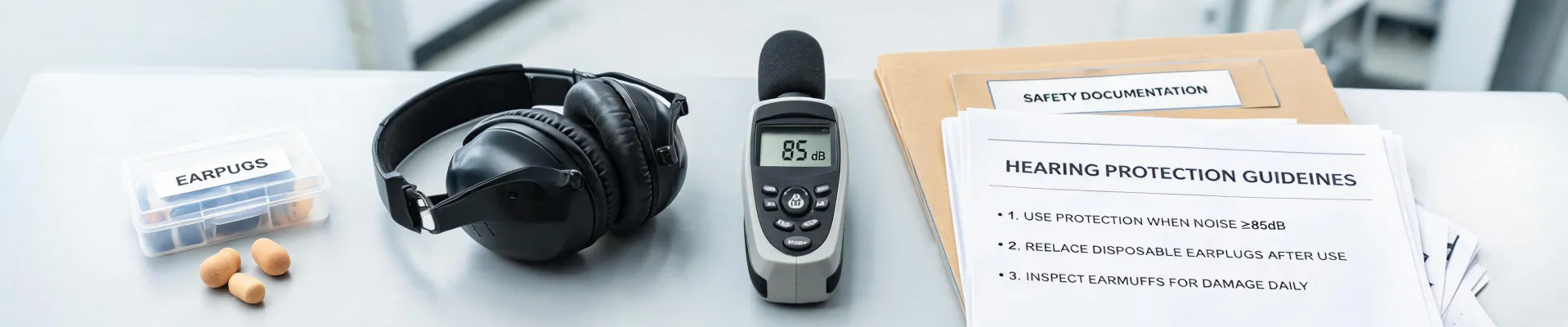
People assume that the higher the NRR, the safer the worker. The truth is more annoying: an earplug with a lower NRR but a proper fit can outperform a higher-rated model in real life, because protection depends on wearing it consistently and correctly. According to NIOSH (cdc.gov/niosh), roughly 22 million U.S. workers are exposed to hazardous noise at work. That tells me these decisions matter far too much to be made on price alone.
In 2023, our machine shop ran a 90-day trial with two popular Howard Leight products: the Howard Leight Max earplugs and the Howard Leight Fusion reusable earplugs NRR 27. The Max is a classic roll-down foam earplug with an NRR of 33. It is a strong product and a low cost per pair. The Fusion is a reusable earplug with an NRR of 27. On paper, the Max had the higher rating. In practice, the result surprised me.
Some workers loved the Max. They liked the high NRR and the familiar foam feel. A bigger group reached for the Fusion every day because it felt easier to seat and didn't create that blocked-up pressure during all-day wear. The real comparison wasn't simply one box of Max versus one box of Fusion. If disposable foam plugs are worn for one day and thrown away, the cost keeps repeating. A reusable plug that is cleaned and stored properly can last several months. For our situation, the total cost of ownership came out much closer than I expected. The right answer ended up being 'maybe both,' depending on the job and the person.
From the outside, hearing protection looks like a 30-second commodity purchase. The reality is that compliance is a habit. The plug that stays in an ear does more than the plug with a slightly higher rating that sits in a pocket.
Which PPE Can Protect You From Liquid Chemicals?
I hear that exact question more often than you'd expect. It usually comes from a small company owner who has read a Safety Data Sheet and wants a one-sentence answer. Here's the unhelpful truth: no single item protects against every liquid chemical. A nitrile glove is not chemical-proof in an absolute way. The glove that handles one solvent can be degraded by another.
The starting point has to be the hazard. Look at the chemicals in your process, then check the glove or garment manufacturer's chemical permeation and breakthrough time data. According to OSHA's PPE standard, 29 CFR 1910.132, employers must assess workplace hazards and select PPE accordingly, not simply buy whichever product has the word 'chemical' on the label (Source: osha.gov).
For liquid splash, you generally need a combination:
- Chemical-resistant gloves and sleeves matched to the specific chemical
- Unvented goggles or a face shield over eye protection
- A chemical-resistant apron or coverall if the body is in splash range
- Easy access to rinse stations or an eyewash
I still kick myself for accepting a vendor's 'this handles solvents' without asking for the permeation chart. Nothing bad happened. But 'nothing bad happened' is not a standard. I never ordered that way again.
The Vendor Problem: Small Orders Are Not Training Wheels
Here is where my opinion gets sharp. A distributor once told me our order was below the threshold for technical support. We were buying 60 pairs of Howard Leight Fusion and a few cases of safety glasses. It wasn't a huge order, but it was real, and it had real questions.
I went back and forth between that distributor and a regional supplier for almost two weeks. The regional supplier cost about $80 more on the initial purchase, but they asked what we handled, what the noise levels were, and which tasks caused complaints. They also sent a sample box so our lead operator could try two earplug styles before we committed.
I still had doubts after I signed the purchase order. Did I spend too much? Then the first shipment arrived with the wrong revision of a glove, and the regional supplier fixed it by the next morning without treating us like we were difficult. That experience saved us far more than $80.
PPE Is Not a GPS Dog Fence
I use that comparison on purpose. A GPS dog fence is a useful safety tool, but it mostly asks for a boundary, a collar size, and a battery. PPE asks for more. An earplug has to fit a human ear. A chemical glove has to survive the exact substance and exposure. Those requirements don't go away just because you're ordering 50 units instead of 5,000.
And I do like a good deal. I've used a Brunt workwear discount code for my own boots. That's a separate transaction from selecting PPE for a specific hazard. A coupon can lower the price. It can't tell you whether the product is the right barrier.
If You're a Small Shop, Don't Apologize for Asking Questions
I can hear the counterargument: 'We don't have leverage. We are too small to get technical support from anyone. We just need the cheapest thing that checks a box.' I understand. I've bought PPE for a 30-person shop too.
But that mindset lets suppliers off the hook. Try asking two vendors the same question: 'Can you help me choose between Howard Leight Max earplugs and the Howard Leight Fusion reusable earplugs for a small metal shop?' If they say 'go with the cheaper one,' they aren't a safety partner. If they ask about your noise levels and fit, that's the start of a useful relationship.
Bottom Line
My opinion hasn't changed after six years: start with the hazard, not with the price list. Use the best technical advice you can get, no matter the order size.
So next time you look at Howard Leight earplugs, or search for which PPE can protect you from liquid chemicals, remember that the product is only part of the answer. The other part is whether someone is willing to help you match the equipment to the person who will wear it. That might be the best purchase decision you make all year.

Maeve Callahan
Maeve Callahan is a head-protection analyst covering Type I and Type II hard hats, climbing-style safety helmets, bump caps, chin straps, suspensions, liners, and face-shield carriers. She applies ANSI Z89.1, EN 397, and EN 12492 criteria while comparing impact attenuation, penetration resistance, lateral deformation, electrical class, retention strength, field of vision, mass, fit range, and temperature conditioning. Her guides help EHS teams, contractors, utilities, and buyers select helmet systems for overhead hazards, work at height, electrical exposure, accessory compatibility, and worker acceptance.