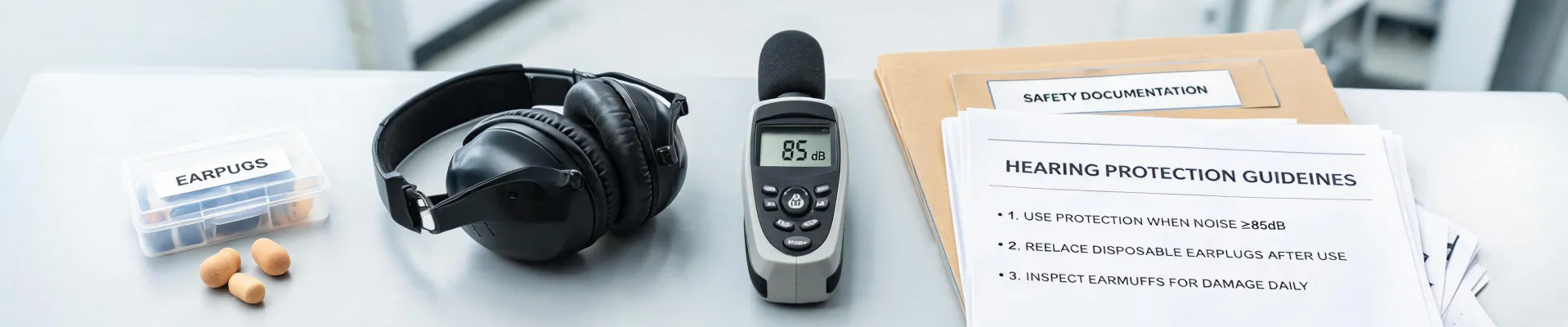
In 2021, I signed off on switching our earplug supplier. The new earplugs had an NRR of 33 and cost $312 less per year than the old ones. I thought that was responsible purchasing. In September 2022, one of my press brake operators failed his annual audiogram. By 2023, that decision had cost our company about $16,400 in claims, consulting fees, and higher insurance premiums. Here's what I got wrong.
The math I used on myself
Our press brake area ran around 98 dB as an eight-hour time-weighted average. The earplugs were rated NRR 33. In my head, 98 minus 33 equaled 65 dB. Perfectly safe. I repeated that math like it meant something.
Let me rephrase it the way I should have said it at the time: 98 dB minus a laboratory number—measured with carefully fitted plugs on trained test subjects—equals safe. The formula completely ignored the people wearing the plugs.
What I mean is, I bought spec sheets, not protection. A foam earplug is a mechanical seal. It doesn't soak up noise like a sponge. It blocks the ear canal with an airtight plug. If the seal leaks, the protection leaks. And I had never once checked whether any of my guys had a real seal.
Why NRR 33 was never the number I thought it was
NRR stands for Noise Reduction Rating. It is a laboratory number. NIOSH recommends estimating real-world protection from foam earplugs at roughly half the labeled NRR (NIOSH Publication No. 98-126). So a plug rated 33 should be treated as delivering maybe 16 dB in the real world—and that estimate still assumes it is inserted correctly.
Foam plugs hide their mistakes well. A worker can push one in too shallow, and it looks fine from the outside. The plug expands, it feels snug, and the person assumes it's working. If you've never been shown how to roll it into a thin crease, pull your ear up and back, insert it, and hold it while it expands, you're probably getting a fraction of the rating.
That's the part I want you to take seriously: an NRR number is a ceiling, not a promise. The only protection that counts is the protection that survives contact with a real person's ear.
The three mistakes that did the damage
1. I bought for an ear that doesn't exist
Human ear canals are not all the same size. Across our 36 employees, there were at least four or five different ear canal shapes. I handed every one of them the same foam plug from the same bulk box. Some plugs were too small and leaked. Some were too large and kept working their way out. Nobody told me, because the plugs came from management, so they must have been the right ones.
2. I assumed people knew how to put them in
Foam earplugs require technique. You roll the plug into a tight, thin crease, reach your opposite hand over your head to pull your ear up and back, insert the plug, and hold it while it expands. It takes about 20 seconds and a mirror the first few times.
Nobody taught my guys this. I gave a 90-second safety talk about wearing your PPE and called it training. When I finally watched our operators insert plugs after the incident, the most common mistakes were obvious: not rolling the plug down enough, not pulling the ear back, and pushing the plug in only until it felt snug—which is often too shallow to form a real seal.
3. I trusted the box more than the behavior
Ask yourself the question I finally asked in 2023: How does a smoke detector work? Most of us would answer, It beeps when there's smoke. That's not wrong, but it's not a real answer either. A smoke detector only protects you if it's the right type, installed in the right place, with working batteries and someone who tests it. An earplug only protects you if it's the right size, seated correctly, and worn every time the noise is loud.
I never would have handed a worker a pair of work boots without checking the size and the safety rating. In fact, our guys wear Brunt work boots, and I've watched supervisors spend real money on them without a second thought. Boots are visible. A split sole or a crushed toe shows up fast, and nobody questions the purchase.
Hearing damage is invisible until it isn't. Meanwhile, I gave more thought to buying my teenager a pair of kids work boots for a summer job than I gave to 36 guys' hearing over two years. I measured his feet, checked the toe cap, watched him walk in them. I have never once watched a worker insert an earplug until after the damage was done.
The bill showed up in a quiet room
The operator was 34. He didn't come to me with complaints. The annual audiogram found a standard threshold shift in his right ear, with the classic notch at 4,000 Hz. The doctor asked if he'd noticed ringing after shifts. He said sometimes, but I wear my earplugs. He truly believed that. So did I, until the test data said otherwise.
Noise-induced hearing loss is quiet in more ways than one. It usually starts at frequencies we don't use for conversation, so it can go unnoticed for years. He wasn't deaf. He just couldn't hear certain high frequencies as clearly as he should, and he noticed it in the truck when the radio was on.
That incident became an OSHA recordable, and it triggered a workers' comp claim. We added it up later: $3,800 for an outside noise assessment and program audit, $1,200 in audiology retesting, about $2,000 of my time and the production supervisor's time, and $9,400 in higher workers' comp premiums over two years. Total: about $16,400. The $312 we saved on earplugs was in there somewhere.
What we do now
We didn't switch to some miracle product. We changed the process around the product.
Today the default in our dispensers is the Howard Leight MAX foam earplugs. We stock the Howard Leight MAX-1 earplugs—the disposable foam style rated NRR 33—because they fit the majority of our crew. But the key word is default, not only. If a MAX-1 doesn't seal for a particular worker, we pull other styles. The earplug has to fit the ear. The ear doesn't have to fit my purchasing habit.
We also fit-test every person now. It's not complicated: with the plug in place, a small system measures how much noise actually gets through. The first time we did it, the results were humbling. Some of our guys were getting 8 dB of real protection. Others were getting 20 dB. Same box of earplugs. The difference was fit and technique.
Every new hire now gets a one-on-one session: roll, reach, pull, insert, hold. We check the fit again at six months. And we updated our safety checklist so hearing protection gets the same quarterly review as fire extinguishers and eyewash stations. I keep a copy of that checklist in my office. It's my reminder that the program matters more than the product.
Certainty costs less than hearing
Here's what stings every time I think about it. The extra cost of the new program—better earplugs, fit testing, training time—is roughly $900 per year. The mistake cost $16,400. I have spent more than $900 on a bad week of downtime and never blinked.
I don't choose probably anymore. If there's a way to verify something, I pay for the verification. If there's a reputable product with a real testing program behind it, I pay for the certainty. An uncertain cheap earplug is way more expensive than a certain one.
You don't have to buy the most expensive thing on the market. You do have to make sure your people are actually protected. If that means spending more on a known product like the Howard Leight MAX foam earplugs and building a real training program around them, do it. Hearing doesn't regenerate, and no NRR sticker is worth the gamble.

Maeve Callahan
Maeve Callahan is a head-protection analyst covering Type I and Type II hard hats, climbing-style safety helmets, bump caps, chin straps, suspensions, liners, and face-shield carriers. She applies ANSI Z89.1, EN 397, and EN 12492 criteria while comparing impact attenuation, penetration resistance, lateral deformation, electrical class, retention strength, field of vision, mass, fit range, and temperature conditioning. Her guides help EHS teams, contractors, utilities, and buyers select helmet systems for overhead hazards, work at height, electrical exposure, accessory compatibility, and worker acceptance.