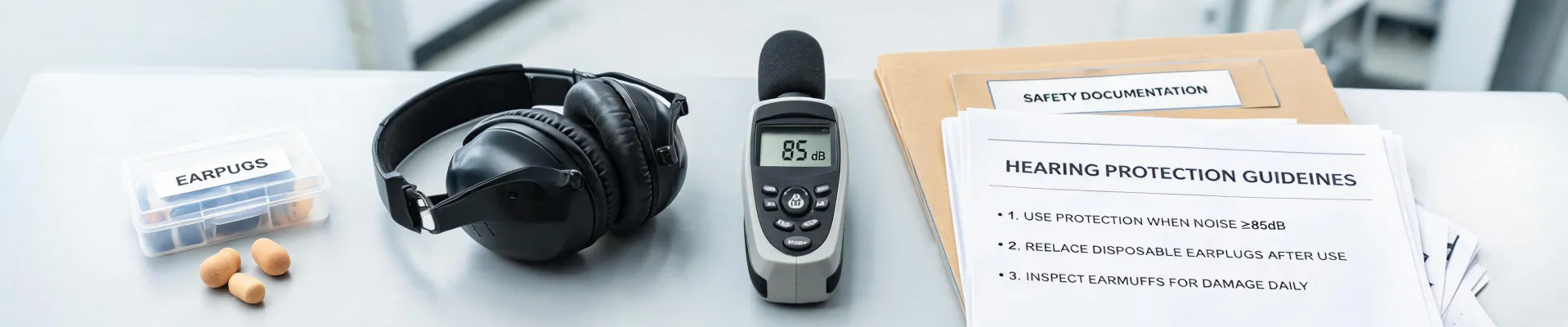
I’m a procurement manager at a 40-person contracting company, and I oversee about $60,000 a year in PPE and safety supplies. I’m not a safety engineer. I’m the person who signs off on the invoices, logs the complaints, and occasionally gets yelled at when something falls apart. So this comparison is less about spec sheets and more about what actually works when you’re buying for a small crew.
We’ve used both Howard Leight Max earplugs and Howard Leight earmuffs for the same crew. If you’re choosing between them, here’s the framework I use: real-world protection, total cost over a year, and whether people will actually wear them. Then I’ll cover the gloves and smoke detector checks that usually sit outside the hearing protection conversation—but shouldn’t.
Dimension 1: The NRR number isn’t the whole story
Howard Leight Max earplugs have an NRR of 33. That’s the highest number you’ll see on most foam earplugs, and it looks like the obvious choice. But after about four years and a stack of product orders, I’ve learned that the NRR on the box is not the protection your workers get in the field.
Earplugs rely on insertion. Get a good seal, and 33 is real. Get a poor seal—which is more common than you think—and you might be sitting closer to 15 or 20 dB of real protection. The OSHA hearing conservation standard (29 CFR 1910.95) requires training on fit, not just handing out supplies. Earmuffs, like the Howard Leight Leightning L3 with an NRR of 25, have lower theoretical protection, but the seal is visible. You can see if the cushion is sitting properly around the ear. That’s a huge advantage in the field.
Bottom line: a perfectly inserted Max earplug will outperform the earmuff. A typical worker in a hurry probably won’t insert it perfectly. The noise survey we had done in March 2023 changed how I think about this. The consultant showed us how much protection dropped when he purposely inserted the earplug wrong. That was the trigger for offering both options.
Dimension 2: Total cost over a year (earplugs aren’t actually cheap)
Here’s where I turn into a total cost nerd. Based on industrial supply catalog prices I checked in January 2025:
- Howard Leight Max foam earplugs: roughly $12 to $20 per box of 200 pairs.
- Howard Leight earmuffs like the Leightning L3: roughly $20 to $35 per pair, with replacement ear cushions around $8 to $15 per set.
For a crew of 40, let’s do the math. If each worker uses two pairs of disposable foam earplugs a day for 250 working days, that’s 20,000 pairs a year. At $0.15 per pair, that’s $3,000. If each worker gets one $25 earmuff and a $10 cushion replacement each year, that’s $35 per worker—$1,400 total in the first year. In year two, the earmuff is already bought, so you’re only replacing cushions: about $400 total. So the “cheap” disposable route can actually cost more than three times as much over two years. That was a surprise the first time I calculated it. (Mental note: update these prices every year; they move.)
The catch is that this only works if workers keep track of their earmuffs. If you have a crew that loses things, you’ll need a sign-out system or a slot on the tool inventory board. But even replacing a few lost muffs each year keeps the math ahead of daily disposables.
And from a small-team perspective, I’ll say this: the distributor I use doesn’t penalize us for smaller orders. That matters when you’re testing options. The vendors who took us seriously when we were buying $300 at a time are the ones I still order from today.
Dimension 3: Compliance, comfort, and why I now buy both
Here’s the practical part. The best hearing protector is the one people actually wear. Earplugs work well in hot work, tight spaces, and jobs where earmuffs get in the way. Earmuffs are easier to use correctly and easier for a supervisor to spot from across the room. When we changed from “everyone gets earplugs” to “here’s a choice,” our compliance log improved.
Not everyone cares about the fit and comfort conversation, but if you’re a cost controller, you should. A hearing protector that sits in a pocket is not protecting your company from a future hearing loss claim. I’d rather buy a $30 earmuff that gets worn than a box of earplugs that gets ignored (note to self: check the lost-and-found bin more often).
For very high noise areas, some of our workers double up with earplugs and earmuffs. That combination is worth considering if you have a job near a diesel engine or a metal shear. The extra cost is small compared to the cost of a hearing damage claim.
Honestly, I’m not sure why so many safety budgets default to earplugs. My best guess is that the upfront cost is so low that nobody bothers to run the yearly numbers. Once you do, the picture changes.
The gloves and smoke detector checks I almost skipped
Hearing protection is the main thing I buy, but it’s not the only thing I manage. In the 2023 audit, I found we were spending about $1,800 extra because we used latex gloves for rough handling tasks that needed leather gloves. The two are not interchangeable. Latex gloves are disposable, cheap, and great for chemicals or clean tasks, but they tear on abrasive materials. Leather gloves cost more up front per pair but hold up when you’re moving lumber, metal, or glass. OSHA 29 CFR 1910.138 says hand protection must be selected based on the task and hazards. That seems obvious, but it’s easy to ignore when a cheaper glove is sitting in the supply closet. For a small crew, the right move is to buy both and let the task—not the price—decide which one gets used.
During the same safety walkthrough, I found a dead smoke detector in the workshop. That’s the kind of thing that’s easy to ignore until it’s not. If you’re in charge of a small facility, here’s the basic install routine:
How to install a smoke detector in a workshop or office
- Turn off the power if it’s a hardwired unit.
- Mount the detector on the ceiling or high on a wall, away from vents and doors.
- Mark the screw holes, drill pilot holes if needed, and use the included anchors.
- Insert a fresh battery or use a sealed 10-year battery model.
- Test it once a month and vacuum out any dust.
How to install a smoke detector isn’t a PPE question, but it’s part of the same mindset: small preventive costs beat big incident costs. I bought three detectors, installed them in 20 minutes, and now it’s on the quarterly checklist.
Who should buy what
If your crew works in hot or humid conditions, or around welding hoods, start with Howard Leight Max earplugs. They’re low profile, disposable, and easy to pair with other gear. If your workers are in and out of noisy areas all day, or you have a few people who never seem to get earplugs in right, buy Howard Leight earmuffs for them. The honest answer for most small teams is both. The cost difference is not as big as people think, and the compliance gain is worth it.
For gloves, choose latex for liquid protection and leather for abrasion. For smoke detectors, install them, test them, and don’t assume someone else did it.
The cheapest safety plan is the one that actually gets used.
My experience is based on a contracting crew, not a foundry or a hospital. Your mix might be different. But the principle—compare the real-world cost of compliance, not just the catalog number—applies across industries.

Maeve Callahan
Maeve Callahan is a head-protection analyst covering Type I and Type II hard hats, climbing-style safety helmets, bump caps, chin straps, suspensions, liners, and face-shield carriers. She applies ANSI Z89.1, EN 397, and EN 12492 criteria while comparing impact attenuation, penetration resistance, lateral deformation, electrical class, retention strength, field of vision, mass, fit range, and temperature conditioning. Her guides help EHS teams, contractors, utilities, and buyers select helmet systems for overhead hazards, work at height, electrical exposure, accessory compatibility, and worker acceptance.