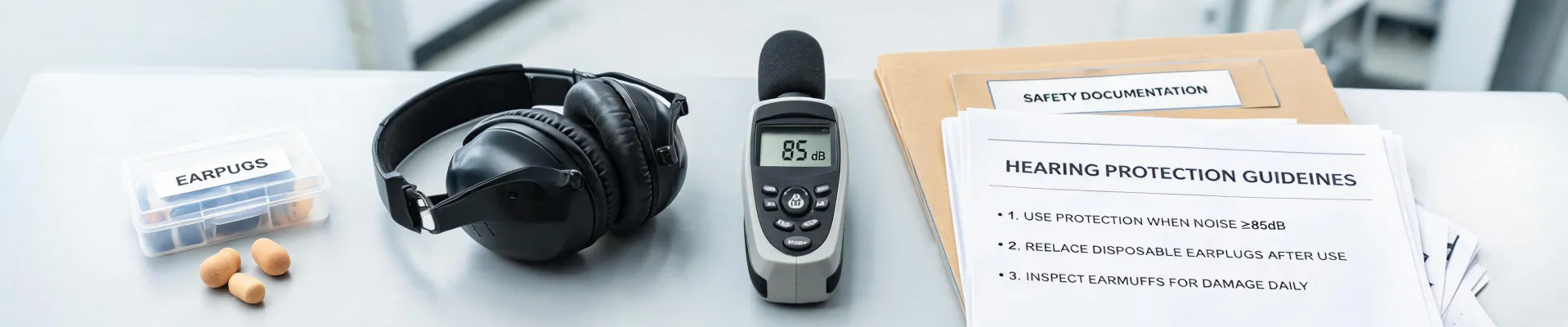
It Started With a Two-Word Request
The email from our warehouse supervisor said 'We need earplugs.' Just that. No noise measurements, no complaints about fit, no mention of which machines were pushing the level over the limit.
I do procurement for a manufacturer with about 140 employees. When I took over purchasing in 2020, I knew PPE in theory, but I had never thought deeply about hearing protection. So I did what anyone would do: I typed howard leight max foam earplugs nrr into a search box. Then I typed whats ppe because I was suddenly unsure whether earplugs counted as PPE.
They do, of course. But the real question I should have been asking wasn't what to call them. It was why hearing protection programs fail even when the product is good.
What Is PPE, Really?
PPE is personal protective equipment. It's anything worn or used to reduce exposure to a workplace hazard: hard hats, safety glasses, gloves, respirators, hearing protection, all of it. OSHA's general PPE requirements for industry are in 29 CFR 1910 Subpart I.
Here's the problem with that definition. It makes PPE sound like a shopping category. You pick a product, order it, put it in the cabinet, and move on. That works for copy paper. It doesn't work for ears.
Hearing damage is invisible and permanent. A worker can stand near a 95 dB press brake all day and feel nothing. No blood, no bruise, no pain. Ten years later, that same worker wonders why he can't hear his wife in a restaurant. There's no surgery to undo noise-induced hearing loss. Prevention is not a nice-to-have; it's the only option.
So what is PPE in a hearing context? It is the last layer of a system. The system is: measure the noise, reduce it if you can, choose hearing protection that fits the remaining exposure, train people in how to wear it, and verify it's actually worn. The product by itself is a fence with no posts.
Why I Order Howard Leight Max 1 Earplugs
With that said, the product itself still matters. For our floor, I order Howard Leight Max 1 earplugs.
They're single-use foam plugs, which solves a real problem for us: our crew comes in from the floor with dirty hands, and disposable plugs are simpler than trying to keep reusable ones clean. The foam is soft enough for all-day wear, and the shape fits a good range of ear canals.
And there's the headline number. The Howard Leight Max foam earplugs NRR is 33. That is one of the highest ratings you can find in a disposable foam plug. It's one of the main reasons you'll see MAX-1 on our purchase orders.
But NRR 33 is not a promise of 33 dB of protection. That is the part that almost nobody explains on the spec sheet.
The NRR Trap
NRR stands for Noise Reduction Rating, and it comes from a laboratory test. A trained subject fits the earplug the exact right way, the test measures the difference between the noise outside and what reaches the inner ear, and the result is printed on the box. The real world is less cooperative.
Workers insert plugs in a hurry. They use one hand. They don't roll the foam tight enough. They put in a plug that's too small for their ear canal. Earwax, sweat, and talking can shift the fit over the day.
To account for that, safety professionals often use a derating formula. A conservative estimate is (NRR − 7) ÷ 2. For the Howard Leight Max with NRR 33, that gives you about 13 dB of estimated real-world protection.
Now, 13 dB is still valuable. But it changes the conversation. You can't buy a box of plugs, point at the number 33, and assume everyone is safe. You have to check the actual exposure and fit.
What 'How to Build a Pet Fence' Has to Do With Earplugs
Here's the part that sounds unrelated until you hear it.
Last year, I spent a weekend searching how to build a pet fence. My dog can clear a four-foot fence when he's really motivated, so my first idea was simple: build a taller one. Six feet. Problem solved.
It wasn't solved. A taller fence doesn't stop a digger. A climber can use a chain-link fence like a ladder. And if the gate latch is weak, the fence height never matters at all. The right fence depends on the dog, the soil, the gate, and how the dog spends his day.
That's the same trap I almost fell into with hearing protection. A higher NRR felt safer to me, the same way a taller fence felt safer. But if the earplug is uncomfortable or blocks too much sound, workers will pull it out. Just for a minute. Just to hear a coworker. Just for one quick phone call. That's the gap in the fence.
The 30-Minute Rule
Here's a number that changed how I buy hearing protection.
The EPA label on hearing protection includes a warning: if the protector is removed for just 30 minutes during an 8-hour noisy shift, its effective protection can be cut roughly in half.
Why? Because noise exposure is a dose. You don't get to subtract 30 minutes from the day. Those 30 minutes at full noise get mixed with the rest of the shift, and they drag the average back up. A worker who wears an NRR 33 plug perfectly for 7.5 hours and then pops it out for half an hour in a 100 dB area has undone a big share of the benefit.
I don't have hard data on how often our own crew members take out their plugs through the day. What I can say anecdotally is that it's more often than supervisors think. People don't announce that they sacrificed protection for a conversation. They just do it.
The 'Hearing Protection Act' Search Confusion
If you search for hearing protection act, you'll find something different. In U.S. federal policy, the Hearing Protection Act usually refers to proposed legislation about firearm suppressors. Suppressors do reduce the sound of gunshots, which is a real hearing issue for shooters, but it's not the law that applies to a factory floor.
What applies in an industrial setting is OSHA's hearing conservation standard, 29 CFR 1910.95. That rule requires an employer to implement a hearing conservation program when noise levels hit an 8-hour average of 85 dB. The program includes monitoring, audiometric testing, training, and providing hearing protectors at no cost.
For a purchasing person, the difference matters. Nobody can order 'compliance' from a catalog. The OSHA standard requires an ongoing program, not just an invoice.
The Real Cost of Getting It Wrong
Let's talk about cost, because that's what purchasing people get judged on.
If an employee develops occupational hearing loss, the bill includes workers' compensation, retraining or replacement, possible OSHA citations, and the part nobody puts in a spreadsheet: a person who can't hear alarms or grandchildren. The penalties for a serious OSHA violation already run into five figures per citation, and they go up every year. That's before you count the claim itself.
I learned to respect that math in a smaller way in 2020. A new vendor offered a lower price on an order. They couldn't produce proper invoices, finance rejected the expense, and I ate roughly $2,400 from the department budget. That was annoying. It was also cheap compared to the cost of picking hearing protection by price alone.
Since then, I've operated on the prevention-over-correction principle: five minutes of verification beats five days of correction.
The Simple Version
Here's what I'd say to another buyer starting from zero.
- Measure the actual noise. If exposure is at or above 85 dB as an 8-hour average, a hearing conservation program is required.
- Buy a product with an adequate NRR. Howard Leight Max foam earplugs with NRR 33 are a reasonable starting point because the rating is high and the foam is comfortable enough that people don't automatically reject them.
- Train. Roll the plug, pull the ear up, insert it, hold it until it expands. Most foam plugs are worn wrong.
- Observe. Walk the floor and look for plugs sitting on workbenches instead of in ears.
- Offer options. One earplug style does not fit every ear. I also buy over-the-head earmuffs from the same Howard Leight line for crew members who won't use foam.
The whole thing sounds like a lot. It's not. It's a few hours up front and a few minutes a week afterward. And it's a lot cheaper than the alternative.
I still build most of our PPE orders around Howard Leight Max earplugs, because NRR 33 matters and the crew tolerates them. But I no longer believe the product is the program. The program is the part that keeps the barrier in place when the day gets long.
So build your fence carefully. Then check the gate once in a while.

Maeve Callahan
Maeve Callahan is a head-protection analyst covering Type I and Type II hard hats, climbing-style safety helmets, bump caps, chin straps, suspensions, liners, and face-shield carriers. She applies ANSI Z89.1, EN 397, and EN 12492 criteria while comparing impact attenuation, penetration resistance, lateral deformation, electrical class, retention strength, field of vision, mass, fit range, and temperature conditioning. Her guides help EHS teams, contractors, utilities, and buyers select helmet systems for overhead hazards, work at height, electrical exposure, accessory compatibility, and worker acceptance.