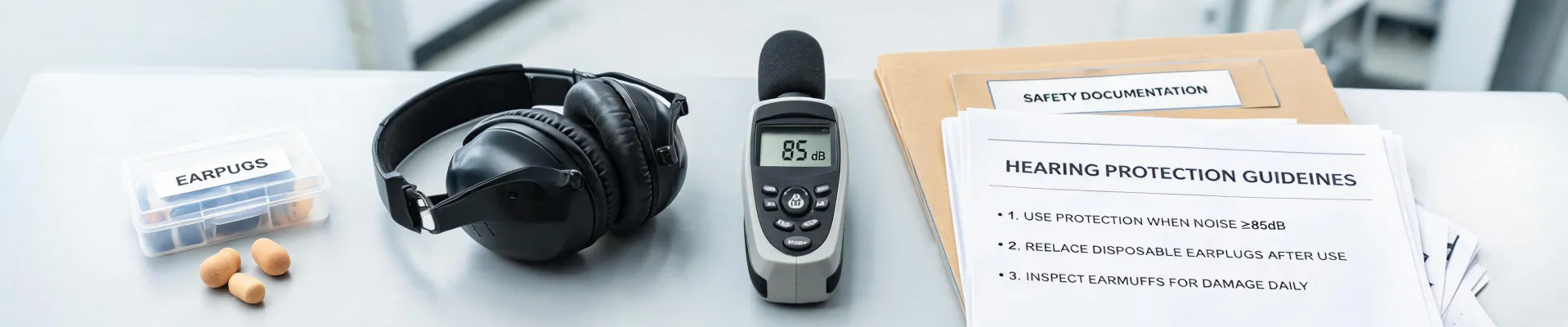
Bottom line: pick the Howard Leight earplug that fits your crew, not the one with the higher NRR. If you're deciding between Howard Leight MAX earplugs and Howard Leight Laser Lite disposable foam earplugs, choose based on fit, comfort, and training. MAX earplugs have an NRR 33 dB rating. Laser Lite foam earplugs are rated NRR 32. That one-decibel gap in the spec sheet is not what saves hearing. A properly fitted NRR 32 plug will outperform a poorly fitted NRR 33 plug every time.
I coordinate PPE orders for an industrial maintenance contractor. When a crew needs hearing protection before tomorrow's shutdown, I'm the one who gets the call. In the last 12 months I've handled over 200 rush orders. The most common mistake I see isn't choosing the wrong color or the wrong case count; it's treating the NRR number as if it were the whole decision. It isn't.
Why NRR 33 Means Less Than You Think
The NRR printed on a box is a lab number. It's measured with subjects who were trained, fit-tested, and told to insert the plugs exactly the right way. You're not working with a lab crew. You're working with people who might insert an earplug halfway, rush on break, or avoid wearing it because it hurts.
OSHA's hearing conservation standard (29 CFR 1910.95) treats hearing protection as a program, not a product. The rule requires employers to make hearing protectors available, to train workers, and to ensure correct fitting. The NRR is only valid when the hearing protector is actually fitted to the individual. In OSHA terms, a 33-rated plug in an A-weighted noise environment gets an adjusted rating of 26 dB (33 - 7). Laser Lite would be 25 dB. A one-decibel difference is close to meaningless next to the 10 dB or more you lose with a poor seal.
Put it this way: a safety goggles drawing doesn't protect an eye, and a high NRR number doesn't protect an ear until the plug is in and sealed. The product is only part of the safety system.
When MAX Earplugs Are the Right Call
Don't read this as an argument against MAX. In the right situation, MAX is exactly what I specify. It has NRR 33 dB, the highest rating Howard Leight offers in its disposable foam line. It's a slow-recovery polyurethane foam plug. Roll it down, insert it, and it expands to fill the ear canal. That's how it gets to the top of the spec sheet.
Reach for MAX when:
- You have verified fit through training or fit testing.
- Workers don't complain about pressure or discomfort.
- You're dealing with continuous high-noise operations and want maximum passive attenuation.
When Laser Lite Earplugs Are the Better Buy
Laser Lite disposable foam earplugs rate NRR 32, not far behind MAX. Their real advantage is the softer, lower-pressure foam. They're easier to wear for long shifts and more forgiving for people with smaller ear canals. Some crews simply won't tolerate a dense plug that presses against their ear canal for eight hours.
The best hearing protector is the one that stays in the ear. If MAX ends up in a pocket after 20 minutes because it hurts, its NRR 33 rating is worth nothing. A worker who wears Laser Lite correctly for the whole shift is better protected than a worker who takes MAX out at the first chance.
I'd choose Laser Lite for new hires before their first fit test, for all-day wear in moderately noisy areas, and for compliance checks where a bright, visible plug makes spot checks easier.
Fit Is Not a Training Step. It's the Selection Step.
Here's where the invisible fence idea gets dangerous. People treat NRR like an invisible fence: once you install it, the noise is supposed to stop at the boundary. But a foam earplug only works when it seals 360 degrees around the ear canal. Any leak in that fence lets noise bypass the plug entirely.
Foam insertion isn't intuitive. You need to roll the plug into a thin, wrinkle-free cylinder, pull the ear up and back, slide the plug in, and hold it until it expands. If you don't, you're wearing an expensive ear canal decoration.
Take it from someone who has watched crews stop listening halfway through a toolbox talk: fit training pays for itself faster than paying extra for the next NRR step.
What the Emergency Orders Taught Me
I still kick myself for assuming a higher NRR was always the better solution. A few years ago, I approved MAX as our main earplug because we had a lot of high-noise areas and MAX had the best number on the box. We did the training, but one group never got the hands-on fitting. A supervisor saw earplugs in ears and marked the box complete. Then a worker told me he thought you just push the plug in like a cork. He'd been wearing them wrong for months. We found it before an audiometric test, but only by luck.
Now every order, even rush orders, includes a short fitting demo. It's easier than explaining to an OSHA inspector why the training checkbox was filled but no one could demonstrate a proper insertion.
When This Advice Falls Apart
One thing I can't do is give you a universal yes or no without seeing your noise exposure. This guidance is based on my experience in industrial maintenance and construction, not on every setting where hearing protection is used. If your crew works in impulse noise, requires radio communication, or needs to hear warning signals, a passive foam plug might be the wrong starting point. You may need electronic, level-dependent, or communication-enabled protectors.
For most B2B buyers, the best next step is simpler than you think. Don't ask which number is bigger. Ask whether the plug fits, whether the crew knows how to insert it, and whether someone will check that the seal is actually happening. An informed customer asks those questions. That customer is the one who doesn't end up calling me at 4:30 p.m. for an emergency order.

Maeve Callahan
Maeve Callahan is a head-protection analyst covering Type I and Type II hard hats, climbing-style safety helmets, bump caps, chin straps, suspensions, liners, and face-shield carriers. She applies ANSI Z89.1, EN 397, and EN 12492 criteria while comparing impact attenuation, penetration resistance, lateral deformation, electrical class, retention strength, field of vision, mass, fit range, and temperature conditioning. Her guides help EHS teams, contractors, utilities, and buyers select helmet systems for overhead hazards, work at height, electrical exposure, accessory compatibility, and worker acceptance.