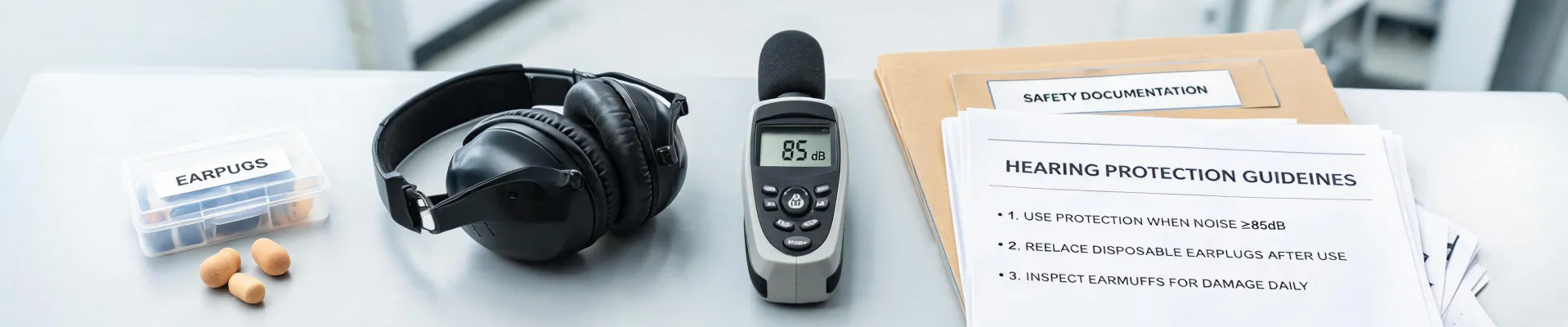
For nearly five years, I have been the quality/compliance reviewer for safety goods at a PPE supply company. I check roughly 200 SKUs each year—earplugs, earmuffs, respirators, hard hats, gloves, fall-protection harnesses. I am the person who compares the spec on the box to the product that actually arrives, and I have rejected deliveries for lot traceability issues, missing date codes, inconsistent foam behavior, and packaging that could compromise a product in storage. None of that shows up on a purchase order.
So let me make my position clear: the cheapest PPE unit price is usually the most expensive PPE decision. In hearing protection, as in every other safety category, total cost of ownership matters more than the sticker price.
Total Cost of Ownership Is Not a Buzzword
When I evaluate a hearing protection purchase, I do not start with per-piece price. I ask what the order will actually require: training, proper fit, worker acceptance, consistent supply, reorder frequency, storage, and follow-up if a lot fails. The unit price is the beginning of the cost conversation, not the whole conversation.
Early in this job, I didn't think that way. I assumed that two foam earplugs with the same NRR were essentially the same and that cost should decide. In 2022, a customer switched to a lower-price foam plug because the label showed the same NRR 33 as the Howard Leight MAX product they had used for years. The first lot was acceptable; the second lot behaved differently. Workers complained the plugs did not expand consistently, and I spent weeks sorting out a material problem that had been created to save about six cents a pair. The projected savings disappeared into troubleshooting, replacement sampling, and labor. That was my “unit price is not total price” lesson.
NRR 33 Does Not Protect Anyone Sitting in a Locker
Ratings matter. Howard Leight MAX earplugs have an NRR 33 because it is a strong product with good attenuation. But NRR is measured under laboratory conditions with a careful fit. In the real world, the person inserting the protector may be wearing gloves, in a hurry, or unfamiliar with the product. Real-world protection is rarely equal to the label.
The larger problem is wear time. A hearing protector only reduces noise exposure while it is actually in the ear. If workers remove plugs to talk, hear an alarm, or because the plug feels uncomfortable, the effective protection drops to zero for those minutes. This is why selecting hearing protection solely by the highest NRR can give a false sense of safety.
Electronic Earmuffs Show the Human Side of TCO
This is also where products like the Howard Leight Impact Sport electronic earmuffs make more sense than a quick price comparison suggests. The unit price is higher than a foam plug, but they let the wearer hear voices and ambient sounds while suppressing hazardous impulse noise. A worker who can keep an electronic muff on during a noisy task is better protected than one who keeps taking out a high-NRR plug. If the earmuff increases wear time, the total cost per protected worker can be lower despite a higher first cost.
Search Queries Tell Me Who Understands This
I can often tell whether a buyer thinks in total cost by the way they search.
When someone searches for honeywell earplugs howard leight, they are not just looking for the cheapest box. They are trying to verify which Honeywell brand and line is the right one, and they want a product with a traceable supply chain. That is a total-cost instinct because consistency between lots is what quality programs depend on. A one-time bargain with no lot traceability is a cost you only discover later.
The same logic applies across the safety catalog.
A search for what is a respirator usually comes from someone at the start of an unfamiliar buying process. The honest answer is: a respirator is a device that protects the wearer from airborne hazards, but under OSHA's respiratory protection standard, 29 CFR 1910.134, it is part of a system that includes selection, medical evaluation, fit testing, training, cleaning, and changing cartridges on a schedule. If you buy only the respirator without the system, the unit price does not reflect the actual cost of compliance.
Another nearly always-reactive search is fire extinguisher service near me. Fire extinguishers need periodic maintenance, inspection, and recharging under NFPA 10 standards. A business that waits until an inspection failure to search for service is paying for the maintenance cost plus the failed inspection cost. The lowest-priced service visit is not really a bargain if it does not leave you with documentation and accountability.
Even non-PPE items follow the same rule. Compare two quotes for vinyl porch railing and the cheaper option might look identical online. But if the inexpensive railing does not meet local code or is not durable enough for outdoor exposure, the replacement and liability costs overwhelm the money saved. I don't spec porch railing for a living, but I recognize the pattern: people treat visible up-front price as the whole cost when it is only the first layer.
The Objection I Keep Hearing
“We don't have a budget for that.”
That objection is worth taking seriously. But a budget cut does not remove the obligation to protect workers. It makes the cost of failure larger. A workers' compensation claim from hearing loss or a respiratory illness can erase every dollar saved by buying the least expensive products, and an OSHA citation adds to that.
I am not saying you must always buy the premium option. Total cost thinking can point to the lowest-priced product too, if the hazard analysis, worker acceptance, and compliance costs are genuinely equal. What I oppose is reducing a safety decision to the single number at the top of a quotation.
Price Is Information, Not a Decision
I will close where I started. In safety procurement, the unit price is useful information, but it is not the decision. The decision should include training, wear time, consistency, compliance, and the cost of failure. Whether you are choosing Howard Leight hearing protection, setting up a respiratory program, arranging fire extinguisher service, or even comparing vinyl porch railing for a building project, the question is the same: what will this really cost—including the cost if it fails? Answer that question, and the cheapest option often stops looking cheap.

Maeve Callahan
Maeve Callahan is a head-protection analyst covering Type I and Type II hard hats, climbing-style safety helmets, bump caps, chin straps, suspensions, liners, and face-shield carriers. She applies ANSI Z89.1, EN 397, and EN 12492 criteria while comparing impact attenuation, penetration resistance, lateral deformation, electrical class, retention strength, field of vision, mass, fit range, and temperature conditioning. Her guides help EHS teams, contractors, utilities, and buyers select helmet systems for overhead hazards, work at height, electrical exposure, accessory compatibility, and worker acceptance.