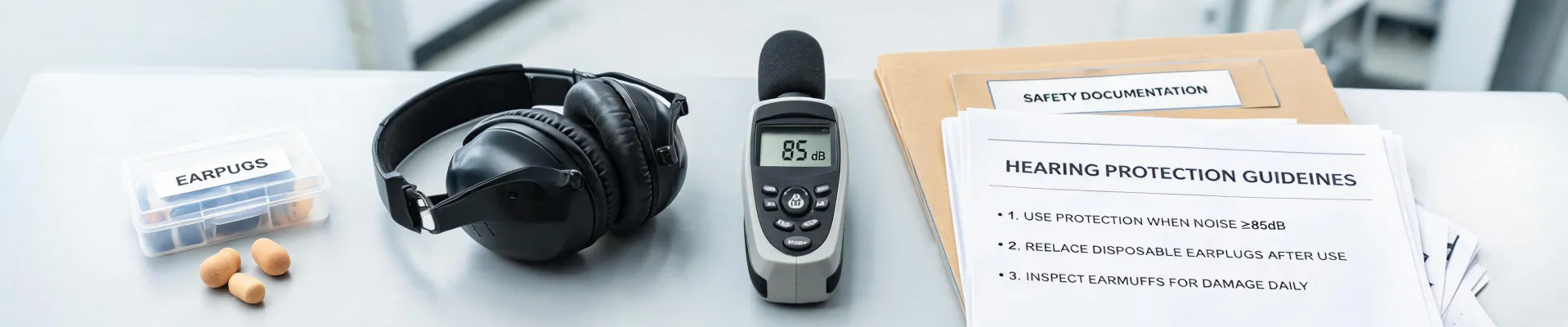
It Started with a Simple Email
Last year, our operations manager forwarded me a request: "Need 500 pairs of Howard Leight MAX earplugs (NRR 33) by end of week. Also, someone wants Honeywell Howard Leight Quiet earplugs for the new hires."
Simple enough. I found a price that looked good—about 15% below our usual supplier—and placed the order.
That decision cost me $2,400 out of my department budget.
The Real Problem Wasn't the Earplugs
The earplugs arrived on time. They were genuine Howard Leight product. The NRR 33 rating checked out. The Honeywell Howard Leight Quiet earplugs were in sealed packages.
Everything looked fine—until accounting tried to process the invoice.
The vendor sent a handwritten receipt. No invoice number. No tax ID. No line items beyond a total amount. Finance rejected the expense report. The payment was delayed. The vendor called me five times the next day asking where their money was.
In the end, I had to pay the $2,400 from my department's discretionary budget just to make the vendor go away.
"I don't have hard data on how often this happens industry-wide, but based on my experience vetting about 60-80 orders annually, my sense is that invoicing issues are the second most common reason for PPE procurement problems—right after wrong product delivery."
The Deeper Problem: We Focus on the Wrong Things
When I tell this story, most people say: "Well, you should have checked the vendor more carefully."
That's true. But it misses the real issue.
The real issue is that as procurement people, we're trained to optimize for the wrong metrics.
- We optimize for price. That vendor was cheaper than our regular supplier. That's what caught my attention.
- We optimize for speed. They promised delivery in 3 days. I needed it in 5. Checked the box.
- We optimize for product authenticity. The earplugs were real. I verified this.
But none of us optimize for invoicing capability. Why would we? It's not part of the evaluation criteria.
The problem isn't that I made a bad choice. The problem is that our evaluation framework is incomplete.
The Cost of Not Knowing What You Don't Know
Here's what I learned: when you're managing B2B PPE procurement—whether it's Howard Leight earplugs, safety glasses, gloves, or hard hats—the line item cost is only part of the equation.
Total cost of ownership includes:
- Product price — obvious
- Shipping and handling fees — sometimes hidden
- Rush fees — if you need it fast
- Replacement costs — if product doesn't meet spec
- Administrative overhead — invoicing, approvals, credit memos
- Reputational cost — how it makes you look to your internal stakeholders
That last one was the real killer. When my VP saw the rejected expense report, he asked: "Why didn't you use our regular vendor?" I had no good answer.
I saved $100 on the order and paid $2,400 for my learning experience.
What I Do Differently Now
Frankly, I'm still not great at this. But I've put a few guardrails in place that help.
First: I verify invoicing capability before placing any first order. I ask for a sample invoice. If they can't produce a proper one, that's a red flag.
Second: I check whether they can provide proper documentation for compliance purposes. For PPE like Howard Leight earplugs, this means the NRR rating documentation, lot numbers, and in some cases, test results.
Third: I don't optimize for price alone anymore. In fact, I don't even look at price until I've checked everything else. The cheapest option that can't invoice properly costs more than the most expensive option that can.
"I wish I had tracked vendor rejection rates more carefully from the start. What I can say anecdotally is that about 1 in 4 new vendors I tried had some form of paperwork issue—whether it was invoicing, compliance docs, or delivery confirmation."
The Simple Fix: Verify What Matters
I'm not going to pretend I have a perfect system. I don't. But here's the thing: the solution isn't complicated.
Before you order Howard Leight Quiet earplugs—or any PPE—from a new vendor, just ask three questions:
- Can you provide a proper invoice with tax ID, line items, and order reference?
- Can you provide compliance documentation (NRR ratings, lot numbers, etc.)?
- What's your return/replacement policy if the product doesn't match spec?
If they can't answer these clearly and in writing, move on. It's not worth the risk.
I lost $2,400 learning this lesson. If you take one thing from this post, let it be this: the cheapest price is never the total cost. Trust me on that.
Maeve Callahan
Maeve Callahan is a head-protection analyst covering Type I and Type II hard hats, climbing-style safety helmets, bump caps, chin straps, suspensions, liners, and face-shield carriers. She applies ANSI Z89.1, EN 397, and EN 12492 criteria while comparing impact attenuation, penetration resistance, lateral deformation, electrical class, retention strength, field of vision, mass, fit range, and temperature conditioning. Her guides help EHS teams, contractors, utilities, and buyers select helmet systems for overhead hazards, work at height, electrical exposure, accessory compatibility, and worker acceptance.