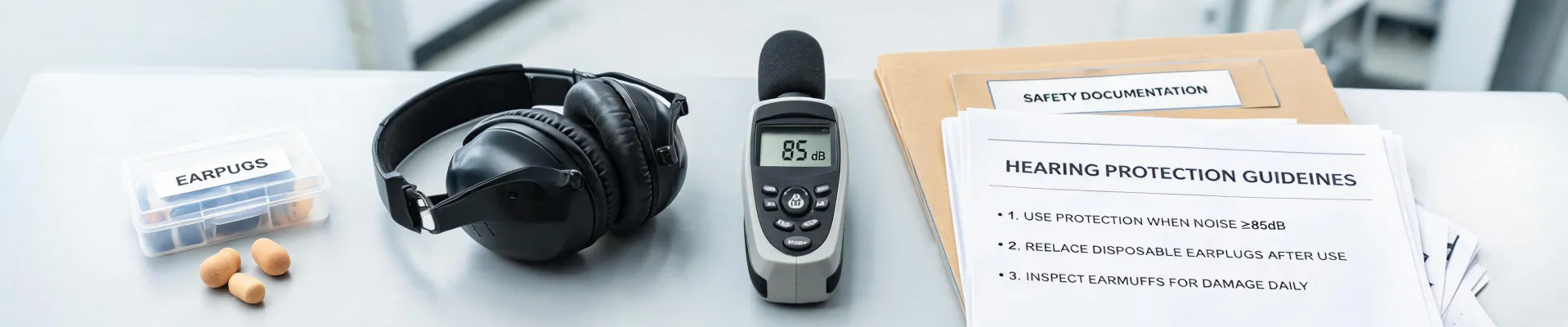
If you're just looking for the highest NRR earplug, you're probably missing the point.
I'm an office administrator for a 200-person company. I manage all our PPE ordering—roughly $40,000 annually across 8 vendors. When I took over purchasing in 2020, I thought the answer was simple: find the highest NRR (like the Howard Leight MAX earplugs with NRR 33) and call it done. But after 5 years of managing these relationships, I've learned that the highest NRR doesn't guarantee the safest workers. In fact, it can create a false sense of security.
Take this with a grain of salt: I'm not a safety engineer. But I've processed over 300 PPE orders, and I've seen the same pattern repeat. The real issue isn't the earplug's rating—it's how it's used.
The oversimplification trap
It's tempting to think you can just compare NRR numbers. The 'highest NRR is best' advice ignores a critical nuance: real-world attenuation. OSHA estimates that the actual protection is only about 50% of the labeled NRR for most users. So that NRR 33 earplug might only deliver NRR 16-17 in practice. I didn't know this until 2022, when a safety consultant pointed it out during an audit. I felt like an idiot.
The numbers said Howard Leight MAX earplugs (NRR 33) were the top choice. My gut said something was off—our workers were still complaining about noise, and we had more hearing-related incidents than expected. Went with my gut and started looking deeper. Turns out the fit-testing data showed most employees weren't getting the rated protection.
How I fixed it (and what I wish I knew sooner)
Our company consolidated PPE suppliers in 2023. I had to standardize orders for 200 people across 3 locations. Using a combination of fit-testing and employee preference surveys cut our ordering time from 8 hours per quarter to 2 hours, and eliminated the 'wrong earplug, no protection' problem we used to have.
Here's the practical framework I now use, and it works for more than just hearing protection:
1. Don't just buy the product—buy the program
Instead of just ordering Howard Leight earplugs, I now work with vendors who provide fit-testing services. I'm not 100% sure every vendor offers this, but Honeywell (Howard Leight's parent company) does. The cost is negligible compared to the reprint and replacement costs of ill-fitting PPE.
Oh, and I should add that this applies to other PPE too. When we needed new hard hats, the Milwaukee hard hat wasn't just about impact ratings—it was about comfort and adjustability. A hard hat that doesn't fit won't be worn.
2. Understand the bigger picture
Hearing protection doesn't exist in a vacuum. You need to know about lockout tagout procedures, because if a machine is still running, closing the door on noise isn't enough. I'll never forget the time we had a near-miss because a maintenance team didn't properly isolate energy sources. We now tie our PPE training to LOTO training. It's all connected.
Also, consider other hazards. For example, a wet chemical fire extinguisher is for commercial kitchens, not general use. If you're in a warehouse or factory, you probably need a different type. The same logic applies: understand the specific risk, not just the generic solution.
3. The 'best' product is the one that gets used
I've learned this the hard way. A few years back, I ordered what I thought was the best Howard Leight earplug. They sat in the supply closet for months. Workers didn't like the fit or comfort. I switched to a different model (still Howard Leight), and usage went up immediately.
Even after choosing the new model, I kept second-guessing. What if the NRR wasn't high enough? The two weeks until we did a follow-up noise survey were stressful. But the results were clear: compliance improved, and noise exposure levels dropped because people were actually wearing the protection.
Boundary conditions: when this doesn't apply
Don't hold me to this as a universal rule, but here's what I've observed: this approach works best for companies with 50-500 employees. If you're smaller, you might not have the budget for fit-testing programs. If you're larger, you probably already have a dedicated safety team.
For very specific environments—like hazardous noise above 100 dBA—you might need electronic earmuffs or dual protection (earplugs + earmuffs). The Howard Leight Impact Sport earmuffs are a solid option for shooting ranges or intermittent noise, but they're not a replacement for proper hearing protection in continuous high-noise environments.
Also, be careful with 'one-size-fits-all' solutions. I've seen companies adopt a single earplug model for everyone, assuming it's fine. It's not. People have different ear canal shapes. That's why I now order multiple models and let employees test them.
Final thought (and a confession)
I spent two years buying the highest NRR earplugs without understanding fit-testing. I could have saved us thousands in wasted orders and potential hearing loss claims. The irony is that the most expensive option—a comprehensive hearing conservation program including fit-testing and multiple product options—is actually the cheapest in the long run.
An informed customer asks better questions and makes faster decisions. I'd rather spend 10 minutes explaining options than deal with mismatched expectations later.
Jane Smith
I’m Jane Smith, a senior content writer with over 15 years of experience in the packaging and printing industry. I specialize in writing about the latest trends, technologies, and best practices in packaging design, sustainability, and printing techniques. My goal is to help businesses understand complex printing processes and design solutions that enhance both product packaging and brand visibility.