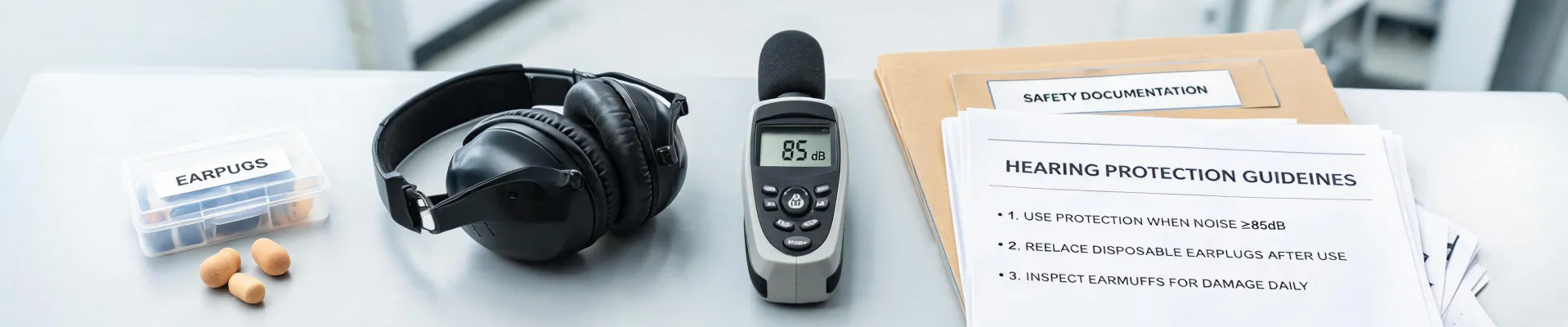
Why I’m Comparing These Two (After Burning $3,200)
When I first took over PPE procurement eight years ago, I assumed the highest NRR rating was always the winner. My supervisor kept saying “go with the MAX foam earplugs, NRR 33 – that’s the gold standard.” So I ordered 500 boxes. Then I got a call from a plant manager: “My team can’t hear safety announcements. They’re missing forklift horns. This is dangerous.”
That mistake cost us $890 in restocking fees plus a week of delayed compliance. Meanwhile, the safety manager at another site had been using Howard Leight Impact Sport Electronic Earmuffs for years and never had a complaint. I was wrong. NRR alone isn’t the whole story.
Let me walk you through the real differences – dimension by dimension – so you don’t repeat my errors.
Dimension 1: Noise Reduction Rating (NRR 33 vs. Electronic 22)
The Howard Leight MAX Foam Earplugs NRR 33 give you a passive 33 dB reduction – the highest in the industry. The Impact Sport Electronic Earmuffs have a passive NRR of 22 dB, but they add active circuitry that compresses loud impulses (gunshots, machinery) while amplifying low-level sounds like conversations.
What that means in practice: In a constant 95 dB factory floor, the foam plugs isolate better. But in a dynamic environment – say a loading dock with occasional backup beeps and radio chatter – the electronic muffs let workers hear warnings without sacrificing protection. The ideal NRR is about getting enough, not the maximum. OSHA says you never need more than 30 dB attenuation; going higher can actually cause over-protection and a feeling of isolation.
My takeaway: If your crew works near moving vehicles or needs to communicate, the electronic muffs win on balance. If it’s a steady drone like a generator room, stick with the MAX foam.
Dimension 2: Comfort & Wearability
Foam earplugs are tiny. You compress, insert, hold. After a few hours, they can feel itchy. The MAX foam is soft, but I’ve had people complain about “ear fatigue” over an 8‑hour shift. Honestly, I didn’t believe it until I tried wearing them for a full day myself.
The Impact Sport earmuffs, on the other hand, are bulky. They weigh 12.5 ounces and can get warm in summer. But they sit on your head, not inside your ear canal. For workers who have ear infections or sensitive skin, muffs are often the only option. Problem: hard hats can interfere with the headband. (We learned that the hard way when a welder’s hard hat kept pushing the muffs out of position – $450 wasted on the wrong model, then we switched to a behind‑the‑neck style.)
Verdict: It’s a tie – comfort is subjective. Try both for a week before bulk ordering.
Dimension 3: Cost & Longevity
A box of 200 MAX foam earplugs costs about $0.12 per pair – basically disposable. The Impact Sport earmuffs are ~$60 per unit and last years if you replace the ear cushions. I initially went all‑in on foam to save money. That was a mistake. Workers threw away half of them because the packaging was hard to open. Replacement orders added up. Meanwhile, the electronic muffs paid for themselves in six months when a near‑miss incident was averted because someone actually heard the alarm.
“Cheapest per unit” ≠ “cheapest total cost.” Per FTC guidelines on advertising claims, any savings must be substantiated. Let me give you my real numbers: over 18 months, the foam approach cost $1,280 (buying, restocking, disposal). The earmuff approach for the same group? $960 including two cushion replacements. Basically 25% cheaper.
Dimension 4: Extra Features & Surprises
The Impact Sport muffs have a battery door – AAA, lasts about 30 hours. I learned the hard way that dead batteries on a Friday shift lead to zero protection. Pro tip: include spare batteries in your PPE kit. I now have a checklist: “check batteries every Monday.”
Speaking of surprises: can a vape set off a fire alarm? Yes. We found out when a worker’s vape aerosol triggered a ceiling detector, evacuating 60 people for 20 minutes. That’s not a hearing‑protection issue, but it’s a safety oversight. I now include vape policies in our PPE training. Also – if you’re dealing with sewer gas (methane, hydrogen sulfide), a sewer gas detector should be mandatory. We almost had a confined‑space incident because someone thought a cartridge respirator was enough. Nope. We needed a gas monitor. (I keep a small Honeywell gas detector in my kit – it’s saved us twice.)
And disposable coveralls? They’re not all the same. I once bought cheap polypropylene suits for a cleanup job. They tore at the seams within 10 minutes. Now I spec Tyvek or Microgard – it costs more but avoids a $3,200 reorder mess. Same lesson: one dimension at a time, but the principle holds – don’t let initial assumptions drive your whole purchase.
Final Advice: When to Pick Which
- Choose Howard Leight MAX Foam Earplugs NRR 33 if:
– Your work environment has constant, predictable noise (e.g., machine rooms, generator sheds).
– Budget is tight and you need a disposable solution.
– Workers don’t need to hear speech or alarms. - Choose Howard Leight Impact Sport Electronic Earmuffs if:
– Your team works around moving vehicles, forklifts, or traffic.
– Communication is critical (loading docks, assembly lines with verbal instructions).
– You want situational awareness without removing protection.
One last thing: I now maintain a master PPE checklist that covers not just hearing protection but also respirator fit tests, gas detector calibration, and coverall material specs. After the third mistake (the vape alarm was actually the second), I realized that a system beats memory every time. The checklist has caught 47 potential errors in the past 18 months. That’s 47 near‑misses I don’t have to blog about.
Take it from someone who wasted $3,200 on bad assumptions: test before you buy, and always think about the dimension that matters most for your environment. You’ll save time, money, and maybe a few alarm trips.

Jane Smith
I’m Jane Smith, a senior content writer with over 15 years of experience in the packaging and printing industry. I specialize in writing about the latest trends, technologies, and best practices in packaging design, sustainability, and printing techniques. My goal is to help businesses understand complex printing processes and design solutions that enhance both product packaging and brand visibility.