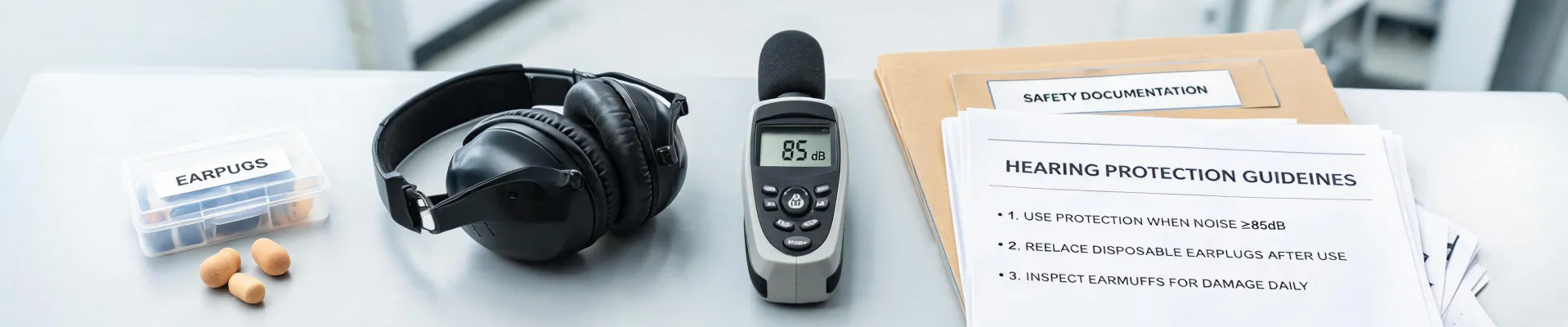
The Safe Choice That Isn't
When I first started reviewing PPE orders for our company—this was back in 2019—I assumed the highest NRR rating was always the safest bet. If a worker needs hearing protection, you give them the best you can get, right? Makes sense on paper. Lower number means more noise gets through, more risk.
That assumption landed us in trouble. I’ll explain.
In Q4 2021, we received a batch of 5,000 earplugs for a new production line. Standard spec: NRR 33—the top of the line. But within two weeks, we had complaints. Workers were taking them out after an hour. Some were cutting them in half (which they're not supposed to do). A few just stuffed them in their pockets and didn't wear them.
The safety manager was frustrated. The plant manager thought the workers were being difficult. But when I asked the workers, the answer was almost universal: “They hurt. I can’t hear anything except my own breathing. They’re too big for my ears.”
That’s when I realized: the best protection on paper is useless if it’s not worn.
The Problem Most People Miss: It's Not the NRR, It's the Fit
Here’s something vendors don’t tell you: an NRR 33 earplug only achieves that rating under perfect laboratory conditions—specifically, when inserted by a trained professional into an ear canal that happens to match the testing mannequin perfectly. In the real world, the actual attenuation drops by 50% or more for a poor fit.
What most safety professionals don’t realize is that earplug fit is not one-size-fits-all. Ear canals are incredibly varied. Some are wide, some narrow. Some are straight, some curved. A single design—even a very good one—won’t serve everyone equally. The Howard Leight MAX-1 (NRR 33) is a great product for a certain ear shape. But for someone with small or unusually shaped ear canals, it’s like trying to fit a cork in a shot glass.
Put another way: you wouldn’t issue one pair of safety glasses for every face shape. Why do we do it with earplugs?
My First Awkward Audit
I remember a specific audit in early 2022. We had around 200 workers in a metal fabrication shop. Roughly 30% had complained about their earplugs. When I did a quick fit test—just asking them to insert a foam plug and seeing how quickly it expanded and sealed—over half of them had an air leak you could see. The plug wasn’t forming a seal. It was just sitting there, giving them a false sense of safety.
We measured the ambient noise at about 95 dB. With a poorly fitted NRR 33 plug, actual protection might be closer to NRR 15-20. That’s a huge difference in real-world risk. That cost us—we had to re-train everyone, order different sizes, and spend on custom-fit options for about 20 workers with very narrow canals. It was a $4,000 re-do, plus the wasted inventory.
Why This Problem Persists
The 'highest NRR = best' thinking comes from a marketing era when companies competed on numbers alone. It’s still common today because it’s easy to measure. A spec sheet is simple. Fit testing? That takes time, training, and budget. But ignoring it is like buying a fire extinguisher rated for a Class A fire when you have a grease fire—it’s the wrong tool.
Another legacy assumption: 'foam earplugs are disposable, so just buy the cheapest.' That thinking comes from an era when labor was cheap and compliance was lax. Today, the cost of one hearing loss claim can wipe out the savings from a decade of buying cheap plugs. The real cost isn't the plug. It's the claim, the lost productivity, the retraining.
What We Changed (and What It Cost Us)
After that audit, we overhauled our approach. We now do a mandatory fit test for every new hire. We stock three different types of earplugs: the classic foam (Howard Leight MAX-1), a pre-molded silicone option (like the Howard Leight Fusion), and a reusable banded earplug for intermittent noise. We also allow workers to try different types for a week before committing to a specific model.
The upfront cost? About $1,200 for the fit testing kit (we used a simple 3M system, but there are cheaper options). Training was maybe $800 in supervisor time. But compared to the potential cost of a single hearing loss claim—which can easily exceed $20,000 in medical and legal fees—it’s trivial. And our compliance rate went from 70% to 95% within three months. Workers were actually wearing them because they were comfortable.
One More Thing on Specifications
When specifying hearing protection for a team, don't just look at the NRR. Look at the product’s fit profile. Some plugs are designed for smaller ear canals (like the Howard Leight Laser Lite or the 3M E-A-Rsoft). Others are wider. If you’re a small company ordering for 10 workers, you might only need one type. If you’re ordering for 200, you probably need three.
Also, check the packaging. I’ve rejected plenty of shipments where the earplugs were compressed, stuck together, or had visible defects (like rough edges). That’s quality control 101. One batch of Howard Leight MAX-1 we received had inconsistent foam density—some were too soft, others too firm. We sent those back.
And here’s a tip: ask your supplier for a certificate of conformance that includes the lot number. It’s not foolproof, but it shows they’re tracking it.
Bottom Line
The best hearing protection is the one your workers will actually wear. It's not always the one with the highest NRR. Focus on fit, comfort, and variety. If you're a small company, don't let a supplier tell you that you don't need fit testing. You do. Today's small order could be tomorrow's repeat customer (or tomorrow's lawsuit).
And if you’re a procurement manager, please, don't buy based on price alone. The cost of a bad fit is higher than any savings on the unit price. I’ve seen the numbers. They don’t lie.
Jane Smith
I’m Jane Smith, a senior content writer with over 15 years of experience in the packaging and printing industry. I specialize in writing about the latest trends, technologies, and best practices in packaging design, sustainability, and printing techniques. My goal is to help businesses understand complex printing processes and design solutions that enhance both product packaging and brand visibility.