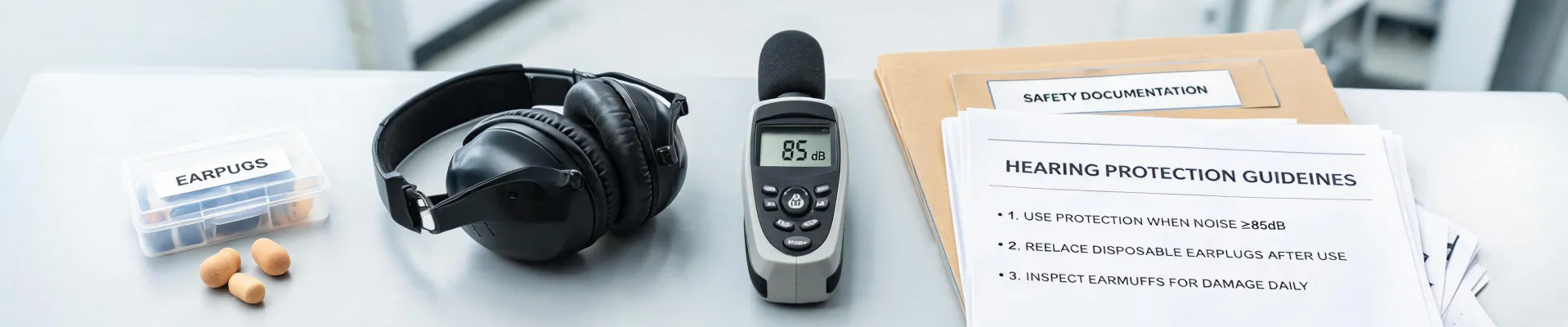
If you’re a safety manager or procurement specialist looking at Howard Leight earplugs, you’ve probably stared at a wall of options: Max Lite, Max, Laser Lite, SmartFit. The NRR numbers are all over the place. Which one do you go with?
I’m a quality compliance manager for a mid-sized industrial distributor. I review every PPE shipment before it hits the floor—about 5,000 units per month. In 2024 alone, I rejected 15% of first-round hearing protection deliveries. Not because they were defective, but because they didn’t match the spec the site actually needed.
Here’s a practical checklist for choosing Howard Leight earplugs. Follow these five steps, and you’ll avoid the most common (and costly) mistakes.
Step 1: Start with the Noise Environment, Not the NRR Number
Sounds obvious, right? But I can’t tell you how many buyers jump straight to the highest NRR rating. They grab a box of Max Lite (NRR 30) because it has a high number. Then they find out their workers can’t hear safety alarms or conversation on the job.
Measure the actual noise level first. If your average exposure is below 85 dBA (over an 8-hour shift), you don’t need an NRR 33 product. You need something workers can wear all day without discomfort. Too much protection is just as dangerous as too little—it leads to workers removing them.
Here’s a quick rule of thumb I use:
- Below 85 dBA: NRR 20-25. Howard Leight Laser Lite (NRR 32) is overkill here. Consider something like the Max Lite (NRR 30) at a stretch, but actually, the regular Max (NRR 33) is more comfortable for most people.
- 85-95 dBA: NRR 25-30. The Howard Leight Max (NRR 33) is solid for this range.
- 95-105 dBA: NRR 30+. The Max Lite (NRR 33) or Max (NRR 33) works, but check the fit.
One more thing: Not all noise is constant. If you have variable noise levels, go for the lower end of the range. Workers will tolerate it more.
Step 2: Understand the NRR vs. SNR Difference
This is where a lot of international buyers get tripped up. Howard Leight earplugs are often labeled with both NRR (USA) and SNR (European). They’re calculated differently.
NRR is measured in a lab with test subjects. The real-world attenuation is typically only about 50-70% of the NRR rating. So a product claiming NRR 33 might give you around 16-20 dB of real protection. The SNR can be safely derated by a similar margin.
Take it from someone who had to re-spec a whole warehouse order in 2022 (a $22,000 mistake that delayed launch by a month) because we didn’t account for this derating. We assumed NRR 31 was enough. It wasn’t. The actual protection was lower, and workers were still exposed to 88 dBA.
The golden rule: Derate the NRR by 50% for a realistic estimate. It’s better to be conservative.
Step 3: Choose the Shape and Material
Howard Leight makes three main types of earplugs in their foam line:
- Pistol-grip (Max, Max Lite): These have a wider, tapered base. Easier to insert and remove. Good for frequent removal throughout the shift. Best for workers with larger ear canals.
- Bell-shaped (Laser Lite): Narrower, tapered at the tip. Good for smaller canals. But they’re a bit trickier to seat correctly.
- Cylindrical (Max): Uniform shape. Offers a very high seal. But if you have a small ear canal, they can pop out.
Most people ignore this: The material matters more than the shape. Howard Leight foam is a slow-recovery foam (polyurethane). It compresses easily and expands slowly. That’s great for creating a seal. But in hot or humid conditions, it stays soft longer—which means it can get a bit stuck if not inserted carefully. If you work in a cold environment, it firms up, takes longer to expand, and the seal can be weaker.
For a warehouse that’s temperature controlled (65-75°F), the standard Max works fine. For an outdoor construction site in summer, I’d lean toward the Max Lite because it’s a bit firmer and seats faster.
Step 4: Check the Fit (And Re-check)
This is the step almost everyone rushes. I run a blind fit test about once a year with our team: same person, same earplug type, inserted by two different people. The difference in attenuation is often 5-7 dB. That’s huge.
How to insert Howard Leight foam earplugs correctly:
- Roll the entire plug into a tight, crease-free cylinder. This is the hardest step for most people. They don’t roll it enough and leave wrinkles.
- Reach over your head and pull your ear back (to straighten the ear canal).
- Insert the plug all the way in. You should feel it seal. If it pops out slightly, you didn’t roll it enough.
- Hold it for 20–30 seconds while it expands. Don’t let go early.
If you can clearly hear someone speaking at arm’s length, it’s not seated right. Period.
I rejected a batch of 8,000 Max earplugs once because the packaging had a diagram showing insertion that skipped the rolling step. The vendor argued it was standard. We didn’t buy it. That level of detail is the difference between a compliant workforce and a costly noise-induced hearing loss claim.
Step 5: Verify the NRR vs. Actual Attenuation
A lot of spec sheets list NRR 33 for the Howard Leight Max. That’s the official number. But that number is from a lab test with perfect insertion. In the field, the real attenuation is often lower.
This was true 10 years ago when digital options were limited. Today, you can do a simple fit test with a validation system. Many distributors offer this. If you can’t, just assume a 50% derate. If your target is 25 dB of protection, don’t buy an NRR 30 earplug. Buy the NRR 33.
Or better yet, use a combination: foam earplugs under earmuffs for extreme noise. Howard Leight has over-ear muffs that work great over their earplugs. But that’s a different checklist.
Things People Get Wrong (Common Mistakes)
- “Highest NRR is always best.” No. Over-protection causes communication issues and isolation. Workers remove them. That’s worse than having a slightly lower NRR.
- “One size fits all.” Ear canals vary hugely. Some workers need the larger Max, others the smaller Laser Lite. If you order 10,000 of one type, you might be creating a compliance issue. Buy a mix for different ear sizes.
- “They all work the same.” The Max and Max Lite are different. The Max is a firmer foam; the Max Lite is softer. The Max has a slightly higher NRR (33 vs 30), but the real-world difference is marginal. Comfort often wins over a 3-point NRR advantage.
- “I can just hand them out and workers will figure it out.” They won’t. You need training. Period. A passive handout doesn’t work.
Final Check
After five years of reviewing PPE, I’ve come to believe that the “best” hearing protection is the one workers actually wear. That means a balance of comfort, correct fit, and real-world protection. The numbers on the box are a starting point, not the final answer.
Next time you look at a box of Howard Leight Max Lite earplugs, ask yourself: “Does this match the noise environment, the workers’ ear sizes, and the comfort needs?” If the answer isn’t an immediate yes, go back to step one. It’s worth the extra hour of checking.

Jane Smith
I’m Jane Smith, a senior content writer with over 15 years of experience in the packaging and printing industry. I specialize in writing about the latest trends, technologies, and best practices in packaging design, sustainability, and printing techniques. My goal is to help businesses understand complex printing processes and design solutions that enhance both product packaging and brand visibility.