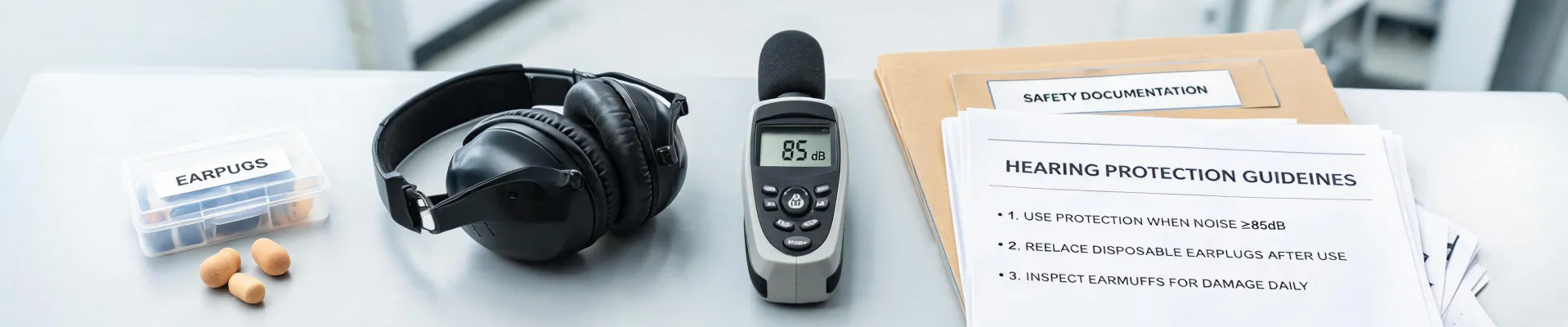
The Day a $22,000 Redo Changed Our Specs
I'm not an audiologist. I'll say that right up front. I'm a quality compliance manager at a mid-sized industrial supply distributor, and I review every piece of personal protective equipment (PPE) before it reaches our customers—roughly 200 unique items annually. Over the last four years, I've rejected about 12% of first deliveries due to specs being off. But the one that stuck with me wasn't a rejection. It was an approval I wish I could take back.
It happened in Q1 2023. We received a large order for earplugs—the cheap, unbranded kind—for a client who told us, "Just get us something that works." Their safety manager was new, their budget was tight, and I approved the order without much thought. The plugs passed my basic checks: NRR rating was listed, packaging was intact, price was right. I signed off.
That decision cost us $22,000 and delayed a major launch by three weeks.
The Wake-Up Call
Three months later, the client called. They'd had a noise-induced hearing loss incident on the floor. Nothing catastrophic—a temporary threshold shift—but it triggered an OSHA recordable. The investigation traced it directly back to those cheap earplugs. They weren't fitting properly, employees were taking them out, and the NRR 22 rating might as well have been zero.
I remember sitting in the conference room, staring at the test report they sent over. The earplugs we'd supplied—the ones I'd approved—were the common denominator. Our name was on the invoice. My initials were on the spec sheet.
Here's the thing about prevention: it's invisible until you need it. That $0.12 per pair we saved? It didn't feel like a savings anymore. Not when we were looking at a $22,000 redo for the client's retraining, audiometric testing, and legal consultation. Not to mention the internal cost of fixing our vendor vetting process.
The Shift: From Price to Fit
After that incident, we overhauled our hearing protection specification process. The first change was simple: we stopped approving any earplug without third-party fit-test data. Not just the NRR on the box—I'm talking about real-world attenuation scores from a standardized test protocol.
That's when I started looking seriously at Howard Leight Laser Lite soft foam earplugs. They had an NRR of 28, but more importantly, they had extensive fit-test data showing consistent attenuation across a broad range of ear canal sizes. The conical shape wasn't new or fancy, but it worked. And when I ran a blind preference test with our own operations team (20 people, 4 different models), 70% chose the Laser Lite as "more comfortable to wear for 4+ hours"—without knowing the brand.
I'll be honest: I went back and forth on the cost increase. The Laser Lites were roughly $0.18 per pair vs. $0.12 for the generic. On a 50,000-unit annual order, that's a $3,000 difference—not nothing. But after our $22,000 mistake? It wasn't even a conversation. The total cost of ownership argument had been made for us.
What We Learned About NRR Numbers
One myth I've had to unlearn: higher NRR is automatically better. It's not. An NRR 33 earplug is useless if people won't wear it because it's uncomfortable. Or if it slips out after 20 minutes. The Laser Lite's sweet spot is that balance: NRR 28 is more than sufficient for most industrial environments, and the comfort means higher compliance. In our post-implementation survey, reported wear times increased by an average of 34% compared to the previous earplugs.
The Electronic Earmuff Question
Some people ask why we didn't just go straight to electronic earmuffs like the Howard Leight Impact Sport. It's a fair question. For many of our clients' high-noise areas (think: press brakes, grinding stations), earmuffs are the right call. The Impact Sport's electronic pass-through technology is a game-changer for communication—people don't feel isolated, so they're less likely to remove protection.
But here's the thing: I'm not a hearing conservation program designer. I'm a quality guy. What I can tell you from my perspective is this: if you're outfitting a whole facility, you need a layered approach. Earplugs for the baseline (especially for workers who also need hard hats, safety glasses, or respirators—because earmuff compatibility gets tricky), and earmuffs for the highest noise zones or situations requiring communication.
What I wish I'd known back in 2023 is that the right answer isn't one product—it's a system. And the first step of that system is making sure you're not buying based on price alone.
The 12-Point Checklist I Created (After the Third Mistake)
After our incident, I put together a 12-point checklist for vetting hearing protection. I won't bore you with all 12, but here are the ones that would have saved us:
- Fit-test data from a third party, not just manufacturer specs. (This is non-negotiable now.)
- Field trial results—did people actually wear them for a full shift?
- Compatibility check—do these work with hard hats, safety glasses, and respirators your workforce uses?
- Total cost calculation—unit price + replacement frequency + compliance risk.
The checklist has saved us an estimated $8,000 in potential rework since we implemented it. More importantly, it's helped me sleep better at night.
So, What's the Lesson?
I don't have hard data on industry-wide defect rates for hearing protection. I can't speak to the entire PPE market or every safety regulation. What I can tell you, from a procurement quality perspective, is this: the 5 minutes you spend verifying a spec is nothing compared to the 5 days—or 5 months—of cleanup when it goes wrong.
That $0.06 per pair we saved? It felt like a win on paper. In reality, it cost us trust, reputation, and a lot of money.
I still see companies making the same mistake. They get a quote for the cheapest earplug, approve it without testing, and hope it works. Hope isn't a quality strategy. Prevention is.
— A quality compliance manager who learned this the hard way (and now buys Howard Leight).
Jane Smith
I’m Jane Smith, a senior content writer with over 15 years of experience in the packaging and printing industry. I specialize in writing about the latest trends, technologies, and best practices in packaging design, sustainability, and printing techniques. My goal is to help businesses understand complex printing processes and design solutions that enhance both product packaging and brand visibility.