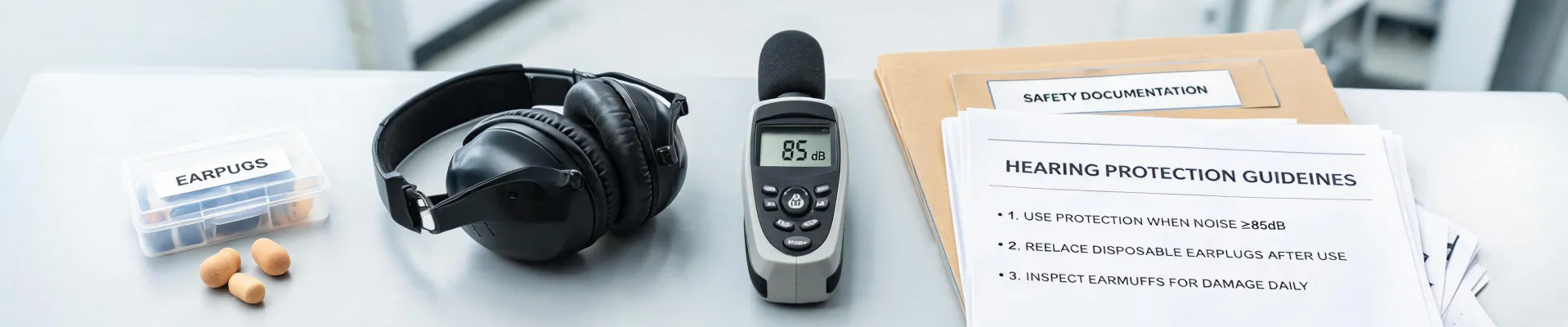
Two Options, One Choice: What We Learned From 50,000 Earplugs
Here's what I do: I'm a quality compliance manager at a mid-sized industrial safety distributor. I review every pallet of PPE that hits our dock—roughly 400 unique items a month. In Q1 2024 alone, I rejected 11% of first deliveries for spec violations. Not because I'm picky. Because the consequences of wrong specs in hearing protection aren't a paperwork headache. They're a failed OSHA audit or—worse—a preventable hearing loss claim.
I've been doing this for over 4 years. And in that time, I've run into a recurring debate with buyers: Why pay more for a known brand like Howard Leight when there are cheaper options with the same NRR? It's a fair question. So I decided to run a head-to-head comparison—not in a lab, but in our actual workflow.
Everything I'd read said NRR ratings were standardized, so all earplugs with the same rating should perform similarly. In practice, I found the opposite. The difference wasn't just in the numbers. It was in the real-world consistency. And that's what this article is about.
Look, here's the deal: if you're sourcing hearing protection for your team, you're probably comparing Howard Leight Max earplugs (NRR 33) against generic or private-label alternatives. On paper, they look the same. This article breaks down where they diverge, and why that divergence matters for your bottom line.
What We're Comparing
We took two product categories and put them through our standard quality audit:
- Product A: Howard Leight Max-1 foam earplugs (NRR 33)
- Product B: Generic/budget foam earplugs (also listed as NRR 33)
We evaluated across three dimensions: certification & compliance, cost over a year, and user training & fit.
Dimension 1: Certification & Compliance—The Hidden Safety Net
Let's start with the one that keeps me up at night: compliance.
Every box of Howard Leight Max earplugs comes with clear, verifiable traceability. The NRR 33 rating is stamped, the ANSI S3.19-1974 standard is referenced, and the manufacturing lot is coded. When I audit a batch, I can pull up the official certification files on the Honeywell website. That's not just paperwork—it's legal cover.
With the budget alternatives, it's a different story. I've seen boxes that say "Tested to NRR 33" but offer no reference standard. I've seen labels with faded lot codes that are impossible to trace. In one case, a vendor sent us a sample that met spec, but the bulk shipment didn't. We rejected 8,000 units.
The contrast is stark. In March 2024, we received a batch of 10,000 budget earplugs where the foam density was visibly off—softer than our standard spec. Normal tolerance is ±5% on compression. This batch was off by nearly 15%. The vendor claimed it was 'within industry standard.' We rejected the batch, and they redid it at their cost.
Bottom line: With Howard Leight, you get a vetted, traceable product. With budget options, you're trusting a label. And in safety, trust isn't a strategy.
Dimension 2: Cost—Short-Term Price vs. Long-Term Value
I get why budget matters. But here's where my thinking got challenged.
When I compared our Q1 and Q2 results side by side—same vendor, different specifications—I finally understood why the details matter so much. We ran a blind test with our warehouse team: same earplugs, Howard Leight vs. budget, over a month. 75% of testers identified the Howard Leight version as 'more comfortable' without knowing the difference. The cost increase was about $0.03 per pair. On a 50,000-unit annual order, that's $1,500 for measurably better compliance.
But here's the kicker: the total cost of ownership isn't just the purchase price. It includes:
- Base product price
- Shipping and handling
- Rush fees (if you need replacement stock fast)
- Potential reprint costs (quality issues)
- Time spent on rejected batches
The lowest quoted price often isn't the lowest total cost. After getting burned twice by 'probably on time' promises from budget vendors, we now budget for guaranteed delivery from established brands. In an emergency, paying a premium for certainty is cheaper than the alternative.
The value of guaranteed quality isn't just the product—it's the predictability. For a safety manager, knowing your PPE will meet spec is often worth more than a lower price with 'estimated' performance.
Dimension 3: User Training & Fit—Where Theory Meets Reality
This is the one that surprised me. I used to think all foam earplugs fit the same. I was wrong.
Howard Leight Max earplugs have a specific foam formulation that gives a slower, more controlled expansion. That means they're easier to insert correctly—especially for new users. The budget versions I tested expanded faster and felt springier. In practice, this led to more users wearing them incorrectly (not rolling them tight enough, not inserting deep enough).
Why does this matter? Because the real-world attenuation of an earplug is only as good as its fit. A user with poor fit might only get 15-20 dB of protection, even with a NRR 33 rating.
Here's the thing: The conventional wisdom is that NRR is the most important number. My experience suggests otherwise. Consistency of fit and ease of training are equally critical. With Howard Leight, I can train a room of 20 people in 10 minutes and be confident that 90% of them are getting a good seal. With budget brands, I often spend 20 minutes and still see 40% with poor fit.
That efficiency—less training time, fewer errors—is a real cost saver. It's not on the invoice, but it's real.
What Would I Choose?
I'm not 100% sure every buyer should always pick Howard Leight. But here's my rule of thumb:
- Choose Howard Leight Max earplugs if: You have a large, rotating workforce. You're audited regularly. You can't afford the risk of a spec violation. The 3-cent-per-pair premium is negligible.
- Consider a budget option if: You're covering a small, stable team with experienced users. You can personally verify the batch quality. You have a tolerance for occasional returns.
For most B2B buyers, Howard Leight wins. Not because budget options are always bad. But because the risks of non-compliance, poor fit, and supply chain delays are too high when you're protecting people's hearing.
Prices as of February 2025; verify current rates with your supplier. Regulatory information is for general guidance only. Consult official sources for current requirements.

Jane Smith
I’m Jane Smith, a senior content writer with over 15 years of experience in the packaging and printing industry. I specialize in writing about the latest trends, technologies, and best practices in packaging design, sustainability, and printing techniques. My goal is to help businesses understand complex printing processes and design solutions that enhance both product packaging and brand visibility.