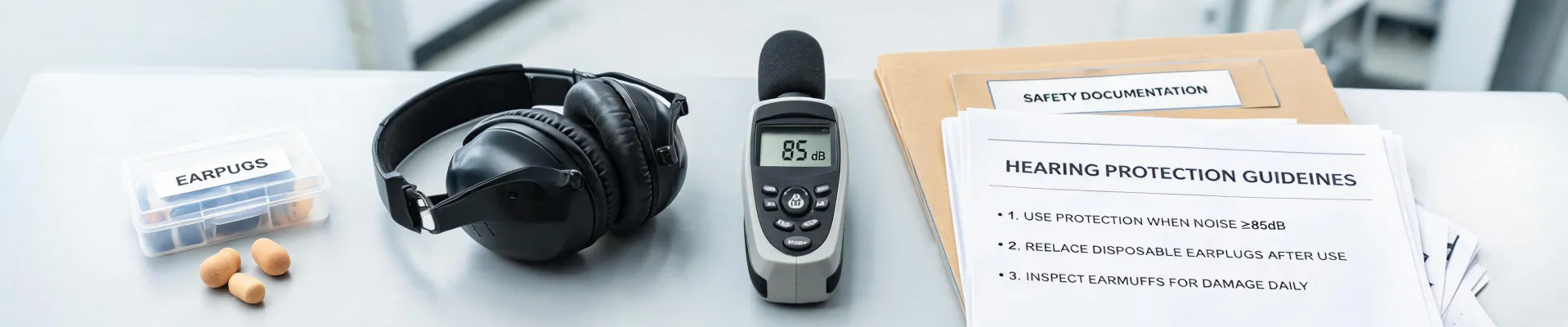
I think most safety buyers are using NRR wrong. I used to be one of them. When I took over purchasing in 2020, I looked at hearing protection the same way I looked at any commodity: find the highest rating, get the best price, move on. Then I spent six months watching perfectly good earplugs end up on the floor of our maintenance shop.
I manage PPE ordering for a 200-person company. That's roughly $60,000 a year in safety products across eight vendors, and I report to both operations and finance. I process 60-80 orders a year, so I see patterns. I'm not an audiologist. I'm the person who has to explain why we spent money on hearing protection that nobody wore. That changes your perspective.
What Howard Leight Earplugs NRR 33 Doesn't Tell You
Let's get one thing out of the way: NRR—the Noise Reduction Rating printed on the box—matters. The Howard Leight earplugs with an NRR 33 rating are among the highest-attenuation foam earplugs you can buy. That's not marketing noise. It's measured under a lab protocol that goes back to ANSI S3.19-1974. If you need serious protection for high-noise work, that rating is a real asset.
But "NRR 33" describes what happens with a perfect fit in a controlled setting. NIOSH and the EPA have both made this point for years: the number on the package is not the number you get in a real ear. One worker has a narrow canal. Another is wearing glasses, so the earmuff seal breaks. Another doesn't insert foam plugs correctly and gets maybe half the rated attenuation. The surprise wasn't the price difference between the high-rated and mid-rated options. It was how much real-world fit mattered.
In my first year, I made the classic rookie mistake: I standardized everything on the highest NRR and called it a day. I ordered Howard Leight Max earplugs by the case. They were cheap, comfortable for some people, and completely wrong for others. The result: boxes of earplugs in a cabinet, complaints about pressure in the ear canal, and one guy who told me he "just didn't wear them when the supervisor wasn't around." You can't buy your way out of that with a better dB number.
Match the Hearing Protection to the Job
Here's what I know now: NRR is a starting point, not a finish line. You have to ask what the job is, how long the person is exposed, and whether they need to hear anything besides the noise.
For steady, high-level noise—think a manufacturing floor or heavy equipment—a good foam plug is hard to beat. I still buy Howard Leight earplugs for that. But for intermittent noise, or for work where people need to hear a co-worker's warning or a machine's change in tone, the better answer is often an electronic earmuff. That's why the Howard Leight Impact Sport earmuffs have a permanent spot on my order list. They don't just block noise; they amplify normal sounds and compress loud ones. The protection is real, but so is the situational awareness.
One more thing I learned the hard way: don't assume every noisy job needs the same solution. If a worker can't hear a warning or a machine's change in tone, they'll find a reason not to wear protection. That's why the electronic option matters. The right tool gives you attenuation and awareness at the same time.
I can only speak to our own operations, so I'll say this carefully: when we started offering both options, usage went up. Not because I gave a motivational speech, but because the people doing the work had an option that actually fit their task. An informed user is a lot more likely to wear the gear.
Same Logic Applies to Gloves, Fire Extinguishers, Even Fence Staining
This is not a hearing-only problem. I see the exact same pattern with leather welding gloves. A heavy pair of leather welding gloves is the right choice for hot work. It's a terrible choice for handling chemicals or doing fine assembly. If I buy one "general purpose" glove and force everyone to use it, I save a line item in the system and create a safety problem. Same with fire extinguishers: a halon fire extinguisher can be the right call in a server room where water or powder will wreck equipment, but that doesn't mean it belongs in a maintenance corridor next to a welding station. It depends on the hazard.
People ask me all kinds of questions, and honestly, some of them are not mine to answer. One of our maintenance folks emailed me asking how to stain a fence, and what they meant was: "What do I need to do this without hurting myself?" That's the right instinct. A pressure washer is loud. A sander creates dust. Chemical stripper can burn your hands. The answer isn't one magic SKU—it's a set of choices based on the task. If you start with the task, the equipment selection gets easier.
I'd Rather Educate Than Hand You a Catalog
I'd rather spend ten minutes explaining options than deal with mismatched expectations later. That's not just a nice-to-have. It's practical. An informed buyer asks better questions and makes faster decisions. When a new supervisor comes to me and asks for "the best earplugs," I ask them what the noise looks like, how long people are exposed, and whether they've watched anyone wear the current ones. That one conversation saves me returns, reorders, and safety incidents.
Maybe that sounds like overcomplication. There's always a procurement manager who wants one SKU and a clean inventory report. I get it. SKU rationalization is a real thing, and I don't want to carry six types of earplugs either. But if the single SKU doesn't fit the work, you're not saving money—you're paying for a false sense of compliance. The third time I watched a worker from our shipping team try to make a foam plug work in a canal it didn't fit, I finally created a simple two-tier system. Max earplugs for high-noise continuous exposure, Impact Sport earmuffs for the people who had to move between loud and quiet areas all day. In our 2024 vendor consolidation project, that system survived because it was tied to actual tasks, not just line items. That solved more problems than any spreadsheet.
I didn't land on this overnight. I started with a spreadsheet of prices and NRR ratings, like every other buyer. The spreadsheet didn't tell me why one worker thought the earmuffs were too heavy or why another had ear canal irritation. So I started paying attention to what got worn and what got left in the break room. That data is more useful than any spec sheet. It tells me where I need to train people and where I need to switch products.
Bottom Line
Buy hearing protection by the NRR number if you need a benchmark. But don't stop there. Ask about fit, task, communication needs, and whether the person will actually wear it. That's what separates a real safety program from a box of earplugs nobody touches.
The Howard Leight earplugs and the Impact Sport earmuffs are both good tools. They're just tools for different jobs. The best hearing protection on the shelf is the one that gets worn. And the only way to make that happen is to understand the person on the other side of the spec.

Maeve Callahan
Maeve Callahan is a head-protection analyst covering Type I and Type II hard hats, climbing-style safety helmets, bump caps, chin straps, suspensions, liners, and face-shield carriers. She applies ANSI Z89.1, EN 397, and EN 12492 criteria while comparing impact attenuation, penetration resistance, lateral deformation, electrical class, retention strength, field of vision, mass, fit range, and temperature conditioning. Her guides help EHS teams, contractors, utilities, and buyers select helmet systems for overhead hazards, work at height, electrical exposure, accessory compatibility, and worker acceptance.