What a Failed Safety Audit Taught Me About Buying PPE
In August 2024, our safety officer walked into my office holding a clipboard and a look I'd learned to dread. We'd just had an unannounced spot check from our insurance carrier, and it hadn't gone well. Three people on the warehouse floor weren't wearing eye protection. Two more were using earplugs that didn't meet the noise reduction rating for their work area. And nobody—including me—could answer basic questions about our respirator program.
I'm the office administrator for a 180-person company with a warehouse and a field services division. I manage procurement across every department—roughly $340,000 annually across eleven vendors. I report to both operations and finance, which means my job is a constant balancing act between "we need this" and "what does it cost." Safety equipment was always in my budget, but honestly, it wasn't something I thought about much beyond making sure the catalog order went out on time.
That changed fast.
The Gap I Didn't Know Existed
The spot check report sat on my desk for a week before I opened it. I knew what it would say. The real problem wasn't the missing safety glasses—it was that our entire approach to PPE ordering had no logic behind it.
Here's what I mean. I'd been ordering the same generic safety glasses for three years, mostly because that's what my predecessor had in the system. I didn't know what standard they met. I didn't know if they fit well. I certainly didn't know if they were the right choice for different work areas.
The safety officer—a former OSHA compliance consultant named Diane—sat me down and asked one question: "Does anyone here actually know what ANSI Z87.1 means?"
I didn't. I had to look it up. Turns out it's the standard for eye and face protection, and—this is the part that stung—not all safety glasses meet it. Some of the cheap ones we'd ordered in bulk didn't have the marking at all.
I'd been buying the wrong stuff for years, and nobody caught it until now.
Rebuilding the Purchase List
Diane gave me a list of what we actually needed: proper eye protection for the warehouse and shop, hearing protection for the areas where noise levels were above 85 decibels, and—this was new to me—a respirator program that didn't exist on paper.
I started with the eyewear because it seemed simplest. It wasn't.
My first instinct was to go with the brand names everyone knows. But when I started reading reviews from actual safety managers (not the star ratings on office supply sites, but the trade forums where people who do this for a living talk), a different name kept coming up: Edge Eyewear.
What caught my attention was a comment from a safety coordinator at a manufacturing plant. She'd written: "We tried the premium brands. Half the team wouldn't wear them because they didn't fit right. Switched to Edge and complaints dropped to almost zero."
That matched my problem exactly. Our people weren't wearing their glasses because they were uncomfortable, not because they were lazy.
I ordered samples of two models: the Edge Eyewear Reclus and the Edge Eyewear Dakura. The Reclus has a wraparound design and interchangeable temples—I'm not going to pretend I understood every technical spec, but the guys in the shop liked that they could adjust the fit. The Dakura was a more traditional look, which suited the older workers who weren't into the wraparound style.
We ran a two-week trial. The Reclus won on the shop floor. The Dakura became the default for visitors and field crews who wanted something less "industrial" looking.
Here's the surprise: I'd been assuming that the expensive brands were better because they cost more. I ordered one pair of a premium brand—$28 each—to test against the Edge models, which ran about $14–16 depending on the model. The premium pair fogged up within ten minutes of use. The Edge Reclus had an anti-fog coating that actually held up for a full shift.
Everything I'd read said premium options deliver better quality. In practice, for our specific use case, the mid-tier option performed better. That was a humbling lesson (and a good reminder that "you get what you pay for" isn't a law of physics).
The Question I Should Have Asked Sooner
While I was sorting out eyewear, Diane dropped another problem in my lap. "We need to formalize the respirator program," she said. "Before anyone uses a respirator, we need to know what OSHA requires."
I didn't. So I learned.
According to OSHA's Respiratory Protection standard (29 CFR 1910.134), you can't just hand someone a respirator and send them to work. Before use, employers have to provide:
- A medical evaluation to confirm the employee can safely wear a respirator
- Fit testing for the specific make, model, and size of respirator
- Training on proper use, storage, and limitations
- Written program documentation and regular re-evaluation
I had none of this. We'd been issuing N95s during the pandemic and never formalized anything. The compliance gap was significant enough that I had to budget for a consultant to help us build the program. Not cheap—but cheaper than a fine.
The Fence Situation
In the middle of all this, my warehouse manager cornered me with a different request. The company had expanded into a temporary lot across the street, and we needed fencing. The landlord wasn't going to let us dig into the asphalt, which ruled out traditional post anchoring.
I'd never heard of a no dig fence before that conversation. Turns out it's exactly what it sounds like—fencing that uses weighted bases or ground spikes instead of concrete footings. Perfect for temporary installations where you can't modify the surface.
I sourced a modular system with weighted bases and had it installed in a weekend. The logistics team was thrilled. Finance was happy because it was a rental, not a capital expense.
That's the thing about this job. One week I'm researching safety glasses standards, the next I'm figuring out temporary fencing. The skill set is basically "learn whatever you need to learn this week."
Earplugs, of All Things
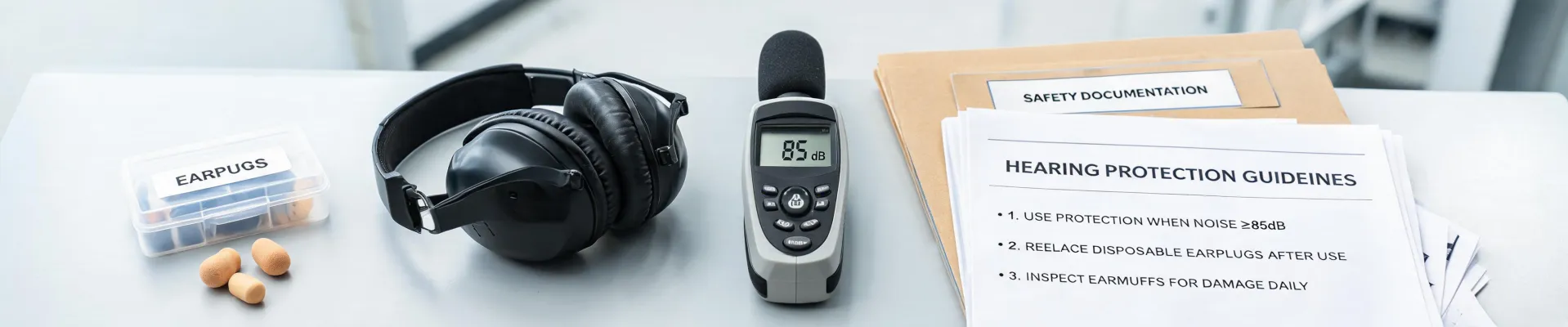
The hearing protection piece surprised me. I'd been buying foam earplugs in bulk—the kind you squish and roll. Diane pointed out that while those work for some people, others never get a proper seal. The far ends of our shop were running around 92 decibels, which is above the level where you need dedicated protection with the right noise reduction rating (NRR).
I'd heard about Loop earplugs through a colleague at another company. They're not traditional industrial earplugs—they look more like something you'd wear at a concert. But their Loop Experience model carries an NRR of 18 decibels with a filter that preserves speech while cutting the dangerous noise.
The older guys in the shop resisted at first. "Those look like toys," one said. But after a few days of not having to remove them to talk to a coworker, the complaining stopped. We kept the foam plugs for anyone who preferred them, but the Loop models became the default for the supervisor team.
What I'd Do Differently
If I had to do this over, I'd start with the standards, not the products. Knowing what ANSI Z87.1 actually requires would have saved me from buying three years' worth of non-compliant glasses. Knowing the OSHA rules for respirators before issuing them would have saved us a scramble.
But I'd also push back on something I hear a lot in procurement: the idea that efficiency is just about getting the lowest unit price. Sometimes it is. But sometimes efficiency means ordering a $16 pair of safety glasses that people will actually wear instead of a $28 pair that sits in a drawer.
I've come to believe that the most efficient purchasing decision is the one that solves the problem once. I replaced three years of random generic orders with a consistent order from Edge for the Reclus and Dakura. It's not cheaper per unit. But it's cheaper than buying replacements for glasses that get "lost" because they're uncomfortable—or dealing with a failed audit that forces the whole company to scramble.
The fence and the earplugs? Both were one-time fixes, but they taught the same lesson: there's usually a specialized solution for problems I didn't know existed. My job is to find it before someone else has to.
We passed the next audit. Diane's clipboard still makes me nervous, though.
Maeve Callahan
Maeve Callahan is a head-protection analyst covering Type I and Type II hard hats, climbing-style safety helmets, bump caps, chin straps, suspensions, liners, and face-shield carriers. She applies ANSI Z89.1, EN 397, and EN 12492 criteria while comparing impact attenuation, penetration resistance, lateral deformation, electrical class, retention strength, field of vision, mass, fit range, and temperature conditioning. Her guides help EHS teams, contractors, utilities, and buyers select helmet systems for overhead hazards, work at height, electrical exposure, accessory compatibility, and worker acceptance.