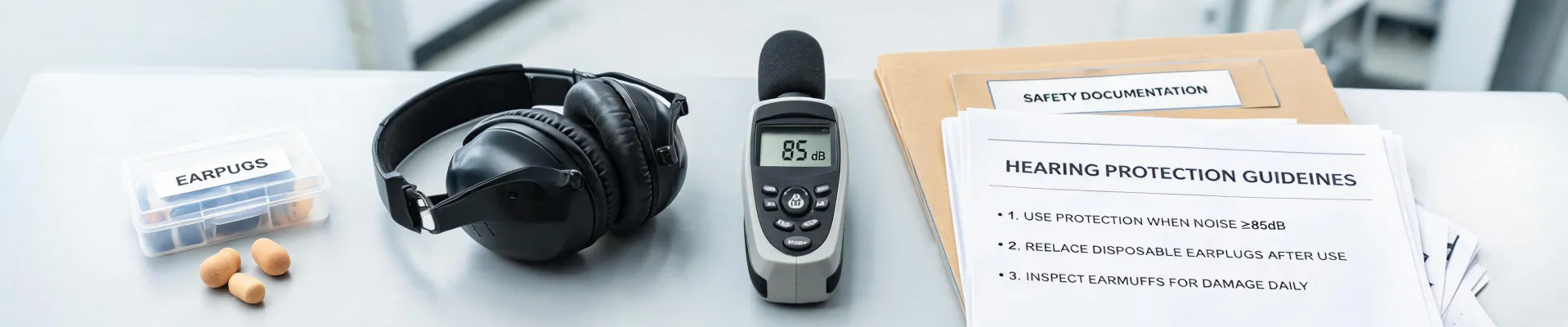
I don't buy the cheapest hearing protection anymore. I'm not going to pretend that's a bold opinion—it's just math.
In my role coordinating PPE rush orders for industrial plants, I've seen the same budget-driven mistake repeat itself. A plant saves a few hundred dollars on generic foam earplugs, then loses more than that in expedited freight, lost labor, or compliance headaches when the crew simply won't wear them. The two cents you save per pair doesn't matter if the pair is sitting in a pocket.
Here's my stance: the right earplug is the one a worker will actually put in and keep in. That's why I usually specify Howard Leight Laser Lite earplugs (NRR 32) for general plant floors, and Howard Leight Max earplugs (NRR 33) for high-noise shutdown work. Howard Leight is part of Honeywell's safety line, and in my experience, the quality is consistent. But this isn't a brand loyalty thing. It's a 'what actually works' thing.
A 9:30 p.m. Call That Changed How I Buy Earplugs
In February 2024, at 9:30 pm on a Thursday, I got a call from a safety manager at a food processing plant. He had a shutdown maintenance window starting Friday at 6 a.m. with 140 people on site. Normal lead time for 5,000 pairs of earplugs was three days. He needed them by 5 a.m. the next morning.
Why? Because purchasing had saved $180 on a 'value pack' of cheap foam earplugs. The crew opened a box Thursday afternoon, tried them, and complained immediately. The foam was hard. It didn't expand enough to hold a seal. By the second hour, half the crew had them around their necks like necklaces.
We found 5,000 pairs of Howard Leight Max at another warehouse, paid $210 in after-hours freight, and delivered them at 4:20 a.m. Missed deadline? There was a $50,000 penalty clause tied to the shutdown window. So a $180 'saving' almost turned into a $50,000 problem.
I hit 'confirm' and immediately thought, what if the trailer hits traffic? Didn't relax until I saw 'delivered' on the tracking screen.
The Howard Leight Max Earplugs Review Worth Reading
People ask for a Howard Leight Max earplugs review more than you'd think. Here's the short one: NRR 33, soft foam, slow recovery, reliable seal when inserted correctly. It's not a magic plug—you still have to roll it, pull your ear up, and let the foam expand. But compared to the hard generic stuff, the Max is in a different league.
For lighter noise, I prefer Howard Leight Laser Lite earplugs. Their NRR is 32, not 33, but they're softer and more comfortable for a full eight-hour shift. In a warehouse where forklifts beep but the average level is under 90 dBA, Laser Lite is often enough and feels better.
An uncomfortable 33-dB earplug won't stay in for eight hours. A comfortable 32-dB earplug might. Real-world protection is a function of comfort, not just lab numbers.
An NRR Number Doesn't Fit Inside an Ear
NRR stands for Noise Reduction Rating. Higher is better, but only under ideal conditions. The EPA requires the rating to be on the package, yet the test fixture doesn't have a human ear canal and doesn't have to deal with caffeine, sweat, or someone trying to talk over the noise.
According to OSHA (29 CFR 1910.95), hearing conservation is required when the 8-hour average hits 85 dBA. And according to CDC/NIOSH, roughly 22 million workers are exposed to hazardous noise on the job. That means the decision about earplugs isn't a detail. It's the front line.
The NRR you pick should match your noise map, not your budget spreadsheet. And if the earplug causes pain by hour three, it doesn't matter what the package says.
Smoke Detectors, Picket Fences, and Pepper Spray: Same Logic
This might seem like a small product decision, but the same pattern shows up in other safety items.
Smoke detector. A smoke detector with a dead battery is just a plastic disk on the ceiling. It looks safe. It isn't. The cheapest working detector can do the job; the most expensive dead one can't. What matters is function, not price.
Picket fence. A picket fence marks a boundary. It doesn't stop a car or a determined intruder. If you know it's decorative, fine. If you're counting on it as a barrier, that's a dangerous misunderstanding. Hearing protection works the same way: a pair of earplugs hanging around the neck is a picket fence, not a protective barrier.
What is the difference between mace and pepper spray? It's a common search, and for good reason. Historically, mace was a tear gas based on CN. Pepper spray uses oleoresin capsicum (OC) from chili peppers. These days, many products labeled mace are actually OC pepper sprays. The important part isn't the name—it's knowing what you're carrying and whether it will do what you need in a crisis. If you just buy the cheapest canister on the shelf, you're gambling with the wrong variables.
The common thread? Price says very little about whether a safety product works. Ratings, ingredients, and maintenance say a lot more.
What If Procurement Only Cares About Unit Price?
I know how this sounds to a procurement manager staring at a P&L. 'He wants us to spend more on foam earplugs?' Yes, but with a reason.
I'm not saying buy NRR 33 for every environment. If your monitoring shows a legit 80 dBA, you may not need NRR 32 either. But the decision should be based on noise data and worker fit, not a purchase order line item. The right question is: what's the total cost of keeping hearing? Not: what's the lowest price per case?
For what it's worth, I went back and forth on Laser Lite vs Max for a distribution center last year. The average noise level was around 83 dBA, so Laser Lite's NRR 32 should have been plenty. But I kept second-guessing because of intermittent compressor spikes near the dock. I ordered Laser Lite anyway, then spent two weeks worrying. The follow-up survey came back at 83 dBA average with a few 88 dB spikes, well inside the protection envelope. I was glad I'd made the decision based on data, not on a sales pitch.
The Bottom Line
So here's what I tell every safety manager who asks: The cheapest hearing protection is the most expensive way to buy hearing protection. Unit price is only the first line of the cost model. Add fit, comfort, compliance, training, and the cost of a claim. Then decide.
I'll keep specifying Howard Leight Laser Lite and Max earplugs for most of my clients. Not because they're the cheapest. Because they're reliable, consistent, and people actually wear them. That's a price difference I'm comfortable defending.
If you're managing a site, buy enough hearing protection—not enough to pass inspection, but enough that a worker forgets it's in their ear. That's the value. And it's worth more than the price.

Maeve Callahan
Maeve Callahan is a head-protection analyst covering Type I and Type II hard hats, climbing-style safety helmets, bump caps, chin straps, suspensions, liners, and face-shield carriers. She applies ANSI Z89.1, EN 397, and EN 12492 criteria while comparing impact attenuation, penetration resistance, lateral deformation, electrical class, retention strength, field of vision, mass, fit range, and temperature conditioning. Her guides help EHS teams, contractors, utilities, and buyers select helmet systems for overhead hazards, work at height, electrical exposure, accessory compatibility, and worker acceptance.