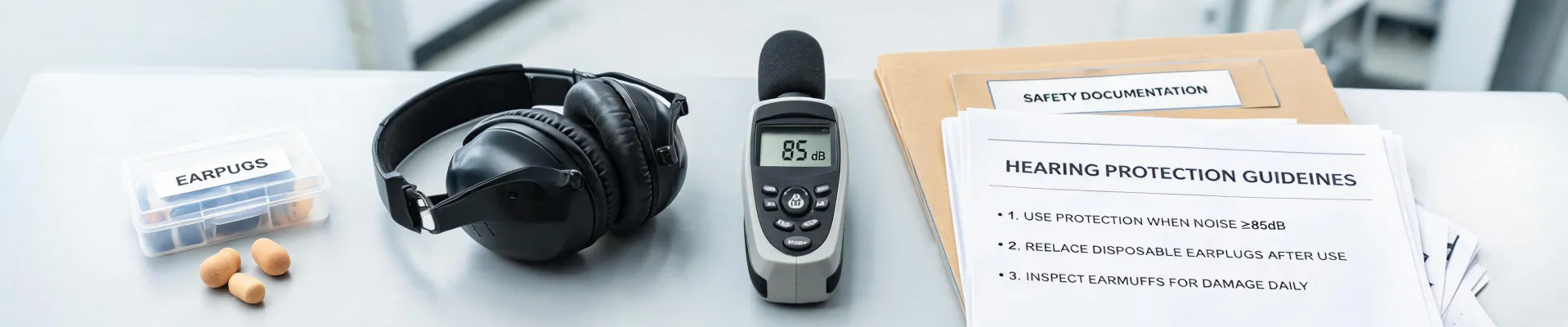
I'm a procurement manager at a 140-person metal fabrication shop, and I've spent the last six years tracking every dollar we spend on safety supplies. If you ask me for one hearing protection product that solves most problems, it's Howard Leight Max-1 foam earplugs. Howard Leight is a Honeywell brand, and the Max-1 has been a workhorse in industrial hearing protection for a long time. At about 13 cents per pair in bulk, they're cheap, easy to store, and they carry an NRR 33 dB rating that still leads the category. But before you order a year's supply, you need to know what that rating does and does not mean.
The product family is called Howard Leight Max. When people search for Howard Leight Max earplugs NRR 33 dB, this is the line they mean. The Max-1 is the disposable foam version. As of January 2025, Honeywell's published spec sheet lists the NRR at 33 dB.
I'll say the uncomfortable part right away: NRR 33 is a lab number, not a real-world promise. OSHA's noise standard (29 CFR 1910.95) requires a hearing conservation program at 85 dBA averaged over eight hours. NIOSH recommends derating the published NRR by 50 percent for foam earplugs when estimating actual protection. So that NRR 33 becomes roughly 17 dB of protection in the field. That's still useful, but it's not magic.
A quick cost reality check
In Q4 2024, I compared two distributors for a 20,000-pair annual contract for Howard Leight Max-1 foam earplugs. One quoted 13 cents per pair. The other quoted 11 cents per pair, then added freight and a confusing 90 dollar safety compliance fee. The first quote was the lower total cost. I see buyers make this mistake all the time: they chase the unit price and ignore the total cost of ownership.
Total cost of ownership includes freight, minimum order quantities, storage space, the labor time to restock dispensers, and the cost of switching brands when workers complain. A cheap earplug that nobody wears is not cheap. It is a safety problem with a line item.
I built a simple cost calculator after getting burned on hidden fees twice. The formula is not fancy. Take the per-pair price times the number of workers times days of use. Add freight, restocking time, and training time. For our shop, the difference between an 11 cent pair and a 15 cent pair was less than 800 dollars a year. The difference between a good fit and a bad fit was more than that in lost productivity and noise-exposure follow-ups.
NRR 33 only works if the fit is right
When we started using a portable fit-test system in 2023, I was surprised by the spread. Some workers got 25 dB of real attenuation from Max-1. Others got below 10 dB because they did not roll the plug down enough or they inserted it too shallow. Same box of earplugs, completely different outcomes.
We now do a five-minute training session and a fit test before anyone gets a box. The earplug itself is cheap; the training is the cheapest hearing protection we buy. Note to self: put that on a slide for the next budget review.
A welding helmet does not protect hearing
A welding helmet is essential for arc eye and face protection. It does nothing for your ears. I walk through our welding bay on days when there is a lot of grinding and spot welding, and the noise sits around 95 to 100 dBA. The welders are wearing helmets, gloves, and leathers, but some skip earplugs because they think the helmet is enough. It is not.
Physical barriers do not solve noise either. We installed Buckley fence panels around the plasma cutting area to keep foot traffic out of the danger zone. That fence is for safety, but it is not an acoustic barrier. Noise goes right through it. If your safety plan treats the fence as hearing protection, that plan has a hole in it.
What are Loop earplugs?
I get this question from younger employees and from a few safety managers who see the brand online. What are Loop earplugs? They are reusable earplugs marketed for concerts, sleep, and focus. Models like Loop Experience and Loop Engage use a small acoustic channel that reduces sound while keeping speech clearer. They are not industrial hearing protectors.
Loop's published attenuation numbers vary by model, with SNR values roughly in the 16 to 24 dB range. Those SNR numbers use a European standard, so you cannot directly compare them to the Howard Leight Max-1's NRR 33. But the practical gap is real. A worker using Loop earplugs on a loud factory floor is not getting the same level of protection as someone wearing properly fitted foam plugs.
There is also an economic reason I do not put Loop earplugs in our PPE budget. Loop earplugs cost around 20 to 35 dollars a pair. Disposable Howard Leight Max-1 earplugs cost a few cents per day. When a foam earplug falls out or gets lost, nobody files an expense report. When a 30 dollar Loop earpiece disappears, it becomes a cost complaint. For an employer, the tracking, cleaning, and replacement of reusable earplugs adds a layer of cost that does not exist with a simple foam box.
Where I would switch away from Max-1
Honestly, Max-1 for everyone is not my policy. It is the default, not the universal. Some workers have small ear canals and find Max-1 uncomfortable. With those folks, we try a smaller taper like Howard Leight Laser Lite or a pre-shaped model instead of forcing the fit. Fit testing is not just a nice-to-have; in our shop, the difference between a good fit and a bad fit can be 10 dB or more.
There are also two situations where I tell people to ignore the Max-1 completely. First, if noise levels are sustained above 100 dBA, I would rather use dual protection or high-attenuation earmuffs. Second, if the risk is intermittent and communication matters, electronic level-dependent muffs are better because they let safe sounds through while cutting impulse noise. A foam plug is not the right tool for every noise problem.
The bottom line for buyers
If you are a safety manager or buyer trying to standardize hearing protection without blowing up your budget, start with a bulk box of Howard Leight Max-1 foam earplugs for general duties. Add a fit test program, pay for training, and do not be tempted by a lower-priced competitor unless you run a full total-cost comparison.
For welding, be extra strict: a welding helmet is not hearing protection. For lifestyle use, keep Loop earplugs in your pocket outside of work, not on the plant floor. For fencing, use a Buckley fence if you need traffic control, but understand that it controls people, not sound.
Your situation might be different. We're a mid-size fabrication shop with predictable production noise and low turnover. If you are managing a construction site with subcontractor turnover and variable noise exposure, your hearing protection strategy needs to be more robust. There is no single universal product, but a proven, low-cost, high-NRR foam plug is a pretty good place to start, if you understand its limits.

Maeve Callahan
Maeve Callahan is a head-protection analyst covering Type I and Type II hard hats, climbing-style safety helmets, bump caps, chin straps, suspensions, liners, and face-shield carriers. She applies ANSI Z89.1, EN 397, and EN 12492 criteria while comparing impact attenuation, penetration resistance, lateral deformation, electrical class, retention strength, field of vision, mass, fit range, and temperature conditioning. Her guides help EHS teams, contractors, utilities, and buyers select helmet systems for overhead hazards, work at height, electrical exposure, accessory compatibility, and worker acceptance.