Let me start with a confession: for the first year of my purchasing job, I bought whatever was cheapest. Then I spent the next four years explaining to finance why my brilliant "savings" kept turning into bigger costs somewhere downstream.
I'm the office administrator for a 140-person industrial services company. I manage all PPE and facility maintenance ordering—roughly $200,000 annually across 12 vendors. I report to both operations and finance, which basically means I get pulled in both directions on every purchase decision. When I took over purchasing in 2020, one of the first things I learned is that "cheap" and "value" are completely different animals.
This article is a side-by-side comparison of buying the lowest-quoted option versus buying established brands, across three spending categories that make up a big chunk of my budget: hearing protection, work boots, and facility contractor work. Plus a little story about a smoke detector that cost me way more than it should have. My goal is to show you how to compare based on total cost, not unit price.
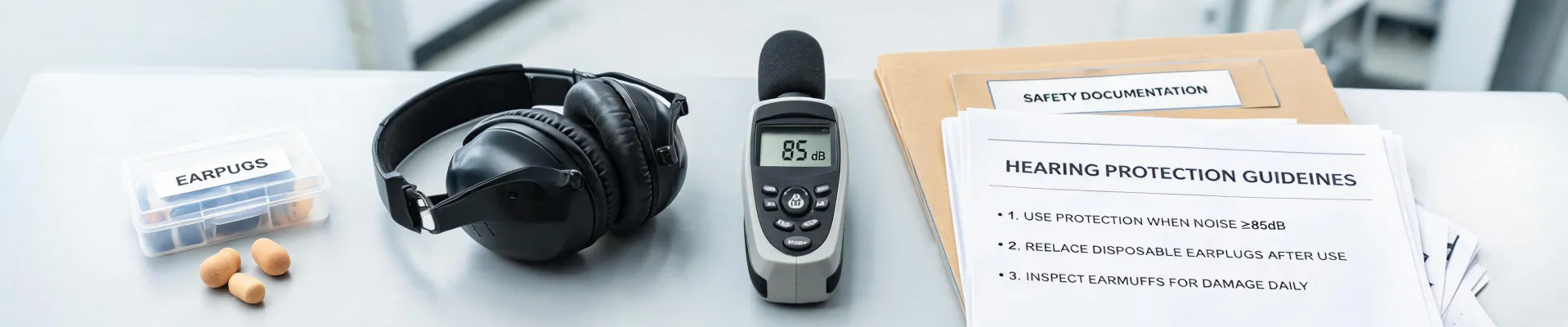
Hearing Protection: Generic Foam vs. Howard Leight
You'd think an earplug is an earplug. It's a piece of foam you roll up and shove in your ear. But I found out the hard way that there's a real difference.
In 2021, I sourced an unbranded foam earplug from a supply liquidator. It had an NRR of 29 and cost about $0.11 per pair—roughly half the price of Howard Leight foam earplugs. Since my 80 shop-floor employees go through two or three pairs a day, that looked like meaningful savings. I ordered a six-month supply.
Within a month, the complaints started. Workers said the generic plugs felt stiff. They hurt after four hours of wear. Guys were leaving them dangling around their necks—visible, but useless. We were technically "providing" hearing protection while people were standing a few feet from a stamping press running at 91 dBA. That's well above OSHA's 85 dBA action level for an 8-hour shift (and since every 3 dB doubles the acoustic energy, the gap between 85 and 91 is bigger than you'd think).
When I switched to Howard Leight foam earplugs, most of the complaints went away. But the real surprise came a couple months later, when I ordered a case of Howard Leight Laser Lite earplugs (NRR 32)—the bright orange, cone-shaped ones you see on job sites everywhere. I figured our existing NRR 33 foam plugs were the "better" product, but I wanted to test that assumption.
Turns out, it was wrong. The Laser Lites have a slightly lower rating (32 vs. 33), but workers find the tapered shape much more comfortable. People actually kept them in. And the high-visibility orange made compliance checks effortless—supervisors could see from across the room whether someone was properly protected. An earplug that sits on a workbench provides exactly zero protection, regardless of what its NRR paperwork says.
Bottom line: don't chase the highest number on the box. Pay more attention to whether your people will actually wear the thing. A 32 NRR plug that workers tolerate beats a 33 NRR plug they won't touch.
Work Boots: Budget Boots vs. Ariat
Our annual PPE allowance includes one pair of work boots per field employee. For my first two years in the role, I bought a $60 boot from a national safety supply catalog. The accounting team approved it without blinking. The warehouse guys? Less impressed.
Those boots lasted about four months before the soles started separating. Then came the replacement requests. Each replacement had an administrative cost—order processing, shipping coordination, delivery tracking—which I estimate at $18 per order. So a $60 pair really cost us $78 per cycle. With replacements landing twice a year, that's $156 per worker per year. Multiply by 15 field staff, and the "cheap" option wasn't looking so cheap anymore.
In 2023, I put Ariat work boots into the rotation for a trial group: 10 employees, $165 per pair. I'll be honest—I had mixed feelings. Part of me thought we were paying a premium for a name. Part of me remembered that data doesn't care about my skepticism.
Here's the one-year comparison:
- $60 budget boots: 4-month lifespan, $156/yr actual cost per worker (with admin overhead), foot-fatigue complaints, $18 reorder cost each time
- $165 Ariat work boots: 15-month lifespan, roughly $132/yr actual cost per worker, zero reorder overhead, zero complaints
Yes, the Ariats cost 2.75x more per pair. But on an annual cost-per-worker basis, they came in about $24 cheaper—not even counting the intangibles like better traction on slick surfaces or the fact that employees stopped submitting replacement forms. There's something satisfying about seeing the math line up like that. It felt like winning an argument with my own prejudice about "brand names."
Facility Work: National Chain vs. Local Fence Company
In 2024, we needed to secure the back lot around our equipment yard. I requested quotes from a national fencing contractor and a local business we found by searching "fence company near me."
The national company's bid came in 23% lower. I nearly signed with them. Then the communication problems started.
I told the project manager, "We need this installed by July 15th." He said, "Noted." I should have recognized that as a warning sign. On July 18th, with no fence installed, I called to follow up. His response: "Our crew is finishing another job in [city]—we can start next week." I asked why he'd confirmed a date he couldn't keep. He said he'd understood my timeline as "flexible." We were using the same words but meaning completely different things. To me, a deadline is a commitment. To them, it was an estimate.
The local company, on the other hand, took two days to return my initial call (annoying, but bearable). Then they actually visited the site, walked the lot, and pointed out that the single gate in my spec wouldn't clear our trailer's turning radius. They recommended a wider sliding gate for an extra $2,200. I approved it, figuring it was the right long-term call.
Let's compare the totals:
- National chain: $14,800 bid, but the equipment yard wasn't secured for an extra 2 weeks, I spent $900 on temporary rental fencing, and I burned at least 10 hours coordinating late-night schedule changes
- Local fence company: $18,600 final invoice, delivered on schedule, and the gate spec has already proven itself in daily use
So the "expensive" local contractor ended up being the cheaper project, overall. Not because the national company was incompetent—I think it was more about lacking the incentive to care about a job that size. We were a small fish to them. To the local company, we were a client they'd see at the grocery store.
The Smoke Detector That Wouldn't Stop Beeping
If you've ever wondered why is my smoke detector beeping, I can save you some frustration: it's usually the low-battery warning. Or it's a cheap detector with a flaky sensor. We had the second one.
In 2022, I bought budget smoke detectors for our office break rooms. $8 each, versus $23 for a reputable unit. Total savings: $45 for the whole project. I considered it a win.
Four months later, one started chirping. Replaced the battery. It kept chirping. Called the manufacturer's helpline, which suggested "cleaning the unit" (I didn't know that was a thing either). It still beeped. I ended up paying $215 for an electrician to come out and diagnose the issue—faulty sensor, he said, and replaced it with a $45 detector. Problem solved.
So: the $8 detector ended up costing $260 and three weeks of office staff annoyance. The $23 detector would have cost $23. That's the penny-wise, pound-foolish pattern in its purest form. I basically heard a literal warning beep about my own purchasing strategy.
So What Do I Actually Recommend?
I'm not arguing that you should buy top-of-the-line everything, all the time. That's its own kind of waste. But after five years of managing these purchases, here's how I think about it:
Buy budget when the item is single-use, low-risk, and a failure is neither dangerous nor disruptive. Standard shipping envelopes, basic packing tape, office paper—go wild with the cheapest option.
Buy trusted brands when the item protects a human being, must pass a regulatory inspection, or gets used daily in demanding conditions. Howard Leight for hearing protection. Ariat for work boots. A solid smoke detector for facilities. These are not areas where "how cheap can we go?" is a fun experiment.
Compare total cost, not sticker price. Add up unit price + replacement frequency + administrative overhead + downtime + risk. Put that in a spreadsheet. It takes five minutes and it's saved our budget way more than bargain-hunting ever did.
The pressure to cut costs doesn't go away—it's part of the job. But now I have numbers to push back when a cheaper option would actually cost more in the long run. And the 2 a.m. smoke detector beeps? They stopped, the minute I stopped treating safety equipment like a commodity.

Maeve Callahan
Maeve Callahan is a head-protection analyst covering Type I and Type II hard hats, climbing-style safety helmets, bump caps, chin straps, suspensions, liners, and face-shield carriers. She applies ANSI Z89.1, EN 397, and EN 12492 criteria while comparing impact attenuation, penetration resistance, lateral deformation, electrical class, retention strength, field of vision, mass, fit range, and temperature conditioning. Her guides help EHS teams, contractors, utilities, and buyers select helmet systems for overhead hazards, work at height, electrical exposure, accessory compatibility, and worker acceptance.