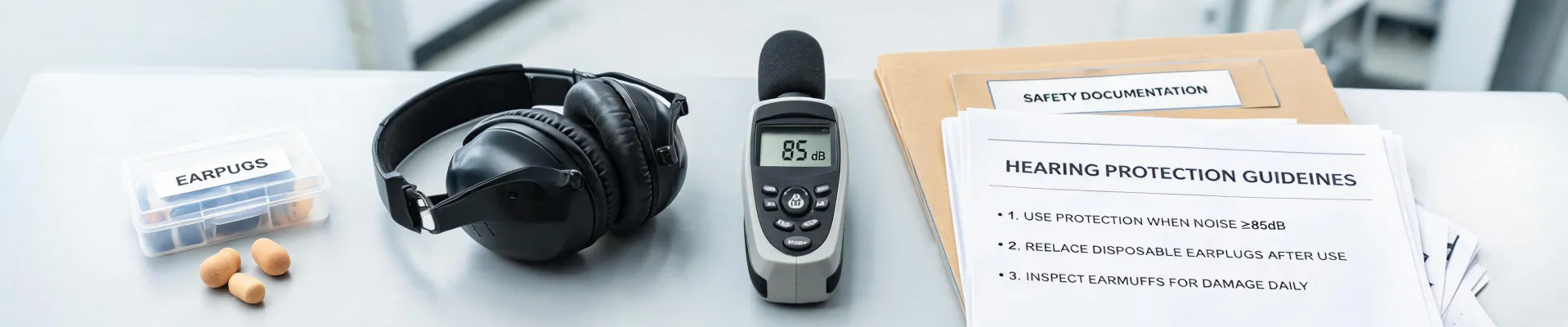
If you're still choosing safety equipment the way you did in 2019, you're behind. Not by a little—by a full product generation. That's not a guess. It's the conclusion I've reached after 11 years and 200+ rush orders in this industry.
I'm the person who gets the panicked calls. The safety manager whose hearing protection order got misrouted. The facilities director who just realized the fire extinguishers are three months out of inspection and the corporate audit is next week. In March 2024, I took a call at 6:40 PM from a contractor facing a safety audit in 36 hours. Their hearing protection shipment was stuck in a sorting facility two states away. Rescheduling the audit would have triggered a $50,000 penalty clause. We tracked down a distributor with stock, paid a very unflattering rush fee, and had product on site by 9:00 AM.
Doing that for over a decade teaches you a few things. When the choice is between eating a rush fee and a client eating a penalty clause, you learn how this industry really works. The main thing I've learned: the safety industry has quietly transformed since 2020. Most buyers haven't.
Why the Highest NRR Stopped Being the Right Answer
When I first started, I assumed the highest NRR rating was always the best choice. NRR 33? Done. Maximum protection, maximum compliance. It took about three years and a failed fit-test to show me how wrong that was.
Here's the thing: NRR is a theoretical ceiling, not a guarantee. OSHA's hearing conservation standard (29 CFR 1910.95) kicks in when noise exposures hit an 8-hour time-weighted average of 85 decibels. But the protection you actually get from an earplug depends on fit, training, and whether workers will actually wear the thing. NIOSH research has shown, multiple times, that real-world attenuation runs lower than the labeled rating. A perfect NRR on paper means nothing if the plug doesn't seal in that specific ear canal. It's worth repeating: the number on the box is not the number in the ear.
And that's exactly why fit-testing has become the new standard for serious hearing conservation programs. The question used to be, “what's the highest NRR we can buy?” It's now, “can we prove this protector actually works for these workers?” A labeled NRR 33 doesn't demonstrate compliance. A fit-test result does.
In my first year, I made the classic spec error. I recommended our best-selling Howard Leight foam earplugs—the Max series, NRR 33—to an airsoft facility owner who needed staff to hear commands and players to hear whistles. They didn't need the highest rating; they needed the right one. The Howard Leight AirSoft earplugs sit at NRR 27, which sounds like a downgrade until you understand what an air-cushioned design does for speech clarity. I ended up covering the replacement order myself. Lesson learned.
I'm not saying NRR 33 is useless. High-attenuation foam earplugs absolutely still have their place, especially in continuous high-noise environments. But the “biggest number wins” mindset is the old playbook. The new one asks: what's the actual exposure, what does the worker need to hear, and did the fit-test confirm the chosen protector actually works? That's the industry evolving.
And then there's the Hearing Protection Act. Whatever your position—and it's been reintroduced in multiple Congresses since 2015 without passing as of early 2025—the debate did something useful. It got more people talking about noise-induced hearing loss than any earplug spec sheet ever did.
Even “Simple” Products Are Still Misunderstood
If you think hearing protection has a knowledge gap, try self-defense sprays. I get asked about the difference between mace and pepper spray constantly, usually by someone who assumes they're interchangeable.
They're not. Traditional mace (CN gas) is a tear agent. Pepper spray (OC, oleoresin capsicum) is an inflammatory agent derived from hot peppers. Different mechanisms, different legal status depending on your state, different aftercare. To make things worse, many products labeled “mace” these days actually contain OC or a blend, so the name itself has become unreliable.
The bigger point: if a category this simple is this misunderstood, imagine what's happening with hearing protection, fall protection, or lockout/tagout. The products have evolved—better formulations, better labeling, better options. Buyer knowledge hasn't kept up. In my opinion, that knowledge gap is the next problem this industry has to solve, because it's not a product problem. It's a training problem.
Services Had to Catch Up
The product side wasn't the only thing that evolved. The service side did too—and that's where a lot of buyers are still stuck.
When someone searches “fire extinguisher service near me,” it's almost never a casual query. It's an audit deadline. It's a compliance inspection. It's a facilities manager who just realized the extinguishers are two months past their annual maintenance date.
A few years ago, one of our clients was exactly in that spot: six extinguishers to inspect, one to hydro-test, 48 hours before a corporate audit. I replied that we'd “have it handled by Thursday.” They heard “guaranteed by Thursday.” Same words, two different meanings—which I discovered when the vendor's truck broke down on Wednesday and I paid $400 out of pocket to courier the units from a different shop across town. My fault. I left out the word “estimated.” (Note to self: never skip the word “estimated.”)
The good news: the category has professionalized. Mobile service trucks, digital inspection records, centralized scheduling—it's fairly straightforward now to find a fire extinguisher service provider that actually shows up. Typical annual inspection runs roughly $15–$35 per unit depending on region and vendor (based on publicly listed rates, January 2025; verify current pricing before you budget).
That's not a line item to cut corners on. A non-compliant extinguisher is the worst thing to discover mid-emergency. The time to find that provider is before the emergency, not during it.
Granted, the Fundamentals Haven't Changed
To be fair, I'm not saying everything is different. The fundamentals of workplace safety are stubbornly consistent. OSHA's noise limits didn't disappear. Extinguishers still need annual inspections. Fall protection still needs a pre-use check. Anybody who tells you compliance doesn't matter is trying to sell you something.
But the execution has transformed. Fit-testing made hearing protection measurable instead of aspirational. Digital tracking made service documentation auditable in minutes instead of days. Product design improved across nearly every category. If you're still making purchasing decisions on a 2019 seminar, you're using a genuinely outdated playbook.
Bottom Line: Move With the Industry
The fundamentals haven't changed, but the execution has transformed.
That's the short version of what 200+ rush orders have taught me. Now the practical version.
Stop grabbing the highest NRR without asking whether it fits your workers' ears—and their actual work environment. Stop treating fire extinguisher service as an afterthought. And please, for the sake of your training program, learn the difference between mace and pepper spray before you stock them side by side. Your workers, your audit record, and your emergency response plan will thank you.
I've watched this industry change from the inside. A lot of that change has been good, and a lot of it has quietly happened without most buyers noticing. What was best practice in 2020 doesn't necessarily apply in 2025, and pretending otherwise is how gaps appear. In safety, gaps surface at the worst possible moment. Don't let that be you.

Maeve Callahan
Maeve Callahan is a head-protection analyst covering Type I and Type II hard hats, climbing-style safety helmets, bump caps, chin straps, suspensions, liners, and face-shield carriers. She applies ANSI Z89.1, EN 397, and EN 12492 criteria while comparing impact attenuation, penetration resistance, lateral deformation, electrical class, retention strength, field of vision, mass, fit range, and temperature conditioning. Her guides help EHS teams, contractors, utilities, and buyers select helmet systems for overhead hazards, work at height, electrical exposure, accessory compatibility, and worker acceptance.