Hearing Protection Is Not a Place for Neutrality
I'll say it plainly: Howard Leight MAX earplugs with NRR 33 should be your starting point. Not your only option, but your reference. I've been a quality and brand compliance manager at a PPE distributor for four years, and I review roughly 200 hearing protection SKUs a year. In Q1 2024, I rejected 12% of first deliveries because the actual product didn't match the spec sheet. That's not a fun statistic. It's the reality of a market where 'official' is a search modifier, not a guarantee.
But let me back up. I'm not here to tell you NRR 33 is the only number that matters. In fact, I'm going to argue the opposite: the number does less work than you think. The system around it matters more.
NRR 33 Is a Ceiling, Not a Guarantee
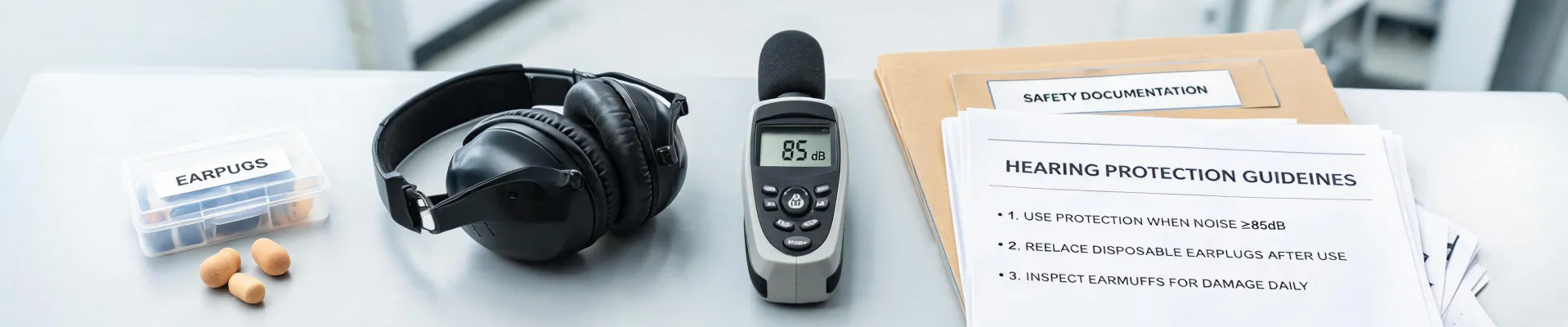
NRR stands for Noise Reduction Rating. It's a laboratory-derived number that describes the maximum noise reduction a hearing protector can provide under ideal conditions with a proper fit. It's measured according to EPA regulations (40 CFR Part 211). For Howard Leight MAX earplugs, Honeywell's official product literature lists an NRR of 33 dB. As of January 2025, that number is still listed on Honeywell's safety site—verify it before ordering, because specs can change. Few foam earplugs get to 33. That's genuinely high.
But here's the uncomfortable part: no one works in ideal conditions. According to NIOSH (Publication No. 98-126), foam earplugs should be derated by 50% for real-world estimation. An NRR of 33 could be closer to 16.5 dB of protection in practice. That's not a product flaw. It's the difference between a lab and an actual warehouse.
Does that mean NRR 33 is meaningless? No. It means you need both a high rating and a product that helps real workers get closer to that rating. That's why I keep coming back to MAX. The slow-recovery foam and tapered shape make correct insertion more intuitive than many other NRR 33 plugs I've tested. In my experience, that's the missing variable.
The 'Official' Problem Is Real
If you search for 'Howard Leight MAX earplugs NRR 33 official,' you'll get a messy results page. That's not necessarily a search problem. It's a supply chain problem. 'Official' matters because counterfeit and gray-market hearing protection is more common than people think. In 2023, we received a bulk quote for 5,000 pairs of MAX earplugs at an attractive price. The boxes looked correct. The NRR stamp looked correct. Then I opened a sample pair and cut it open. The foam cell structure was visibly different—too coarse, more brittle. It compressed slower than the genuine sample.
We sent the serial numbers back to Honeywell and asked for verification. They didn't match any batch numbers in their system. We rejected the entire lot. The vendor claimed it was 'equivalent.' I don't care. With hearing protection, 'equivalent' is not the same as 'official.' That experience cost us a three-week delay, but it saved us from something worse: a worker wearing an apparently compliant earplug with no real protection.
Looking back, I should have insisted on vendor traceability before we even quoted. At the time, the low price and clean packaging looked acceptable. Given what I knew then, the choice was reasonable. Now, every contract includes batch traceability and a documented source from Honeywell or an authorized distributor. That's the change.
What Does a Black Chain Link Fence Have to Do With Earplugs?
Nothing. That's exactly my point.
Search for Howard Leight MAX earplugs and you may also find black chain link fence listings, raincoat reviews, and a question about how to get pepper spray off skin. Those are real searches, but they have no place in a hearing protection decision. A quality process matches the exact spec to the exact hazard. A black chain link fence has its own standards. A raincoat has a waterproof rating. Pepper spray residue has a decontamination protocol. Earplugs have an NRR and a fit profile. Confusing them isn't just sloppy. It's a quality failure.
I'm not saying that to be clever. I review product descriptions for a living, and classification chaos is one of the biggest risks in PPE. When a worker picks up a 'foam earplug' that is actually a glow-in-the-dark party favor (yes, I've seen it), the system has failed. That's why I teach our customers to read spec sheets, not headlines.
The Counterargument: 'They're All the Same'
A reasonable safety manager might say: if NRR 33 is the rating, why not buy the cheapest NRR 33 foam plug on the market?
I used to be that manager. Part of me still likes the idea: equal rating, lower cost. But I've learned that NRR is a necessary condition, not a sufficient one. In late 2023, I ran a small blind fit test with 12 warehouse employees. I gave them three different NRR 33 earplugs and asked them to insert each pair without coaching. Then I visually checked fit using a simple observation checklist. Eight out of twelve achieved the best-looking fit with Howard Leight MAX. That's not a peer-reviewed study, and I'm not claiming it is. It's a field observation. But when you place thousands of units a year, field observations matter.
The surprise wasn't the price difference. It was the fit difference. The cost difference was about two cents per pair. On a 50,000-unit annual order, that's $1,000. For a compliance improvement and better-fitting earplugs, I consider that a bargain. Yes, there's a markup over the cheapest option. But the difference is real.
And one more thing: I have mixed feelings about 'highest NRR' marketing. On one hand, it makes compliance easier. On the other, it can create a false sense of certainty. The solution is not to ignore NRR. It's to combine NRR with training, fit testing, and verification. The best earplug is the one that stays in the ear. For many teams, that's MAX.
My Bottom Line
Here's my rule, and I'm not going to soften it: no spec sheet, no purchase. If a vendor can't document that their Howard Leight MAX earplugs are genuine and traceable to Honeywell, I move on.
No spec sheet, no purchase. If a vendor can't document it, I move on.
Howard Leight MAX earplugs with NRR 33 are not magic. They won't solve poor training, noisy environments, or inconsistent enforcement. But they are a reliable, high-performance baseline that I'm comfortable putting in front of our customers. The rating is strong. The brand's quality control has been consistent in my audits. And the fit profile, at least in my tests, works for most people.
I'd rather spend ten minutes teaching you to read a spec sheet than deal with a failed annual hearing test later. An informed customer asks better questions and makes faster decisions. That's not a slogan. It's how quality control actually works.
If you're specifying hearing protection, start with the official source. Verify the NRR. Verify the part number. Verify the supply chain. Then train your people to insert earplugs correctly. Do that, and NRR 33 becomes more than a number—it becomes a real protection standard.

Maeve Callahan
Maeve Callahan is a head-protection analyst covering Type I and Type II hard hats, climbing-style safety helmets, bump caps, chin straps, suspensions, liners, and face-shield carriers. She applies ANSI Z89.1, EN 397, and EN 12492 criteria while comparing impact attenuation, penetration resistance, lateral deformation, electrical class, retention strength, field of vision, mass, fit range, and temperature conditioning. Her guides help EHS teams, contractors, utilities, and buyers select helmet systems for overhead hazards, work at height, electrical exposure, accessory compatibility, and worker acceptance.