-
Who This Checklist Is For
-
Step 1: Match the Earplug to the Noise Level, Not Just the NRR
-
Step 2: Test a Sample Box Before You Standardize
-
Step 3: Calculate Total Cost Per Worker-Month, Not Per Box
-
Step 4: Add the Rest of the Site to the Same Order
-
Step 5: Know the Answer to the Pepper Spray Carry-On Question
-
Common Mistakes I Still Watch For
Who This Checklist Is For
I'm the admin buyer for a facilities company with roughly 180 employees — maybe 185, I'd have to check the current headcount. I manage safety supply orders across three locations, a little under $60,000 a year, give or take. I report to operations and finance, so I get squeezed from both sides. This checklist came out of a 2024 consolidation project when I realized I was repeating the same purchasing mistake: I was looking at unit prices instead of what the products actually cost in use.
If you buy Howard Leight hearing protection, temporary fence panels, fire extinguisher cabinets, or field questions about pepper spray in a carry-on, this is for you.
Here's the checklist I use now. Five steps. Step 2 is the one I would have skipped years ago.
Step 1: Match the Earplug to the Noise Level, Not Just the NRR
When I first started buying safety supplies, I thought the highest NRR was the only number that mattered. That's how we ended up with a drawer full of earplugs no one used.
Howard Leight is part of Honeywell's safety portfolio, though the product line keeps its own name in our orders. The two I compare the most are Howard Leight Max earplugs NRR 33 and Howard Leight Max Lite earplugs NRR 30. Max is the higher-rated option for high-noise areas; Max Lite is softer and more comfortable for moderate-noise work. A three-point NRR difference doesn't sound huge, but it changes how the plug feels. And feel changes behavior.
Comfort drives compliance. Put another way: a 33 NRR earplug that sits in a pocket protects no one.
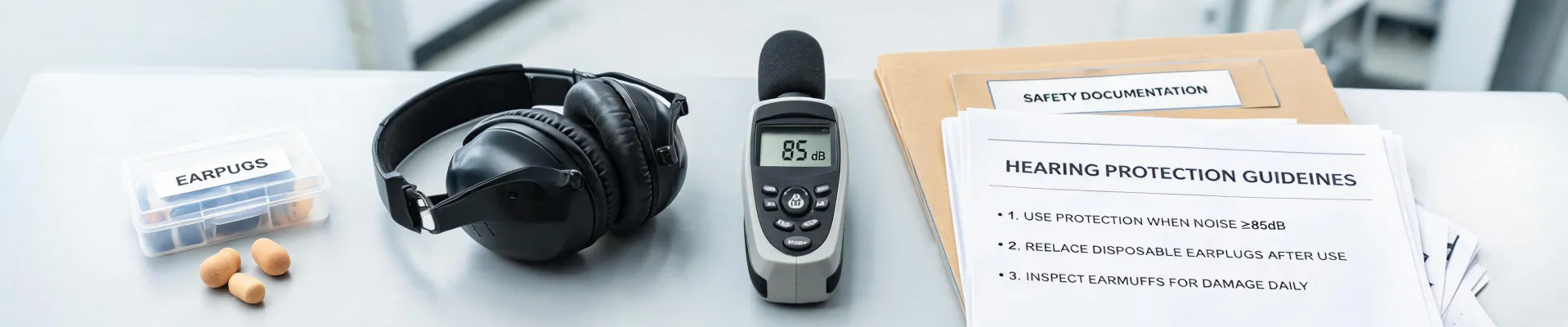
Under OSHA 1910.95, you need a hearing conservation program when exposures reach 85 dBA as an 8-hour TWA. The NRR is a lab rating, not a field guarantee. I use the NRR as a starting point, then check the actual noise levels before I commit to one product.
Checkpoint: know the range of noise levels in your facility, and pick the Howard Leight Max or Max Lite that people will actually wear in each zone.
Step 2: Test a Sample Box Before You Standardize
This is the step I used to skip. In 2023 I ordered a big volume of a cheaper generic foam earplug because the price per box looked unbeatable. Two months later, the warehouse supervisor showed me a drawer full of them.
When I compared Howard Leight Max side by side with the generic, the lab ratings were close. What mattered was how easily they inserted, how they expanded in the ear, and how they felt after an hour. I don't have hard data on industry complaint rates, but the informal test was clear: the crew asked to keep the Max.
Now I ask for a sample box of 50 or 100 pairs and send it to the people who do the noisy jobs. If they don't like it, no NRR number is going to save me from reorders, wasted expense, or an audit finding.
(I really should have done this for the first bulk order. I know.)
Step 3: Calculate Total Cost Per Worker-Month, Not Per Box
The box of earplugs is the visible cost. The hidden cost is the labor: ordering, receiving, distributing, training, and replacing lost pairs. A $0.10 earplug that gets ignored is more expensive than a $0.15 earplug that gets used.
I now calculate total cost of ownership before comparing vendor quotes. The formula I use for disposables is simple: (unit price + freight allocation + labor cost per issue) x pairs used per worker per month. If the cheaper product creates waste, the cheaper price is the more expensive decision.
As of early 2025, a box of 200 Howard Leight Max (uncorded) is listed anywhere from around $20 to $28 at the safety distributors I use. Max Lite is usually within a couple dollars. Those prices change, so the line item isn't the point. The point is that a one-dollar price difference per box is noise compared with a week of fit-testing, training, and reordering.
Step 4: Add the Rest of the Site to the Same Order
While I'm building the hearing protection order, I walk the site and check the other safety stuff. This is where temporary fence and fire extinguisher cabinets usually show up.
Temporary fence panels aren't just for construction sites. We use them to block off a loading dock area during maintenance. Renting panels sounds straightforward, but delivery, pickup, and missing pins add up. If you need them more than twice a year, buying a few panels can be lower total cost. Check panel and gate compatibility before you order—different brands don't always use the same connectors.
Fire extinguisher cabinets are easier to get wrong than fire extinguishers. In 2022 we bought a new extinguisher for the loading dock but treated the cabinet as an afterthought. The extinguisher sat exposed, got scratched, and the inspection tag faded. Now I order a surface-mounted or recessed cabinet with a door that opens without a key if there's a tampering risk. Verify the extinguisher depth before purchasing—a too-shallow cabinet is a stupid way to burn money. As of January 2025, basic steel cabinets run roughly $50 to $120 depending on size and style, but that varies by region.
Local fire code usually requires the extinguisher to be readily accessible. Check with your fire marshal before installing a locked cabinet.
Step 5: Know the Answer to the Pepper Spray Carry-On Question
This one isn't a typical procurement item, but in an admin buyer role, it comes up. Employees travel for training or conferences, and at least once a year someone asks: can I bring pepper spray in my carry on?
No. TSA prohibits pepper spray in carry-on bags. In checked bags, it's allowed only in containers up to 118 ml (4 fl oz) with a safety mechanism to prevent accidental discharge. State laws also vary, so the honest answer is: "Not in your carry-on, and check the rules for your destination before packing it."
(I used to think pepper spray was just a TSA question. Then a supervisor asked me if he could keep it on a belt in a warehouse. That's a different policy, and it depends on local law and company rules.)
Common Mistakes I Still Watch For
- Comparing unit prices without freight. A cheap quote with $80 shipping can lose to a slightly higher quote with free shipping.
- Ordering fire extinguisher cabinets without measuring the extinguisher depth. I've seen a cabinet that couldn't close, and it wasn't the installer's fault.
- Assuming all temporary fence panels are compatible. They look the same; the connectors are not always.
- Guessing at the TSA pepper spray rule. Say it plainly: not in carry-on, checked only under 4 oz with a safety cover.
- Buying one NRR for every noise zone. High noise, moderate noise, and intermittent noise deserve different answers.
The perfect safety supply order doesn't exist. A repeatable checklist does. Mine is: match the product to the real job, test it with the people who wear it, count the total cost, fill the rest of the site, and answer travel questions with the current rule.

Maeve Callahan
Maeve Callahan is a head-protection analyst covering Type I and Type II hard hats, climbing-style safety helmets, bump caps, chin straps, suspensions, liners, and face-shield carriers. She applies ANSI Z89.1, EN 397, and EN 12492 criteria while comparing impact attenuation, penetration resistance, lateral deformation, electrical class, retention strength, field of vision, mass, fit range, and temperature conditioning. Her guides help EHS teams, contractors, utilities, and buyers select helmet systems for overhead hazards, work at height, electrical exposure, accessory compatibility, and worker acceptance.