I don't trust a safety supplier who says they can handle everything. That sounds odd coming from someone in purchasing, since consolidation is usually the goal. But after managing safety and facility orders for about 240 people across three sites, I've learned that broadline vendors are useful for paper towels, not for personal protective equipment.
I'm not a safety engineer or an audiologist. I'm the person who places the POs, verifies the invoices, and answers when an employee says the earplugs hurt or the winter gear didn't work. Since 2021, I've ordered everything from breakroom supplies to railings. In the beginning, I gave as much as possible to one vendor because one invoice is easier than eight.
Then came the snow fence order.
The fence order that changed my approach
In January 2024, we needed a snow fence around the supply yard entrance. If you've never bought one, a snow fence is temporary, lightweight, and designed to break the wind and keep snow from drifting across a walkway. It doesn't look permanent because it isn't supposed to be.
Our consolidated supplier delivered a split rail fence instead. When I called, the rep said, “It's still a fence, right?” No. A split rail fence is a fixed boundary marker. It's nice for defining property lines, but it won't stop snow from drifting, and it doesn't flex under wind load. We had to return it, pay rush freight for the correct product, and lose a week of setup time.
The mistake wasn't just frustrating. It made me realize that safety products are not interchangeable categories. If a supplier doesn't understand the difference between a snow fence and a split rail fence, why would I trust them to help me choose hearing protection?
A supplier who knows and admits their boundaries is more useful than one who claims to cover every category.
Buying Howard Leight earplugs is not just picking a number
Hearing protection is the clearest example. You can't buy earplugs the way you buy printer paper.
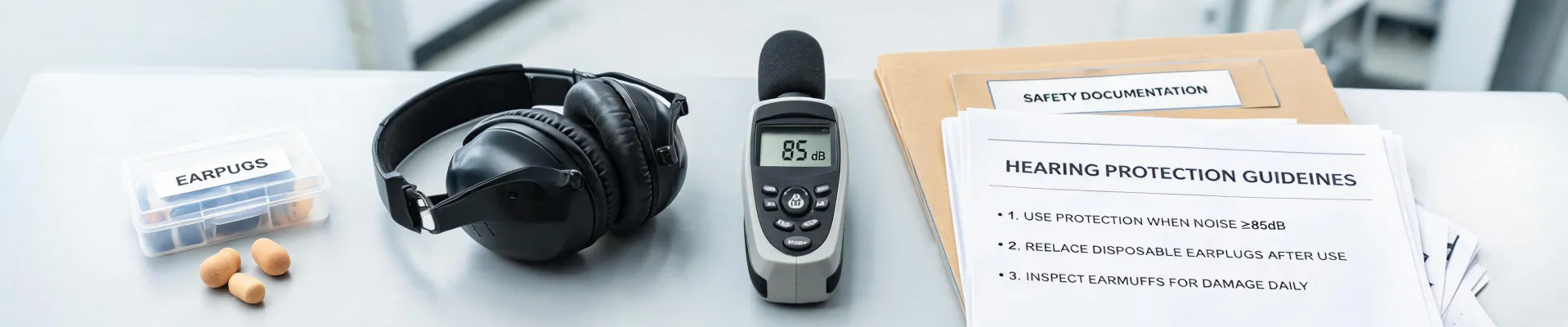
On our production floor, we use Howard Leight earplugs from Honeywell. The Howard Leight Max foam earplug carries an NRR rating of 33, which is one of the highest ratings available. But that number only means something if the earplug fits the person wearing it and is inserted correctly.
According to OSHA (osha.gov/noise), once noise exposure reaches an 8-hour time-weighted average of 85 dBA, employers need to start a hearing conservation program. That includes training, testing, and making sure workers actually use the protection. A good hearing protection supplier doesn't just ask, “How many boxes?” They ask about shift duration, noise levels, whether employees have trouble hearing alarms, and whether the workforce includes people who need different sizes.
We have a separate set of Howard Leight Impact Sport earmuffs for maintenance staff and site visitors. These are not the same as heavy-duty earmuffs used for continuous loud machinery. They reduce impulsive noise while letting lower-level sounds through, so someone can still hear a radio call or a warning shout. That distinction matters. If I order the wrong type, the worker is either overprotected and isolated or underprotected and exposed.
I'm not an acoustics expert, so I now ask the supplier to explain exactly why they're recommending one product over another. If they can't answer that, I find someone who can.
Snow fences, split rail fences, and gloves are the same problem
It would be easy to say the snow fence issue was just a bad order. But the same pattern shows up everywhere.
Take gloves. People often ask, “Are nitrile gloves latex free?” The short answer is yes for most nitrile gloves—they're made from synthetic nitrile rubber, not natural rubber latex. But if a supplier only answers yes and doesn't ask what the gloves are being used for, that's a red flag. Do workers need chemical resistance? Are they handling sharp metal? Do they need textured grip for oily parts? The glove's material is only the beginning.
I'm not a chemist, so I don't pretend to know every glove specification. What I do know is that a specialist will say, “This glove is good for general use, but if you're working with solvents, check the permeation data before you commit.” A broadline vendor usually just says, “Nitrile is latex-free, you're good.”
The same logic applies to the split rail fence problem. A specialist in outdoor safety barriers would never have sent a permanent split rail fence for a temporary snow drift issue. They would have said, “Snow fence is what you need, and here's why.” Or they would have told us, “We don't do snow fence, but this local supplier does.” That kind of honesty is rare, and it's exactly what I'm looking for now.
Does that mean more vendors? Sometimes.
I process maybe 70 to 80 purchase orders a year, so I'm not naive about administrative workload. I don't want a different supplier for every SKU. But I'd rather have four suppliers who know their specialties than one supplier who claims to know everything and actually knows a little about a lot.
The standard I use now is not what a supplier says they can sell me. It's what they say they can't do well. When a salesperson tells me, “This part of your request is outside our lane, and you should talk to a fall protection specialist,” that tells me they understand safety has real limits. I trust the rest of their recommendations more, not less.
We still buy Howard Leight earplugs and earmuffs. They remain a strong choice for our hearing protection needs, especially when matched to the right task. But the difference now is that we buy them from a supplier who treats hearing protection as a technical discipline, not a category in a warehouse pick list.
My take
I don't need a supplier to be perfect at everything. I need them to be honest about where they're strong and where they're not. A supplier who says, “This isn't our specialty, here's who does it better,” earns more of my budget, not less.
That snow fence mistake was annoying, but it was also the best training I've had as a buyer. Now I stop before placing an order and ask the same question every time: does this vendor actually know what this product is supposed to do?
Maeve Callahan
Maeve Callahan is a head-protection analyst covering Type I and Type II hard hats, climbing-style safety helmets, bump caps, chin straps, suspensions, liners, and face-shield carriers. She applies ANSI Z89.1, EN 397, and EN 12492 criteria while comparing impact attenuation, penetration resistance, lateral deformation, electrical class, retention strength, field of vision, mass, fit range, and temperature conditioning. Her guides help EHS teams, contractors, utilities, and buyers select helmet systems for overhead hazards, work at height, electrical exposure, accessory compatibility, and worker acceptance.