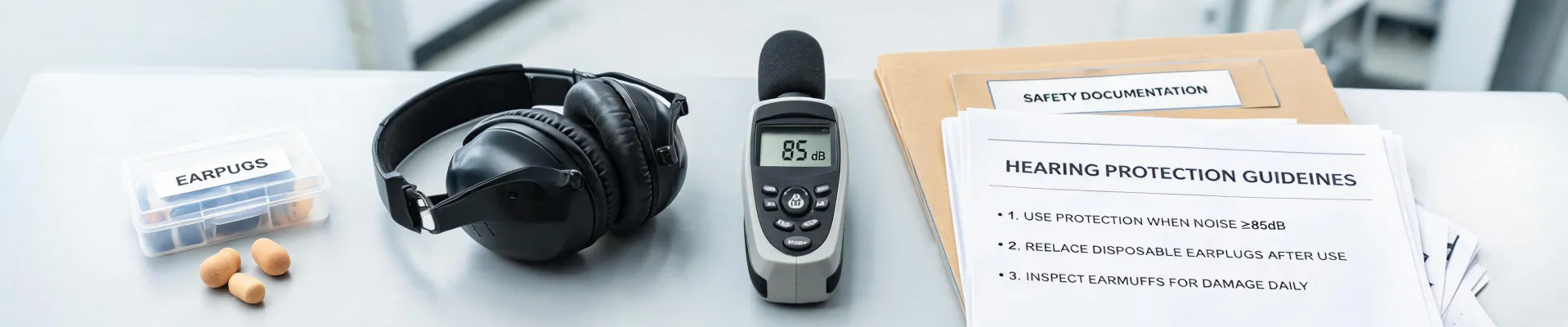
I’m going to start with an opinion that hasn’t made me popular in safety committee meetings: the NRR number printed on an earplug box is one of the most overrated pieces of information in workplace hearing protection.
That sounds like I’m about to tell you to ignore the ratings entirely. I’m not—I check NRR on every product I evaluate. But after five years of buying hearing protection for a mid-sized manufacturing facility, roughly 2,400 pairs of earplugs a year (maybe 2,500 during the rehiring push, I’d have to check the system), I’ve learned that choosing earplugs by NRR alone is like choosing a vehicle by its top speed. The number matters. It’s just not the thing that determines whether you get home safely.
To level with you about where I’m coming from: I’m not a safety engineer or an audiologist. I’m the office administrator who manages procurement for our plant—about $400,000 in annual spend across a dozen vendor categories. That means I order everything from brown work boots for the maintenance crew and hog wire fence panels for the equipment yard to safety glasses, gloves, respirators, and security supplies. I have also spent more time than I care to admit researching whether pepper spray and mace are the same thing, which is a whole other article. The point is: I’m the person who signs the purchase orders and takes the phone calls when a product doesn’t work out in the real world.
And what I’ve learned from that seat is this: for everyday industrial noise, the most dependable hearing protection purchase I make is Howard Leight Max earplugs, NRR 33. Not because they win every spec-sheet comparison—but because they win across the factors that actually determine whether hearing protection works: fit, compliance, supply stability, and cost per protected worker.
What NRR 33 Actually Tells You
Let’s start with the number everyone quotes. NRR stands for Noise Reduction Rating, and it’s assigned through a laboratory test regulated by the EPA under 40 CFR Part 211. In that test, research subjects are fit with the earplugs by trained personnel, and their hearing thresholds are measured in an acoustic chamber. The 33 NRR on Howard Leight Max means those subjects achieved 33 decibels of attenuation under those controlled conditions.
Here’s what tends to get lost in the marketing: a real factory floor is not an acoustic chamber. NIOSH explicitly recommends derating hearing protectors for field use—for foam earplugs, that’s roughly a 50% reduction. So a plug rated at 33 NRR might deliver something closer to 16 dB of real-world protection for the average worker inserting it in a hurry, with gloves on, at 6:45 in the morning.
Does that make NRR useless? No. The rating tells you the ceiling of what a product’s design can achieve under ideal conditions. A 33 NRR earplug has a higher performance ceiling than a 27 NRR one, and with proper training that advantage shows up in real-world results. But NRR tells you almost nothing about whether your workers will get anywhere near that ceiling.
What I mean is this: a spec sheet describes what a product can do in a perfect world. This review is about how Howard Leight Max behaves in the imperfect one—the one where I actually have to live with my purchasing decisions.
The Compliance Factor: Why Design Beats the Spec Sheet
When I took over purchasing in 2020, our supply closet was a graveyard of mismatched hearing protection. Three different earplug models, including an off-brand foam plug in a bulk tub that nobody could identify. The maintenance crew’s complaints were consistent: the plugs were uncomfortable, they didn’t seem to fit, and one technician finally admitted he’d stopped wearing them in the compressor room because they were more hassle than they were worth.
That is the uncomfortable math of hearing protection: an earplug with an impressive NRR sitting in someone’s pocket protects nobody. A hearing conservation program only works at the point of worker compliance.
This is where the design of Howard Leight Max does something quietly important. The foam has a slow recovery rate. You roll the plug down, slide it into the ear canal, and it keeps expanding for those first critical seconds—forming a consistent seal before you let go. In my experience, workers achieve a proper fit far more consistently with this product than with faster-rebounding foams that begin expanding before the plug is fully seated. That, more than the NRR 33, is what makes it effective on our floor.
It took me about two years and a complete annual audiometric testing cycle to understand what I should have been tracking all along: consistency, not peak performance. Since we standardized on Max, complaints about earplug comfort have dropped to nearly zero. Our hearing conservation results have stayed stable over two consecutive testing rounds, with no recordable threshold shifts. And that one technician? He wears them now. I know because he told me, unprompted, which is the closest thing to a glowing review you’ll get from a maintenance guy in his fifties.
The Supply Chain Argument Nobody Writes About
Here’s an angle that doesn’t show up in most Howard Leight Max earplugs review content: the product is boringly reliable to source. Howard Leight is a Honeywell brand, and that means the distribution network is broad and deep. Across roughly 60 earplug orders through multiple suppliers since 2020, I can’t recall a single stock-out that lasted more than a few days.
Supply reliability has a dollar value, and I discovered it the expensive way. In late 2022, I switched us to a budget earplug that was four cents cheaper per pair. The projected savings was about $96 a year on 2,400 pairs. It looked like free money.
It wasn’t. Three months in, the budget supplier couldn’t fill our quarterly order. I paid $160 in expedited shipping to get replacement stock from a different vendor, wasted the better part of a morning on the phone, and received a pointed email from our operations manager about the gap in coverage. The “cheaper” earplugs ended up costing us more than the entire year’s projected savings before I even counted my own time. Now I treat unit price as one factor in a longer equation.
The other logistics advantage is packaging flexibility. We buy uncorded plugs in 200-pair boxes for the production floor, and the corded version for the maintenance crew so that plugs don’t fall into the equipment they service. One product family across both use cases means one part number in our purchasing system, one material safety data sheet, and one reorder routine that takes about twenty minutes every quarter.
What About the High-Tech Alternatives?
At this point in the conversation, someone usually brings up electronic earmuffs. And I get it—hearing protection has evolved dramatically since I started this role. There are now level-dependent earmuffs that let workers hear speech while still blocking dangerous impulse noise. There are Bluetooth options and custom-molded plugs with features that would have sounded like science fiction a decade ago.
I’ve evaluated several of these products, and they do have a place. Our punch-press area uses electronic earmuffs because the noise there is intermittent and the operators need to communicate. That’s the right tool for that job, and I’ll defend that line item in any budget meeting.
But for the majority of our workforce—people spending eight-hour shifts in continuous industrial noise—a well-designed foam earplug is still the more effective solution in practice. The high-tech options carry hidden costs that don’t appear on the invoice: battery management, maintenance, repair downtime, and the simple human reality that a device requiring active upkeep is more likely to sit in a locker on a busy morning. A disposable earplug that costs pennies and gets used every shift will always outperform a sophisticated earmuff that gets worn when someone remembers to charge it. My experience is grounded in one mid-sized manufacturing environment, so a mining operation or airport ground crew might reach a different conclusion. But for a typical plant floor, the math has been clear for five years running.
What I Keep Coming Back To
I’ve changed my perspective on a lot of things since 2020. The hearing protection market itself has changed—more technology, more options, more attention to worker experience than ever before. Best practice from five years ago is not necessarily best practice today.
But the fundamentals haven’t moved. Hearing protection only works if it’s worn, worn correctly, and worn consistently. And on those three measures, Howard Leight Max earplugs have outperformed every alternative I’ve ordered in five years. The NRR 33 rating is where I start the conversation, not where I end it. If you’re evaluating earplugs for your own facility, I’d recommend you do the same: ask the people who’ll wear them, track the actual complaints, and watch what happens after the boxes show up. The real review is written on the floor, not on the spec sheet.

Maeve Callahan
Maeve Callahan is a head-protection analyst covering Type I and Type II hard hats, climbing-style safety helmets, bump caps, chin straps, suspensions, liners, and face-shield carriers. She applies ANSI Z89.1, EN 397, and EN 12492 criteria while comparing impact attenuation, penetration resistance, lateral deformation, electrical class, retention strength, field of vision, mass, fit range, and temperature conditioning. Her guides help EHS teams, contractors, utilities, and buyers select helmet systems for overhead hazards, work at height, electrical exposure, accessory compatibility, and worker acceptance.