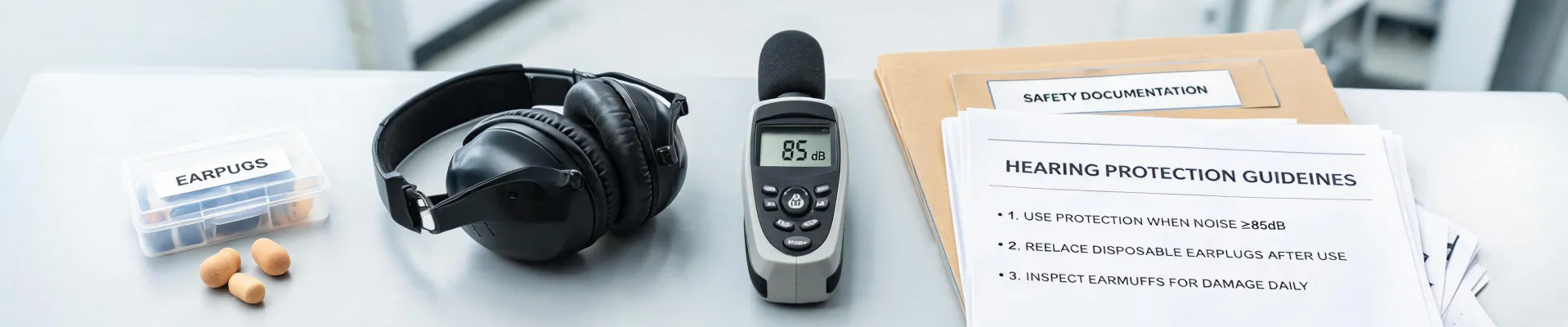
Here's the 10-second answer: If you need the maximum noise reduction rating in a foam earplug, Howard Leight Max earplugs with NRR 33 are as good as it gets—but that rating won't mean anything if you skip fit-testing and training. I learned that the hard way in 2019, when I spent $2,800 on a bulk order of earplugs that my crew refused to wear. This article is my Howard Leight Max earplugs review, the NRR 33 specifications I now check, and the checklist that's saved us at least $8,000 in potential rework since then.
Quick background: I handle PPE purchasing for a contracting company with around 60 field employees. I've been doing this for five years. I've personally made—and documented—four significant mistakes, totaling roughly $12,000 in wasted budget. That's not a flex. It's why I keep a detailed pre-order checklist and why I'm sharing it here. In my first year, I was the guy who looked at NRR numbers and thought the higher the better. Then I ordered 1,150 pairs—no, 1,250, I'm mixing it up with the second order—of a cheap generic plug and watched them sit in our storage room for six months. I'll never forget hitting submit on that order and thinking, maybe I should have ordered samples first. Yep, should have.
Howard Leight Max Earplugs NRR 33 Specifications
The basics, straight from the spec sheet:
- NRR: 33 dB (one of the highest foam earplug ratings available)
- Material: Slow-recovery polyurethane foam
- Shape: Bell-shaped, tapered design to fit most ear canals
- Options: Corded or uncorded
- Insertion: Roll-down, then gently pull the ear up and back
- Pack sizes: 200 pairs/box (uncorded), 100 pairs/box (corded)
That NRR 33 rating is tested under ANSI S3.19. And per FTC advertising guidelines, Howard Leight has to back up that claim with actual test data—you can find the full report in Honeywell's product documentation. But here's the part that surprised me: a lab rating of NRR 33 doesn't mean your workers are getting NRR 33 in the field.
Why the NRR 33 Rating Isn't the Whole Story
The most frustrating thing about hearing protection is this: if a plug isn't inserted correctly, the real-world attenuation can be dramatically lower than the box claims. You'd think that a higher NRR just does the job, but it doesn't work that way. I've seen measured fit-test results where the same NRR 33 plug only delivered 18-20 dB of protection because the person used the wrong insertion method.
That's not a knock on Howard Leight Max. It's true for every foam earplug on the market. The lesson is: don't choose a product purely based on specs. Choose a product you can train people to use properly. In my experience, Howard Leight Max works well because the bell shape makes it forgiving—workers can get a decent fit without wrestling with it. But you still have to train them.
The other surprise? Cost. The difference between the cheap plugs that failed and Howard Leight Max is only a few cents per pair. A $0.02 savings per pair was not worth the $2,800 disaster it caused.
My Howard Leight Max Earplugs Review After 10,000 Pairs
Since switching, we've gone through maybe 10,000 pairs. A few things I've noticed:
- Comfort is the #1 reason workers actually wear them. The slow-recovery foam is comfortable for a full shift. No one complains after hour six.
- Durability is fine for single-use and even a few re-uses if they stay clean, but we treat them as disposable.
- Training is still required. We do a quick 2-minute demonstration at onboarding and include a poster in the break room.
I can't speak to every earplug out there, because I don't have time to test them all. But I know what works in a real industrial environment, and this one works.
What About Eargasm Earplugs?
One employee asked if he could use Eargasm earplugs instead, because he liked them at concerts. I get it—Eargasm makes a decent product for music. But it's not designed for 8-hour industrial noise exposure, and it doesn't carry the same NRR rating our program relies on. So no, they stay on the not-for-work shelf.
Other PPE: Don't Forget the Rest of the Body
Hearing protection is one piece of the puzzle. A good safety program also includes solid footwear. We learned that after a few guys wore fashion boots that fell apart. After a trial period, our crew settled on Tecovas work boots for lighter tasks—they're comfortable, hold up well, and don't need much break-in. The same rule applies: let users try the gear before you buy a truckload.
Can You Carry Pepper Spray in NYC?
This isn't strictly a PPE question, but it comes up more often than you'd think in safety meetings. "Can you carry pepper spray in NYC?" The honest answer is: I'm not a lawyer, and the law changes. From a purchasing and policy standpoint, I'd say check NYPD regulations and New York State law, then get advice in writing from your legal team before issuing any self-defense item to employees. I keep our lawyer's one-page summary in the onboarding binder.
The Checklist That Saved Our Team (Prevention Beats Cure)
After three years and four mistakes, I built a 12-point checklist for any PPE purchase above $500. The core, in order:
- Get samples—one per person, not one per crew.
- Test them in the real work environment for at least a week.
- Provide a short fit-training session before you issue them.
- Collect feedback from at least five end users.
- Only then place the bulk order.
Five minutes of verification beats five days of correction. Since we started using this checklist, we've caught 47 potential issues and saved an estimated $8,000 in avoided rework. That includes order mistakes, wrong specs, and gear nobody wanted.
Boundaries: When This Review Doesn't Apply
One last boundary: this review comes from a buyer, not an audiologist. If your team has unusual ear anatomy or medical issues, bring in a professional. And if you need to hear speech or alarms, skip foam plugs entirely—look at electronic earmuffs. For most general industry noise, Howard Leight Max is solid. Just don't buy based on NRR alone. Buy based on fit, training, and follow-up.

Maeve Callahan
Maeve Callahan is a head-protection analyst covering Type I and Type II hard hats, climbing-style safety helmets, bump caps, chin straps, suspensions, liners, and face-shield carriers. She applies ANSI Z89.1, EN 397, and EN 12492 criteria while comparing impact attenuation, penetration resistance, lateral deformation, electrical class, retention strength, field of vision, mass, fit range, and temperature conditioning. Her guides help EHS teams, contractors, utilities, and buyers select helmet systems for overhead hazards, work at height, electrical exposure, accessory compatibility, and worker acceptance.