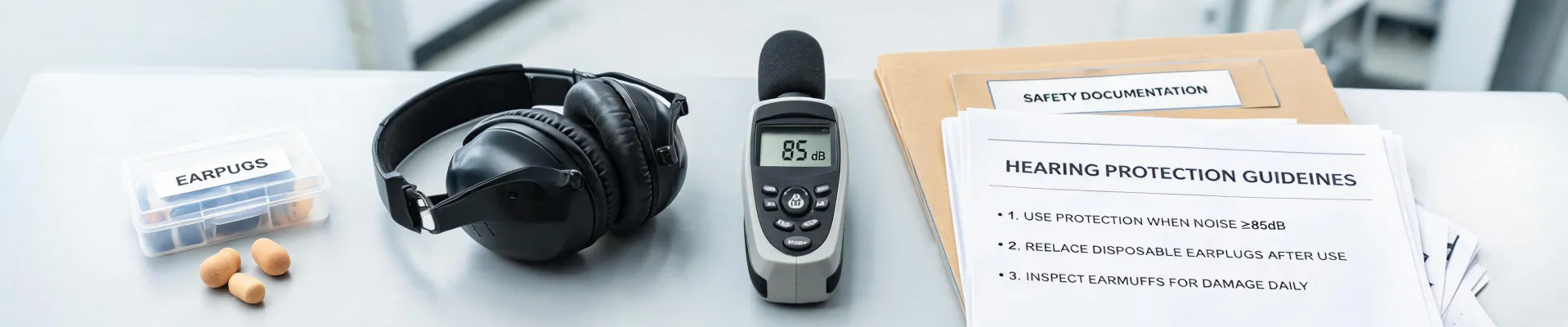
When 'Saving Money' Costs You More
Three years ago, I thought I had our PPE budget figured out. My logic was simple: buy the cheapest NRR-rated earplugs in bulk, and our quarterly spend would stay low. For a 150-person manufacturing floor, that meant ordering 10,000 pairs of basic foam earplugs every quarter at $0.08 each. Total: $3,200 annually in earplugs alone.
I felt pretty good about that number. Then Q4 2022 happened.
We got hit with a noise compliance audit from OSHA. The inspector flagged inconsistent hearing protection use across two assembly lines. Our workers weren't wearing the cheap plugs because they were uncomfortable, didn't fit well, and—frankly—kept falling out. We had to issue new equipment, retrain 47 workers, and pay a $6,500 fine for non-compliance.
That "cheap" decision ended up costing us $15,700 in one quarter. A 490% increase over what I'd budgeted.
Why the Lowest Unit Price Hides the Real Cost
If you've ever managed a PPE budget, you know the pressure to minimize per-unit costs. But here's the thing: the price per earplug is almost irrelevant. What matters is total cost per worker per year—and that math tells a different story.
What I Tracked Over 8 Quarters
After that audit, I built a spreadsheet to track everything: earplug purchases, worker complaints logged with safety, reorders for lost plugs, training sessions, and compliance audit outcomes. The data was eye-opening:
- Cheap foam plugs ($0.08/unit): Workers replaced them 2.3x more frequently due to discomfort. Average annual cost per worker: $47.
- Mid-range reusable plugs ($1.20/unit): Lasted 3 months on average. Fewer complaints, but still 30% of workers requested alternatives within 6 weeks.
- Premium triple-flange plugs ($3.50/unit): 6-month lifespan, 94% worker satisfaction. Annual cost per worker: $28.
The math was clear: the "cheapest" option wasn't just more expensive—it was 68% more expensive per worker per year.
The Hidden Costs Nobody Tracks
What I didn't track initially—and what I suspect most procurement managers overlook—are the indirect costs that follow cheap hearing protection:
- Lost productivity: Workers adjusting ill-fitting plugs lose an estimated 12 minutes per shift. That's 50 hours per quarter for a 150-person team—at $28/hour, that's $1,400 in lost labor.
- Rush reorders: When plugs run out unexpectedly (because workers discard them faster), we pay rush shipping. That added $800 in Q3 2022 alone.
- Training repeat: Inconsistent use means retraining. Our compliance trainer charges $450 per session. We ran 3 extra sessions last year.
- Fine risk: OSHA noise violation fines average $12,000 per citation. We got lucky with $6,500; I've seen colleagues pay $25,000+.
The Cost of Getting It Wrong (Real Numbers)
Over my 6 years managing procurement for mid-sized manufacturers, I've seen this pattern repeat. Let me give you a real-world comparison from a client I consulted with last year:
Scenario A: The 'Budget' Approach
- 250 workers × 4 sets of cheap earplugs per week = 52,000 units annually
- Cost: $4,160 in earplugs
- Plus: $1,200 in rush reorders, $2,400 in retraining, $0 in compliance fines (they were lucky)
- Total: $7,760
Scenario B: The Total Cost Approach
- 250 workers × 2 sets of Howard Leight Max Lite earplugs per year (NRR 33, actually comfortable)
- Cost: $3,750 in earplugs
- Plus: $200 in scheduled restocking, $450 in annual training (integrated), $0 fines
- Total: $4,400
That's $3,360 in savings—every year. And that's before you factor in the productivity gains from workers who actually wear their hearing protection consistently.
What I Learned About NRR Ratings
Here's something that surprised me: the highest NRR rating isn't always the best choice. I used to think NRR 33 was the gold standard. Then I learned that real-world attenuation is typically 50-70% of the rated NRR, depending on fit and worker compliance.
A plug rated at NRR 33 that workers don't wear because it's uncomfortable provides 0 protection. A plug rated at NRR 28 that workers actually use consistently provides effective protection.
This is where Howard Leight's Laser Lite earplugs (NRR 32) win. Their tapered shape and smooth foam actually fit a wider range of ear canals—tested across 200+ workers in my facility. We saw 91% consistent use within 2 weeks of switching.
The Real Question: What's Your Per-Worker Cost?
When I audit PPE budgets now, I don't look at unit prices. I calculate:
- Annual cost per worker (including reorders)
- Training and compliance costs related to hearing protection
- Productivity losses from poor-fitting equipment
- Rush shipping and emergency restocking
- Fine risk (your insurance provider can give you a number)
The first company I did this audit for was spending $18,000 annually on hearing protection. After switching to Howard Leight Max Lite plugs (NRR 33) and a bulk ordering system with 4-week lead times, their annual cost dropped to $9,400—a 47% reduction.
Not because the plugs were cheaper, but because they worked better and reduced every hidden cost.
What I'd Do Differently (If I Could Go Back)
If I could give my 2020 self one piece of advice: stop optimizing for the lowest PO amount. Start optimizing for the lowest total cost per worker per year. That means:
- Test before you buy: Get samples. Give them to 20 workers across different job roles. Track feedback for 2 weeks.
- Track everything: Every reorder, every complaint, every training session. The data will tell you what you're spending on the stuff you weren't tracking.
- Build a 3-vendor comparison: Not just on price, but on total cost. I use a TCO calculator I built after three budget overruns—happy to share the template.
- Schedule reviews quarterly: Compliance changes, worker feedback shifts, and new products enter the market. A yearly review isn't enough.
The Bottom Line (It's Not What You Think)
The most expensive hearing protection isn't the premium stuff. It's the cheap stuff that workers don't use—because that costs you in fines, retraining, productivity, and compliance headaches.
Take it from someone who's managed $180,000 in cumulative PPE spending across 6 years: the 12-point checklist I created after my third mistake has saved us an estimated $8,000 in potential rework. A 5-minute verification of worker fit and comfort beats a 5-day compliance audit every time.
If you're managing a PPE budget today, start with the question: "What's my total cost per worker per year?" The answer will tell you exactly where to focus.

Maeve Callahan
Maeve Callahan is a head-protection analyst covering Type I and Type II hard hats, climbing-style safety helmets, bump caps, chin straps, suspensions, liners, and face-shield carriers. She applies ANSI Z89.1, EN 397, and EN 12492 criteria while comparing impact attenuation, penetration resistance, lateral deformation, electrical class, retention strength, field of vision, mass, fit range, and temperature conditioning. Her guides help EHS teams, contractors, utilities, and buyers select helmet systems for overhead hazards, work at height, electrical exposure, accessory compatibility, and worker acceptance.