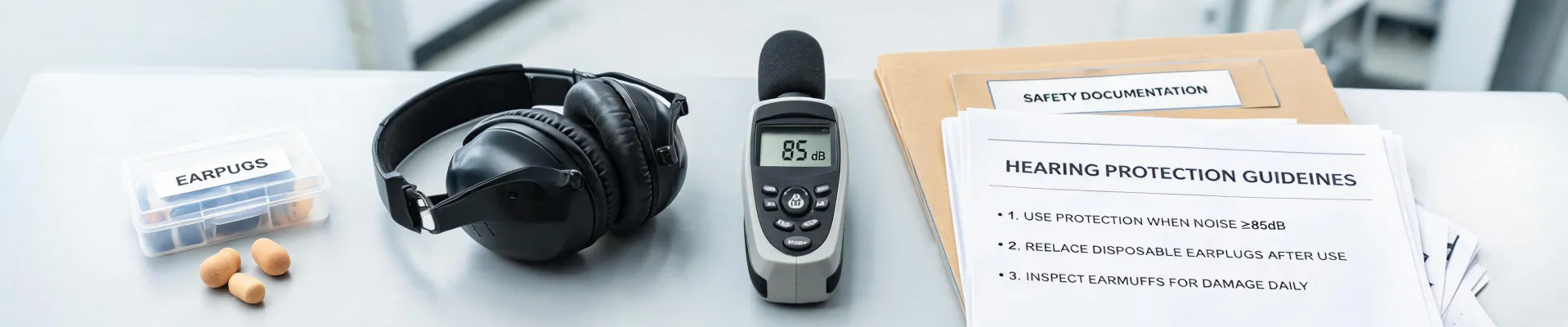
I still kick myself for that $890 mistake. The order was for 2,000 units of Howard Leight Max earplugs – the uncorded version. We needed NRR 33, and we got it. But the packaging was wrong. Every single unit.
The Problem You Think You Have: Price vs. The Real Headache
When you're buying earplugs for a plant, especially something as specific as Howard Leight Max with NRR 33, the conversation always starts the same way. The safety manager talks about protection levels. The procurement manager talks about price. The operations manager talks about supply. Everyone has a pain point.
But the real problem? It’s rarely the product. It’s the acquisition. And the hidden costs that pile up before those earplugs ever reach a worker's ear.
I’ve handled PPE orders in an industrial setting for close to six years. I’ve personally made (and documented) about twelve significant procurement blunders, totaling roughly $7,500 in wasted budget. This is the story of one of them. And the checklist I use now to keep it from happening again.
The Deep Cause: Why You're Not Asking the Right Questions
The problem isn't that Howard Leight Max earplugs aren't good. They are. The problem is that we treat them like a commodity, not a component of a safety system.
You look at the spec sheet: NRR 33. That’s the best in the industry for a foam earplug. You check the price: $0.12 per pair vs. $0.15 from another vendor. Easy decision, right?
Wrong.
When I bought 2,000 units of the corded version instead of the uncorded for a specific clean-room environment—because the cord was a contamination risk—that $0.03 per pair difference turned into a $60 product cost. But the re-order, the express shipping, and the verification testing cost us $890. Plus a one-week delay. Suddenly, the 'cheaper' option was way more expensive.
The Hidden Variables You're Ignoring
- Packaging and distribution: Individually wrapped vs. bulk? Does the packaging need to be anti-static?
- Regulatory fit: Is this exact model approved for your industry? (e.g., for food processing, you might need metal-detectable earplugs).
- Worker acceptance: A higher NRR doesn’t mean better protection if workers won’t wear them.
- Vendor reliability: Are they hitting lead times? Or are you burning hours chasing down backorders?
The most frustrating part? You don't realize these are problems until they cost you money. You'd think a spec sheet would be enough, but interpretation varies wildly between suppliers and applications.
The Cost of Ignoring the Full Equation
Let’s be specific about my $890 mistake.
It wasn't just the earplugs. It was the cost of fixing the mistake:
- Product cost: $240 for 2,000 units of corded Howard Leight Max.
- Rework (buying the right ones): $270 for 2,000 uncorded units + expedited shipping ($50).
- Testing delay: The plant had to halt a certain process for a day because they couldn't provide the specified PPE. Lost productivity: $330 (guesstimate based on 4 workers x $20/hour x 8 hours).
- Administrative overhead: My time tracking down the mistake, fighting with the supplier (who refused a return because the packaging was opened), and re-processing the PO. I value my time at about $50/hour. I spent six hours. That's $300.
Total: $890. For a $0.12 product. That’s insane.
After the third rejection in Q1 2024 for a similar issue (wrong SKU on a large order), I created our pre-check list. We have caught 47 potential errors using this checklist in the past 18 months. Simple.
The Solution: A Total Cost of Ownership (TCO) Framework
I now calculate TCO before comparing any vendor quotes.
The $500 quote turned into $800 after shipping, setup, and revision fees. The $650 all-inclusive quote was actually cheaper.
Here’s my simple framework for hearing protection PPE—specifically for something like Howard Leight Max earplugs with NRR 33:
Step 1: Use a Simple TCO Calculation
Get a quote that includes unit price + shipping + any handling/customs fees + expected lead time (in days). I multiply the lead time by a standard daily cost of delay (like $X per day for your operation).
Step 2: Ask the Specific Questions
- “Is this the specific Howard Leight Max model (NRR 33) or a different variant?”
- “Corded vs. uncorded?” – This is the single biggest hidden variable. I once ordered corded for a welding area (bad idea, heat risk).
- “What is the actual lead time for this volume?” Not the standard lead time. The your-order lead time.
Step 3: The “What If” Check
“What if it’s wrong? What’s your return policy? Is there a restocking fee?” If the answer is “no returns,” factor that risk into the TCO.
That’s it. It’s not a complex system. But it’s the difference between a $240 order and a $890 mistake.
Bottom Line
Stop buying hearing protection by the unit price. Start buying by the total cost of ownership. Your budget—and your sanity—will thank you.
Based on my own procurement experience as of January 2025.

Maeve Callahan
Maeve Callahan is a head-protection analyst covering Type I and Type II hard hats, climbing-style safety helmets, bump caps, chin straps, suspensions, liners, and face-shield carriers. She applies ANSI Z89.1, EN 397, and EN 12492 criteria while comparing impact attenuation, penetration resistance, lateral deformation, electrical class, retention strength, field of vision, mass, fit range, and temperature conditioning. Her guides help EHS teams, contractors, utilities, and buyers select helmet systems for overhead hazards, work at height, electrical exposure, accessory compatibility, and worker acceptance.