I made a classic purchasing mistake last spring, and it cost us around $2,400.
A department manager sent a safety request that read less like a work order and more like a keyword list: Howard Leight earmuffs, fall protection around the mezzanine, fire extinguisher recharge at both locations, and a pallet fence near the racking. He had done genuine research. But when I forwarded that list to a supplier for a quote, the reply asked a better question:
What problem are you actually solving?I didn't have a strong answer.
Background: I'm the office administrator for a 260-person logistics company. I manage vendor relationships for roughly $180,000 in annual purchasing, and I report to both operations and finance. That means I'm judged partly on price and partly on whether the safety items people requested actually get used. It is not the same as ordering printer toner.
Here is the thing I learned after a few years: there is no universal safety inventory. There is no single answer to “what safety gear should I buy?” There is only an answer to “what condition is my facility in?” If I search for Howard Leight earmuffs and “fire extinguisher recharge near me” in the same month, that usually means we have two separate problems, not one shopping list.
I have started sorting every safety request into three scenarios:
- Noise is the problem.
- Height, racking, or falling loads are the problem.
- Fire extinguishers have no current maintenance history.
Here is how each one plays out when I actually buy equipment.
1. Earmuffs Howard Leight Impact Sport: Match the Hearing Protection to the Noise
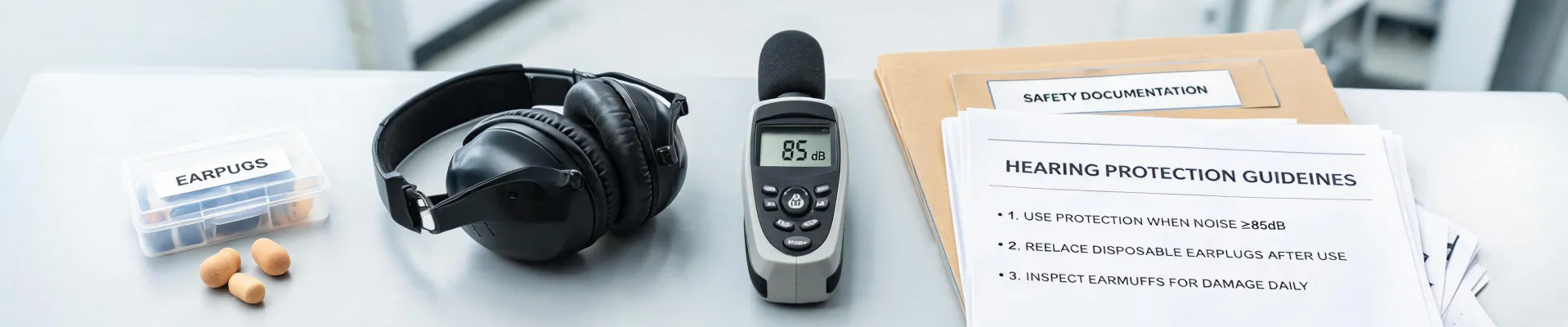
If someone on your floor searches for “earmuffs howard leight impact sport,” they are probably dealing with intermittent noise: a bang from a metal cart, an air hose, a forklift horn. It is not the steady thrum of an engine room. On our packaging floor, the noise comes and goes. People need to hear one another over radios and hear the forklift approaching.
The Howard Leight Impact Sport is an electronic earmuff. It amplifies normal sounds like voices while compressing sudden loud peaks. That feature made it popular with our floor team. I used to believe that “maximum NRR” was always the right answer. I have changed my mind. If a worker cannot hear warning sounds, they will lift the earmuffs for a few seconds more often than they admit. At that point, even the best protection spec is worthless.
People assume better protection means more noise reduction. Actually, the goal is to bring the exposure down to a safe range, not to make the workplace silent. Foam earplugs like Howard Leight Max have an NRR 33 rating and block more noise than most earmuffs. They make sense for continuous high-level noise where communication is not critical. For mixed noise where you need conversation, an electronic muff with a lower NRR can be the safer choice because workers wear it longer. The right purchase depends on the task, not on the highest number on the box.
In 2024, we did a simple noise survey with a rented meter and 30 minutes of fit-testing. That helped more than any catalog order. The mix we ended up with was not glamorous: electronic muffs for operators moving around the floor, regular earmuffs for short shredding tasks, and foam plugs for maintenance crews working near the compressor.
2. What Are Fall Protection Measures? Start with Barriers, Not Just Harnesses
The question “what are fall protection measures?” usually comes up when someone looks at a mezzanine edge or tall racking and realizes a fall is possible. The answer is broader than people think.
Fall protection has three layers:
- Engineering controls: guardrails, safety gates, toe boards, hole covers, and fixed barriers.
- Administrative controls: warning lines, training, permits, and clear procedures.
- Personal fall arrest: a harness, lanyard, and anchor point for tasks where the first two layers cannot work.
Most buyers jump straight to layer three because it is easy to add to a cart. But in our warehouse, the real risk was not a person falling from a platform while working. It was loads sliding off racking or a forklift knocking a pallet loose. A harness would have stayed in its bag and done nothing.
Here is where the keyword “pallet fence” belongs. Pallet fence is not a formal OSHA term; it is a practical name for protective railing around pallet racking and pallet drop areas. A supplier may call it a pallet rack guard, protective railing, or safety gate. The purpose is simple: stop a forklift from hitting the racking base, stop loads from shifting past an edge, and keep pedestrians away from an open drop. If the search term includes “pallet fence,” the buyer probably already knows they need a barrier, not a fall arrest kit.
My own lesson came from asking a general supplier for fall protection equipment and receiving a quote for a harness with a 6-foot lanyard. The supplier searched the phrase, found a harness, and sent a price. It was the wrong response for a mezzanine edge. The correct fix was a swing gate and a fixed steel rail. That is when I stopped ordering from a list and started asking a specialist to walk the area. The specialist could tell me we didn't need another harness. A good safety vendor says “this is not the right product for that hazard” out loud.
3. Fire Extinguisher Recharge Near Me: It Is Maintenance, Not a Quick Purchase
When you search “fire extinguisher recharge near me,” something specific is usually happening: an inspector flagged a unit, the gauge reads empty, or someone used it and put it back on the hook. Recharging requires a licensed local shop because the extinguisher needs to be emptied, inspected, refilled, and pressure-tested before it returns to service. You cannot solve that with a normal purchase order.
I learned this the hard way in 2023. We found one extinguisher with a missing service tag and no record of its last maintenance. Our usual vendor did not do recharge work, so I googled the service phrase and picked the first nearby result. It turned out the shop was certified, but they were two weeks out because of a backlog. Our fire inspection was coming up, so I paid an extra rush fee. Having a pre-identified service vendor would have saved money and anxiety. Now, I keep the recharge contact in our vendor list before we need it.
The assumption is that a fire extinguisher is either full or empty. The reality is more subtle. Dry chemical can pack down, seals can fail, hoses can block, and the gauge can still look fine. NFPA 10 calls for monthly visual checks and an annual maintenance check by a certified technician. Those dates matter. Do not just look at the gauge needle.
When you call about “fire extinguisher recharge near me,” ask two questions before sending money: are you a licensed fire equipment service company, and will the service be recorded on a tag with paperwork? If the answer is no to either, keep looking.
How Do You Know Which Scenario Applies to Your Facility?
Use your own building as the guide.
- If people shout to be heard more than a few minutes every hour, treat it as a hearing scenario. Get a noise survey and choose hearing protection for actual exposure.
- If any edge, mezzanine opening, or racking aisle has a drop or falling-load risk, treat it as a fall protection scenario. Install barriers and gates before buying harnesses.
- If you cannot prove when every fire extinguisher was last serviced, treat it as a maintenance scenario. Find certified local service before an audit does it for you.
My own search history in an average month includes earmuffs, fall protection, and fire extinguisher service. Instead of one safety superstore, I use a few specialists. For hearing protection, we buy from Howard Leight because the range includes basic foam plugs, conventional earmuffs, and electronic models like the Impact Sport. For fall protection and fire extinguisher service, I use vendors who can inspect the site and tell me what is overkill and what is missing.
That approach is not about brand loyalty; it's about expertise. I would rather work with a specialist that knows the limits of its product than a supplier that promises one pallet of equipment will fix every risk. Safety gear is not a shopping list. It is a set of decisions, and each one starts with the same question: what is the actual hazard in my facility, and what will people actually use?

Maeve Callahan
Maeve Callahan is a head-protection analyst covering Type I and Type II hard hats, climbing-style safety helmets, bump caps, chin straps, suspensions, liners, and face-shield carriers. She applies ANSI Z89.1, EN 397, and EN 12492 criteria while comparing impact attenuation, penetration resistance, lateral deformation, electrical class, retention strength, field of vision, mass, fit range, and temperature conditioning. Her guides help EHS teams, contractors, utilities, and buyers select helmet systems for overhead hazards, work at height, electrical exposure, accessory compatibility, and worker acceptance.