-
The claim that turned a spreadsheet problem into a safety problem
-
Howard Leight foam earplugs: what the NRR label does and doesn't tell you
-
Hard hats change the math: Howard Leight Impact Sport earmuffs and a KASK hard hat
-
The boring layer: tracking earplugs before they expire
-
Still think this is overkill for a cheap earplug?
Three years ago, if you had told me I would block a purchase order for a box of foam earplugs, I would have said you were confusing me with the safety department. I was procurement. My job was to make sure we had the right PPE in stock at the right price. That job description changed in March 2023, after a customer's employee filed a hearing-loss claim and our name came up in the audit trail.
I coordinate PPE purchasing for a mid-sized industrial workwear outfitter on the U.S. Gulf Coast. Since 2020 I've placed roughly $1.2 million in PPE orders — respirators, coveralls, gloves, hard hats, and hundreds of cases of hearing protection. I'm not an audiologist, and I'm not going to pretend to be one here. I'm the person who signs the purchase orders, and I've learned, the expensive way, that buying hearing protection without a real process is a liability.
Foam earplugs are some of the cheapest safety products on the market, but they fail more often than almost anything else we stock — because they are treated like office supplies instead of personal safety devices.
The claim that turned a spreadsheet problem into a safety problem
The claim involved a 47-year-old fitter who wore earplugs every day. He wore the yellow foam ones. Howard Leight foam earplugs, actually — the NRR 33 model we had supplied to that site for years. When the safety director reviewed the incident, the photos told an uncomfortable story: the earplugs were visibly sticking out of his ears. He had been inserting them wrong for years. Nobody had ever checked.
The company didn't dispute that hearing protection had been available. What they couldn't prove was that the fitter was using it correctly. The claim settled. I don't know the final number, and it's not my place to share it, but between the settlement, the legal fees, and the OSHA follow-up, it was well into six figures. Then they looked at us. We were the ones who had supplied the earplugs and called it a complete solution.
We lost that account. Not overnight — they gave us 90 days to transition. The recurring PPE volume was worth roughly $14,000 a year. That's the $14,000 in the headline. It could have been worse.
Howard Leight foam earplugs: what the NRR label does and doesn't tell you
An NRR of 33 on Howard Leight foam earplugs is an excellent starting point. But that number comes from laboratory conditions with trained test subjects, not from a tired fitter rolling a plug between his fingers in a parking lot at 6 a.m. In real use, the protection you get depends almost entirely on insertion technique.
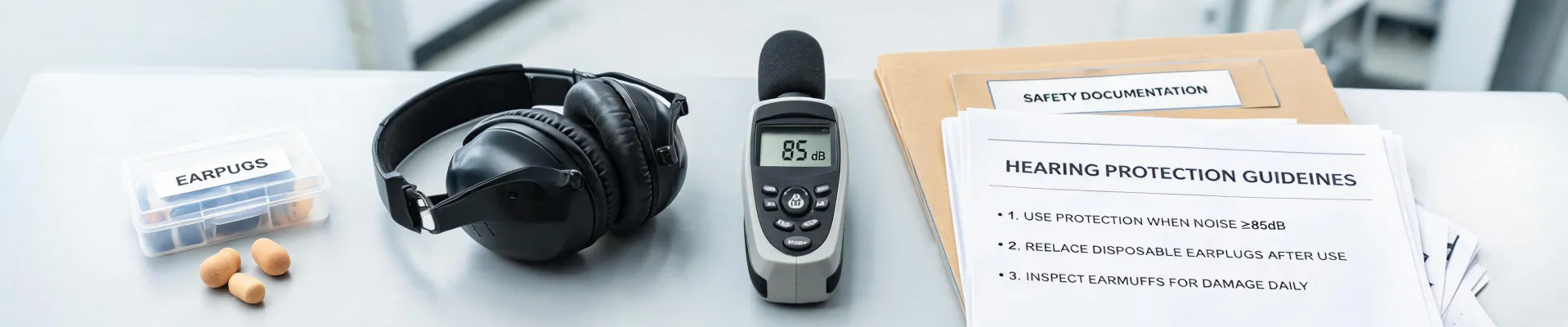
OSHA's noise standard (29 CFR 1910.95) kicks in when exposures reach 85 dBA over an 8-hour TWA. At that level, the employer has to run a hearing conservation program: noise monitoring, audiometric testing, training, and hearing protection made available at no cost. Too many sites interpret that last part as "put a box of earplugs next to the time clock." That's not a program. That's a suggestion.
In late 2023, we bought a small earplug fit-test system and started measuring how our guys actually wore plugs. The first afternoon was humbling. Out of 29 workers who all said they wore foam earplugs regularly, eight tested well below what I would consider acceptable, and a couple were getting almost no measurable protection. These were not careless people. They had simply never been shown how to roll, insert, and hold a plug long enough for it to expand. A 15-minute training session fixed most of them on the spot.
Now we have one rule for Howard Leight foam earplugs: no worker gets a box until they've done a hands-on fitting and their technique has been verified. It takes minutes, and it has already caught more problems than every product spec sheet we've ever filed.
Hard hats change the math: Howard Leight Impact Sport earmuffs and a KASK hard hat
Compatibility is another blind spot that cost us time and credibility. Take the Howard Leight Impact Sport electronic earmuffs we supply for grinding crews. Those are genuinely good earmuffs — they have directional microphones, so a worker can hear a crane signal or a coworker's warning while still getting protection from impulse noise. But earmuffs don't exist in a vacuum. They have to fit around whatever else the worker is wearing.
In early 2024, a customer asked us to put together kits for an elevated maintenance crew. The crew was required to wear KASK hard hats because they were lighter and more comfortable on long overhead work — the workers actually kept them on, which is half the battle with head protection. The same crew needed hearing protection, so we sent Howard Leight Impact Sport earmuffs. On paper, it looked like premium gear all around. In practice, it failed.
The problem showed up within the first week. The KASK hard hat had a chin strap requirement on that job, and the chin strap routed right under the earmuff cushions, breaking the seal every time the worker moved his head. A couple of guys came back with red marks on their ears from cranking the muffs tighter to compensate. We pulled the Impact Sport units from that crew and switched them to Howard Leight foam earplugs under the KASK hard hat, which solved the fit issue for that particular task. The earmuffs stayed on the ground crew, where workers weren't wearing chin-strapped helmets.
That experience is now a permanent part of our checklist. We physically test every earmuff-and-hard-hat combination we offer, and we document which combinations work. It sounds obvious in hindsight, but I would bet most workwear outfitters have never done it.
The boring layer: tracking earplugs before they expire
The least glamorous fix was digital, and it may have saved us the most money. Hearing protection used to be a bulk bin item for us. We ordered cases, shipped them to sites, and forgot about them. Nobody knew what was actually issued, to whom, or when the stock had been manufactured.
In January 2024, during a warehouse cleanup, we found a back corner with 14 boxes of foam earplugs from a 2019 lot. They looked fine. Foam earplugs have a shelf life, though — the polyurethane stiffens over time, and the attenuation you get from a hardened plug is not the attenuation printed on the box. That entire lot should have been rotated out years earlier.
(Mental note: I still have to remind myself that a product with no moving parts can expire. Nobody taught me that in procurement training.)
Now every case is date-stamped when it arrives, and our inventory system automatically blocks issue after four years from the manufacture date. Every worker gets individually bagged plugs with their name on the bag, so we know what was issued and when. On the record-keeping side, the fit-test results and issue dates live in the same system. When a customer's safety manager asks for documentation, we can produce it in five minutes instead of apologizing for a binder we meant to update.
To be fair, that level of tracking is not necessary for every site. If you have three employees and your noise monitoring stays below 85 dBA, you might not need any of this. But once you're operating under OSHA's hearing conservation requirements, the box-on-the-time-clock approach stops being harmless. It becomes an audit finding waiting to happen.
Still think this is overkill for a cheap earplug?
I get the pushback. A single foam earplug costs pennies. Fit testing, training, lot tracking, and compatibility checks sound like bureaucracy designed by someone who has never had to run a real job site.
Here's the counterpoint: the per-unit cost was never the problem. The problem is that hearing loss is permanent, claims are expensive, and no purchase order can undo a bad fit. If a 15-minute training session and a fit test are too expensive for your program, wait until you see the cost of a six-figure settlement for something that was entirely preventable.
We still buy Howard Leight foam earplugs. We still stock Howard Leight Impact Sport earmuffs. The brand was never the issue. What changed is how we treat them: as engineered safety devices that have to fit a specific person, work with a specific hard hat, and be tracked until the moment they're used.
It took three years, one claim, and a lost account for me to understand that. So if you're a safety manager or a buyer and someone tries to sell you hearing protection as a commodity item, question it. And if you're a workwear outfitters sales rep reading this — please start testing your earmuff-and-hard-hat combinations before you put them in the catalog.
Maeve Callahan
Maeve Callahan is a head-protection analyst covering Type I and Type II hard hats, climbing-style safety helmets, bump caps, chin straps, suspensions, liners, and face-shield carriers. She applies ANSI Z89.1, EN 397, and EN 12492 criteria while comparing impact attenuation, penetration resistance, lateral deformation, electrical class, retention strength, field of vision, mass, fit range, and temperature conditioning. Her guides help EHS teams, contractors, utilities, and buyers select helmet systems for overhead hazards, work at height, electrical exposure, accessory compatibility, and worker acceptance.