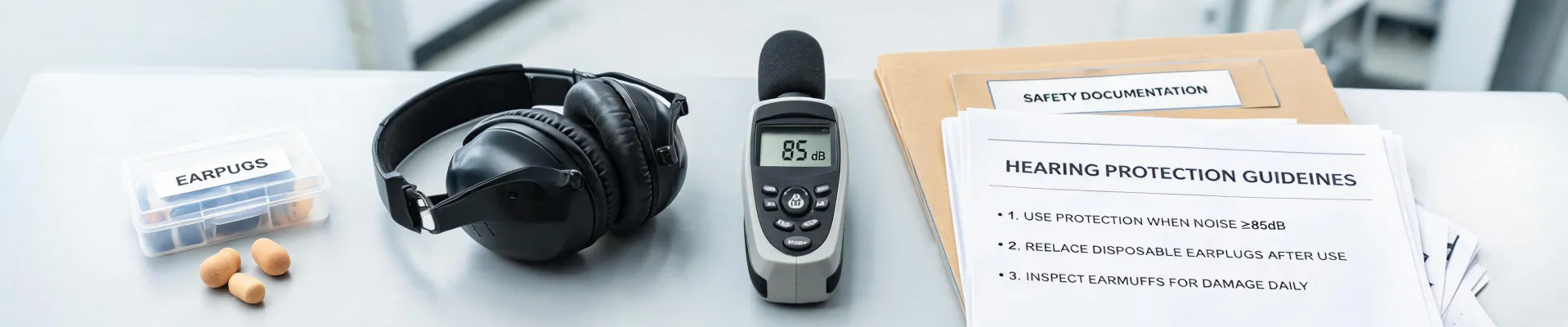
Why This Comparison Exists
I coordinate PPE supply for construction and maintenance contractors, and I've handled more than 200 urgent hearing-protection orders over the past four years. A surprising number of those calls are not about missed deliveries. They are about teams that standardize on Honeywell Howard Leight Lite earplugs or Howard Leight Max-1 earplugs NRR 33 without first checking which plug fits their workers.
That issue shows up a lot in fence and railing installation. Cutting black aluminum fence panels to length, grinding aluminum posts, and drilling anchors for a glass deck railing can all create the kind of noise that slowly damages hearing. OSHA's hearing conservation threshold is an eight-hour average exposure of 85 dBA. That is not a high bar. A miter saw or hammer drill can easily cross it during a normal workday.
Here's the thing I had to learn the hard way: a higher NRR number is not always the safer choice.
What I Compare Before Recommending an Earplug
I'm not going to pretend one Howard Leight product is universally better than the other. Hearing protection is too personal for that. Instead, I compare four practical dimensions: rated attenuation, comfort and fit, visibility, and whether workers will actually keep the earplugs in.
1. Attenuation: Max-1 at NRR 33 vs. Lite at NRR 32
Let's get the spec question out of the way.
The Howard Leight Max-1 earplug carries an NRR 33 rating. The Honeywell Howard Leight Lite earplug carries an NRR 32 rating. On the decibel scale, that is a one-decibel difference. That is close to the smallest change most people can notice. In a controlled lab, one model attenuates slightly more. In a real ear, the difference between a good seal and a poor seal is much bigger than one decibel.
If you're picking Max-1 only because NRR 33 is a bigger number, you may be overestimating the label and underestimating the real risk: bad insertion or no insertion at all.
Dimension verdict: There is no practical safety advantage to NRR 33 over NRR 32 in most field situations. Both are high-performance foam earplugs.
2. Fit and Comfort: Max-1 vs. Lite
The Lite is the lower-pressure model. It tends to work better for people with smaller or more sensitive ear canals, and for long days when an earplug starts to feel heavy or sore. The Max-1 has more foam and a firmer expansion. That makes it the right shape for some ear canals and the wrong shape for others.
I've seen experienced workers struggle with Max-1 because it felt too tight after an hour. I've also seen workers say the Lite felt like it was not sealing securely, even though its NRR 32 rating says it protects.
This is why I never recommend buying a full case from a spec sheet alone. Have a few workers roll the earplugs, insert them, hold them for 30 seconds, and then wear them while doing an actual task. That test tells you more than any product page.
Dimension verdict: Lite is usually the better starting point for all-day comfort and smaller ear canals. Max-1 makes more sense when it fits better and workers prefer a more substantial plug.
3. Visibility and Compliance
Max-1 is the high-visibility model in the Howard Leight lineup. If you walk a jobsite with an inspector, that orange color is easy to spot from a distance. That helps answer a simple question: are your people actually wearing hearing protection?
Lite is less visually assertive. That can be an advantage on a residential deck or fence project where workers do not want to look like they are wearing heavy industrial gear. But if your safety program depends on visual checks, the high-visibility Max-1 gives supervisors more confidence.
Dimension verdict: For visible compliance, Max-1 has the edge. For discretion, Lite has the edge. Neither one protects ears while sitting in a pocket.
4. Real-World Field Conditions: Black Aluminum Fence and Glass Deck Railing Work
I keep mentioning black aluminum fence and glass deck railing because those installations create exactly the noise pattern that hurts hearing over time.
Think about a miter saw cutting aluminum rails to length. Then think about a hammer drill mounting glass railing posts to concrete. The noise is not constant like a factory. It comes in loud bursts throughout the day. Workers treat those bursts as quick interruptions, not as a serious exposure. That mindset is dangerous.
In those conditions, the best earplug is the one that is in the ear when the saw starts. If a plug is uncomfortable, it ends up on a truck seat or behind a hard hat within twenty minutes. That is the whole problem in one sentence.
Dimension verdict: Field noise alone does not force a choice between Lite and Max-1. The real requirement is consistent use, and that is a fit issue, not just a rating issue.
A Rush Order That Changed How I Talk to Buyers
Last spring, a contractor called me late in the day. They had an early start the next morning on a fence project, and the Max-1 earplugs they had picked up locally were causing pain. Several crew members had smaller ear canals. They kept pulling the earplugs out between cuts, which is exactly how hearing damage starts.
We sent a small box of Lite earplugs out for next-morning delivery and paid extra freight to make it happen. The alternative was a crew working without usable hearing protection. The superintendent later told me the fit complaints went away. A lower-rated plug solved a problem that NRR 33 could not.
I tell that story not to say Lite is better than Max-1. I tell it because it shows why the right answer changes from one crew to another.
My Buying Recommendation, With Limits
If someone asks me whether to buy Honeywell Howard Leight Lite earplugs or Howard Leight Max-1 earplugs NRR 33, I say this:
- Order sample quantities of both before buying full cases.
- Choose Lite when workers have smaller ear canals, long shifts, comfort complaints, or a pattern of removing earplugs during breaks.
- Choose Max-1 when fit testing shows a better seal, when visibility during inspections matters, or when a project spec calls for NRR 33.
- Do not choose Max-1 only because the number is higher. If workers cannot tolerate it all day, you are buying protection they will not wear.
Are there situations where neither plug is enough? Yes. Around very high impact noise or certain impulse noise, you might need double protection or an over-ear muff. The honest limit of this comparison is simple: it covers two disposable foam earplugs, not your entire hearing conservation program.
If you are tempted to buy on price per pair alone, keep this in mind: an unused earplug is more expensive than a slightly pricier one that actually gets worn.
One More Thing: No Drink Replaces Hearing Protection
When the conversation shifts to heat stress, someone usually asks, 'is BodyArmor drink good for you?' That question belongs to sports nutrition, not PPE, so I will not give a nutrition review here. What I can tell you from the safety side is clear: hydration does not protect hearing.
BodyArmor, water, electrolytes, none of it changes what a chop saw does to an unprotected ear. On a hot glass deck railing job, you need water in one hand and earplugs in the other. The hydration conversation is important, but it is not a substitute for a hearing protection conversation.
Bottom Line
Honeywell Howard Leight Lite earplugs and Howard Leight Max-1 earplugs NRR 33 are both solid choices for loud construction work around black aluminum fence, glass deck railing, and similar installations. The right option depends on the ears you are protecting.
My rule now is straightforward: compare the real fit before you compare the rating. A Max-1 that fits is excellent. A Lite that fits is excellent. An earplug that ends up in a pocket is just a piece of foam.

Maeve Callahan
Maeve Callahan is a head-protection analyst covering Type I and Type II hard hats, climbing-style safety helmets, bump caps, chin straps, suspensions, liners, and face-shield carriers. She applies ANSI Z89.1, EN 397, and EN 12492 criteria while comparing impact attenuation, penetration resistance, lateral deformation, electrical class, retention strength, field of vision, mass, fit range, and temperature conditioning. Her guides help EHS teams, contractors, utilities, and buyers select helmet systems for overhead hazards, work at height, electrical exposure, accessory compatibility, and worker acceptance.