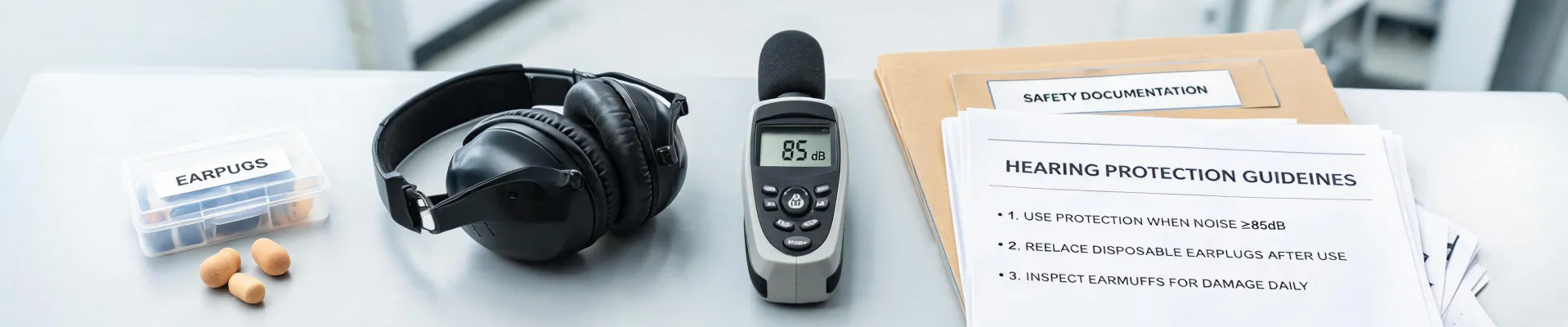
If you've ever stared at a shelf of hearing protection options and wondered which one actually fits your needs, you're not alone. I've been reviewing PPE specifications for over 4 years now—roughly 200+ unique items annually—and I can tell you this: there's no single "best" earplug. It depends entirely on your situation.
Let's break it down into three common scenarios. Find yours.
Scenario 1: Maximum Noise Reduction — The Extreme Environment
You're in a setting where noise levels consistently hit 100 dB or higher. Think metal stamping, engine testing, or heavy construction zones. In these environments, you don't just want protection—you need every decibel you can get.
For this scenario, I recommend the Howard Leight Max 1 Earplugs (NRR 33). With a Noise Reduction Rating of 33 dB, these are among the highest-rated earplugs on the market. I've seen them used effectively in environments that would otherwise cause irreversible hearing damage within minutes.
But here's the trick: NRR 33 is only achievable if they're inserted correctly. I can't tell you how many times I've seen workers with earplugs barely sitting in their ear canals. The foam needs to be rolled into a thin cylinder, inserted deep, and held until it expands. It takes about 30 seconds to do properly. Skipping that step effectively reduces your protection by 10-15 dB.
In our Q1 2024 quality audit of a metal fabrication facility, we found that improper insertion was the #1 cause of failed noise exposure tests. We ran a 15-minute training session, and compliance—and protection—went up significantly.
"I only believed the NRR 33 rating after ignoring the insertion instructions once and getting noise exposure above the limit. The foam didn't seal, and my 15-minute exposure was equivalent to hours of unprotected noise."
That was a lesson I won't forget.
Scenario 2: Situational Awareness — The "Need to Hear" Environment
Now imagine a different scenario: you're in a warehouse with intermittent noise from forklifts, but you also need to hear warnings, alarms, or even conversations. Blocking out everything with NRR 33 earplugs isn't just unnecessary—it's dangerous.
Here, Howard Leight's line of banded earplugs or earmuffs with lower NRR (around 21-25 dB) might be a better fit. They reduce the general drone while letting important sounds through. I've also seen success with level-dependent earmuffs that automatically adjust attenuation based on noise level.
It took me about 50 different site visits to understand that protection isn't always about the highest number. One warehouse manager I worked with rejected standard earplugs entirely because he couldn't hear backup alarms. We switched to a lower-attenuation option with a Noise Reduction Rating of 22, and compliance jumped from 40% to 90% almost overnight.
Put another way: the best PPE is the one people actually wear.
Scenario 3: Comfort vs. Protection — The Long-Duration Shift
Finally, there's the scenario where noise levels are moderate but exposure is prolonged. Think 8-hour shifts in a call center, a distribution center with constant conveyor hum, or a printing facility. The noise might only be 85-90 dB, but over 8 hours, that adds up.
In these cases, comfort becomes paramount. The Howard Leight Max 1 (NRR 33) is still a solid choice—the foam is soft and conforms well. But I've also had good feedback on Howard Leight's pre-molded earplugs, which don't require rolling and can be more comfortable for some ear shapes.
I ran a blind test with our warehouse team last year: same environment, two earplug types. 78% preferred the pre-molded option for comfort, even though the foam ones had a higher NRR. The key insight? The "best" technical spec doesn't matter if people won't wear it consistently.
How to Determine Which Scenario You're In
Here's a quick checklist I use when specifying hearing protection for new clients:
- Scenario 1 (Maximum Protection): Noise consistently above 100 dB, intermittent conversation not needed, workers are stationary.
- Scenario 2 (Situational Awareness): Variable noise levels, need to hear alarms or communication, mobile workers.
- Scenario 3 (Comfort Priority): Noise at 85-95 dB sustained over 8+ hours, comfort is a compliance factor.
Trust me on this one: don't default to the highest NRR rating. It's a common mistake. I've rejected more than a few first deliveries over the years because the spec sheet showed high attenuation but the reality on the ground was poor compliance. It's like specifying a fire extinguisher rated for a chemical fire when you're dealing with paper—it's technically better, but irrelevant to your actual risk.
And yes, that's a real example. We once ordered Halon fire extinguishers for a facility that only had Class A fires. The vendor claimed it was "industry standard." We rejected that batch. Now every contract specifies fire extinguisher class requirements upfront.
So, before you place your next order for howard-leight hearing protection, ask yourself: which scenario are you in? The answer will save you money, improve compliance, and most importantly—protect your people.

Maeve Callahan
Maeve Callahan is a head-protection analyst covering Type I and Type II hard hats, climbing-style safety helmets, bump caps, chin straps, suspensions, liners, and face-shield carriers. She applies ANSI Z89.1, EN 397, and EN 12492 criteria while comparing impact attenuation, penetration resistance, lateral deformation, electrical class, retention strength, field of vision, mass, fit range, and temperature conditioning. Her guides help EHS teams, contractors, utilities, and buyers select helmet systems for overhead hazards, work at height, electrical exposure, accessory compatibility, and worker acceptance.