-
Who This Guide Is For (And Who It Isn't)
-
Step 1: Audit Your Noise Environment (Don't Guess)
-
Step 2: Match Protection Level to Actual Need (Don't Over-Protect)
-
Step 3: Factor in User Behavior (Comfort Over Specs)
-
Step 4: Verify Your Vendor's Support (Not Just Price)
-
Wrapping Up: The Mistakes I See Most Often
Who This Guide Is For (And Who It Isn't)
If you're the person in your company who gets handed the task of ordering PPE—and you're not a safety specialist—this checklist is for you. I'm an office administrator for a 150-person company. I manage all PPE ordering—roughly $30,000 annually across 8 vendors. I report to both operations and finance.
This isn't a deep dive into acoustics or OSHA regulations. It's a practical, 4-step checklist for choosing hearing protection when you need to get the order right the first time.
This guide works if:
- You're buying for a mix of office and light industrial environments
- You need to balance worker comfort with compliance requirements
- You're comparing options like the Howard Leight MAX-1 earplugs versus over-ear muffs
This guide doesn't work if:
- You're in a niche environment like heavy manufacturing or aviation—those need a specialist
- You're looking for a single 'best' product that works for every employee
Let's be honest: there's no universal best. There's only what's best for your team. Here's how to find it.
Step 1: Audit Your Noise Environment (Don't Guess)
I made this mistake in 2022. I assumed our warehouse 'wasn't that loud' and ordered basic foam earplugs for everyone. Three months later, half the team wasn't wearing them. Turns out, the noise levels varied wildly between zones.
Here's what you actually need to do:
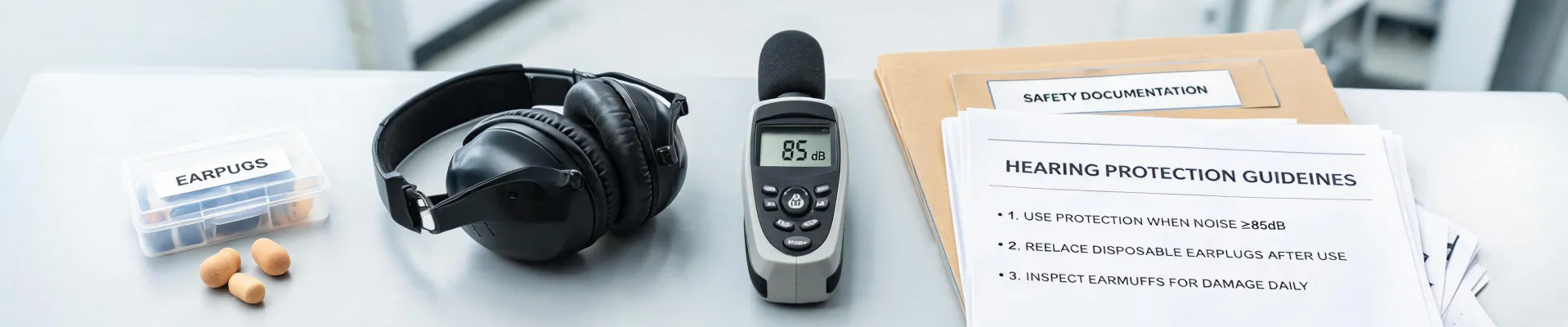
- Check your existing noise monitoring data. If your company already has a safety consultant or internal EHS person, ask them for recent readings. I was surprised to find our shipping area hit 90dB consistently—high enough to require protection.
- Identify the loudest areas. Walk the floor during peak hours. Even without a meter, if you have to raise your voice to be heard from 3 feet away, that's likely 85dB or higher.
- Categorize by zone. Office, warehouse floor, shipping dock, maintenance areas—they all need different solutions.
Looking back, I should have spent a day doing this before making a bulk purchase. But given what I knew then—nothing about PPE procurement—my choice to just 'get the highest NRR' seemed reasonable. It wasn't.
Checkpoint: Do you have a noise map of your facility? If not, get one before placing any order.
Step 2: Match Protection Level to Actual Need (Don't Over-Protect)
This is the counter-intuitive step most people miss. More protection isn't always better. In fact, over-protection can create new problems.
Here's the rule I follow now: aim for a Noise Reduction Rating (NRR) that brings the exposure down to 75-80dB, not silence. If a worker can't hear warning alarms or conversation, they'll remove the hearing protection—and then they're unprotected.
For context:
- Howard Leight MAX-1 earplugs (NRR 33) are excellent for consistent high-noise environments (95dB+)—think heavy machinery, loading docks, engine rooms.
- Standard foam earplugs (NRR 29-31) are fine for moderate noise (85-95dB). I use these for our warehouse floor.
- Low-profile earmuffs (NRR 22-25) work well for intermittent noise or when workers need to hear ambient sounds.
I learned this the hard way. In 2023, I ordered MAX-1 earplugs for everyone—thinking highest rating = best choice. We had complaints within weeks. Workers in quieter zones said they felt 'cut off' and couldn't hear forklift warnings. We ended up swapping out 40% of the order.
If I could redo that decision, I'd invest in better specifications upfront—matching the protection level to each zone's actual noise reading.
Step 3: Factor in User Behavior (Comfort Over Specs)
This step is where procurement meets reality. The best-rated hearing protection does nothing if it sits in a drawer.
Based on managing 400+ orders over 5 years, here's what I've learned:
- Foam earplugs are cheap and disposable, but require proper insertion technique. I'd say 30% of new users insert them wrong the first time. If you go this route, budget for training time or pre-formed plugs.
- Pre-molded earplugs (like Howard Leight's multi-size options) are easier for new users. They cost more per unit but have higher compliance rates.
- Earmuffs are simple to use but can be hot and uncomfortable for long shifts. I've seen workers in warmer climates prefer plugs, even when muffs offer better specs on paper.
I want to say compliance rates are predictable, but they aren't. I've seen teams with identical noise levels where one group loves foam plugs and another prefers muffs. There's no substitute for offering choices and letting workers try before you buy in bulk.
Never expected this, but the real issue in most workplaces isn't protection level—it's adoption. Focus on what people will actually wear consistently.
Step 4: Verify Your Vendor's Support (Not Just Price)
This is the step I wish I'd prioritized earlier. In 2024, I found a great price on hearing protection from a new vendor—$1,200 cheaper than our regular supplier. Ordered a six-month supply. They couldn't provide proper invoices (handwritten receipts only). Finance rejected the expense report. I ate the cost out of the department budget. Now I verify invoicing capability before placing any order.
Here's what to check before you commit:
- Invoicing and documentation. Can they provide proper PO-based invoices with line-item details? Ask for a sample before ordering.
- Lead times and stock availability. 'In stock' on a website doesn't always mean same-day or even this-week shipping. I've had delays of 2-4 weeks on specialty items.
- Return policy on sizing errors. Since hearing protection is often size-specific, check if they accept returns on unopened boxes. Some vendors don't, which makes a wrong order very expensive.
- Training materials. Do they provide user guides or fitting instructions? This matters for foam earplugs especially. The best vendors include visual guides I can print and post in break rooms.
Per USPS pricing (usps.com, effective January 2025), shipping a small box of earplug packs costs $8.50 using Priority Mail flat rate. That adds up if you're returning mis-ordered product. Verify vendor policies upfront.
Wrapping Up: The Mistakes I See Most Often
After 5 years of managing these relationships, here's what I keep seeing buyers get wrong:
- Chasing the highest NRR number. More protection isn't automatically better. Match to actual noise levels.
- Buying for 'the team' without considering individual comfort. Offer choices. Test a sample batch before committing to a large order.
- Skipping the vendor vetting. A good price means nothing if the vendor can't invoice properly or support returns. That unreliable supplier made me look bad to my VP when materials arrived late.
- Assuming one size fits all. It doesn't. Ear canals vary. Pre-molded plugs come in sizes for a reason.
On average, I've saved about 6 hours per month by standardizing on a few proven products and vendors—plus eliminated the 'wrong order' returns that used to eat up time and budget. It's not glamorous work, but it's the kind of process improvement that makes your department run smoothly.
If you're still unsure where to start, begin with Step 1—audit your environment. The right choice for your team will become clear once you know what they're actually dealing with.
Maeve Callahan
Maeve Callahan is a head-protection analyst covering Type I and Type II hard hats, climbing-style safety helmets, bump caps, chin straps, suspensions, liners, and face-shield carriers. She applies ANSI Z89.1, EN 397, and EN 12492 criteria while comparing impact attenuation, penetration resistance, lateral deformation, electrical class, retention strength, field of vision, mass, fit range, and temperature conditioning. Her guides help EHS teams, contractors, utilities, and buyers select helmet systems for overhead hazards, work at height, electrical exposure, accessory compatibility, and worker acceptance.