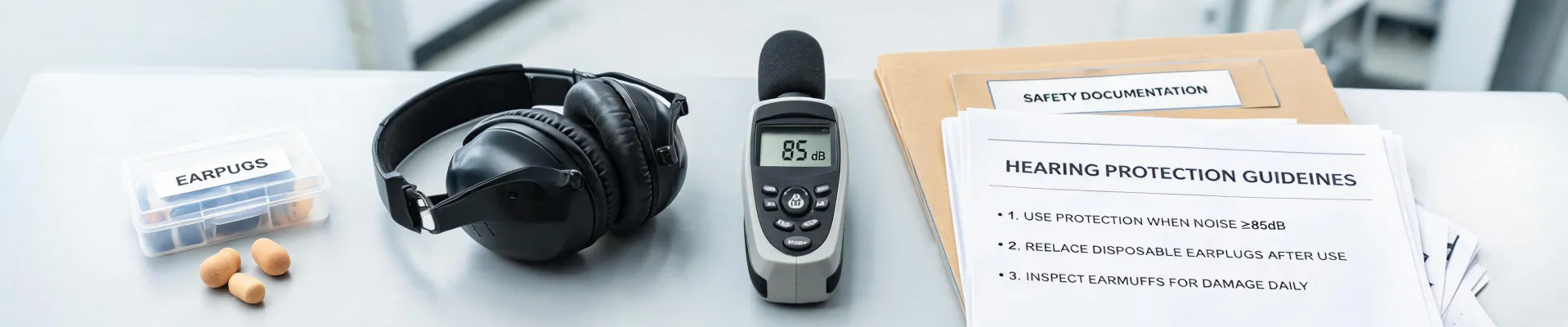
In 2021, I ordered 5,000 pairs of Howard Leight MAX-1 earplugs with a claimed NRR of 33. Then I paid $890 to get 400 replacement pairs shipped overnight. That math still doesn't feel good.
I've been on the supply side of safety gear for seven years. I'm not a compliance officer or an acoustics engineer. I'm the person who puts purchase orders through, checks the specs, and gets blamed when something doesn't work. This is the story of the order that broke my habit.
The Search That Feels Specific
When I typed 'Howard Leight MAX-1 earplugs NRR 33' into a search bar, I thought I had everything under control. The brand. The model. The rating. What else could a buyer need?
Then I looked at the results. Every one of them showed the Howard Leight logo. The same logo. The same packaging. I compared prices, picked the cheapest one, and hit submit.
Hit submit and immediately thought: did I just pick the wrong supplier? The boxes arrived two weeks later. Nothing looked wrong. Then a crew supervisor sent me a message: 'Can you take a look at these?' The foam felt harder. Not dramatically. Just different.
The Real Question Is Not the Logo
Here's the thing: I had bought a logo, not a spec.
The actual product spec behind 'NRR 33' is not measured by looking at a logo. It's measured in a lab with a microphone and a test fixture. I'm not an acoustics engineer, so I can't speak to exact foam density. What I can tell you from a purchasing perspective is this: if the only evidence of performance is a brand mark, you have no evidence.
Most buyers focus on price and brand recognition and completely miss the only thing that matters: can the manufacturer trace this product to a tested standard? If the supplier can't answer that, the logo is just a picture.
The question everyone asks is 'Is this the real Howard Leight product?' The question they should ask is 'What standard does this need to meet, and how is that verified?'
The 'big brand means safe' idea was more reliable years ago, when a local distributor you trusted handled every order. Today, a logo on a listing page tells you almost nothing about the box you'll actually receive.
I'm not saying the batch we received was counterfeit. Honestly, I'm not sure why it failed. My best guess is that it sat in a warehouse that got too hot. What I know is that the workers could feel the difference, and that's a bigger alarm than any packaging photo.
Same Shortcut, Other Products
After that order, I started noticing the same pattern everywhere.
A maintenance requisition asked for a Studson hard hat. I'd never heard of the Studson hard hat. That's fine, but 'is this a good hard hat?' isn't the right question. The right question is whether it meets the head protection standard for the job and whether the suspension fits the person wearing it. Brand name told us almost nothing.
Someone in our office once searched for 'Chanel rubber boots' when we actually needed chemical-resistant boots for a maintenance crew. The Chanel rubber boots would have been great for a photoshoot. Not great for a chemical splash. That one sounds ridiculous now, but it's the same wrong shortcut: found a name, skipped the requirements.
'What's the difference between pepper spray and mace?' is a real question, and it's the same pattern. Pepper spray is a category based on oleoresin capsicum (OC), derived from chili peppers. Mace started as a brand name for a different chemical irritant, and many modern Mace-brand products are actually OC sprays. If you're carrying something and don't know which one it is, you don't have a brand advantage—you have a knowledge gap. I'm not a self-defense expert, so read the label and check the law in your area.
What the Cheap Option Actually Cost
Let's go back to the math.
The cheap supplier cost $0.18 per pair. Our usual supplier was $0.25 per pair. On 5,000 pairs, that was a $350 difference. In a quarterly budget review, that looked like a smart saving.
Then the foam complaint came in. We couldn't test the NRR on site. No lab, no budget for it. So we did the practical thing: we listened to the workers. A safety manager compared the new plugs to the old batch and said the compression speed felt off. We stopped distributing them.
I rejected the remaining stock. The supplier took it back. That left the crews without product. I paid $890 for an overnight delivery of 400 pairs from the usual supplier. The $350 saving turned into an $890 shipping bill, plus the safety manager's time, plus the inconvenience of a site change.
When I added it up, the 'savings' was a loss of at least $1,400. And that's before counting the quiet damage: workers started wondering whether the company was cheaping out on their hearing protection.
From experience, the lowest quote has cost us more in most of the cases where the only differentiator was price. I don't have an exact ratio, but I have a stack of invoices that say it.
Per FTC advertising guidelines, performance claims have to be truthful and substantiated. A claim like 'NRR 33' should come from a documented test. But even with documentation, the real question is whether the product in the box is the product that was tested. That's why buying the logo instead of the standard is dangerous.
The Boring Fix
The fix is not to buy the most expensive option. The fix is boring:
- Buy against the relevant standard, not against the logo.
- Order samples before a volume order, especially if the price is unusually lower.
- Ask the supplier where the product came from and whether they can show test traceability.
- Trust the workers who wear it. If they say it feels different, stop distributing it.
I still buy Howard Leight when it's the right product for the fit. I also buy other brands when they meet the standard. But I don't buy logos anymore. The logo should be the last check, not the first one.
That mistake taught me something that no product spec sheet ever taught me: the cost of the cheapest option is just the first payment. The rest comes later.

Maeve Callahan
Maeve Callahan is a head-protection analyst covering Type I and Type II hard hats, climbing-style safety helmets, bump caps, chin straps, suspensions, liners, and face-shield carriers. She applies ANSI Z89.1, EN 397, and EN 12492 criteria while comparing impact attenuation, penetration resistance, lateral deformation, electrical class, retention strength, field of vision, mass, fit range, and temperature conditioning. Her guides help EHS teams, contractors, utilities, and buyers select helmet systems for overhead hazards, work at height, electrical exposure, accessory compatibility, and worker acceptance.