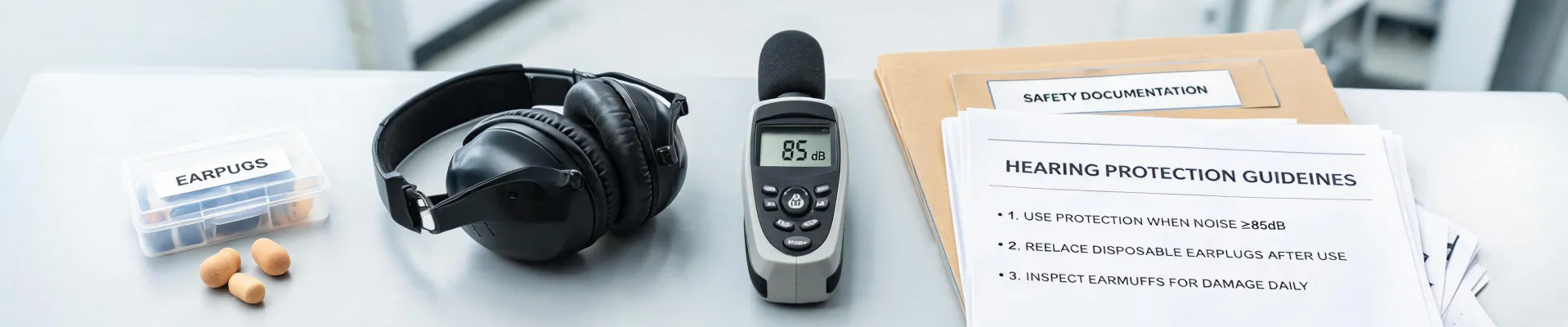
It was a Tuesday afternoon in July 2023, and I was feeling pretty good about myself. I had just signed off on a bulk order—1,200 pairs of earplugs for our distribution center. The price was right, the supplier was responsive, and the NRR rating was decent enough to meet OSHA requirements. I checked every box. Or so I thought.
Fast forward three weeks: I'm standing in our safety manager's office, looking at a stack of unopened boxes. Every single pair had been returned by the floor staff. They refused to wear them. Said they were uncomfortable. Said they didn't stay seated. Said it was like shoving a rock in their ear.
I knew I should have done a fit-test trial first. I knew the research on hearing protection compliance—it's not about the NRR on the package, it's about the NRR in the ear. But I thought, "What are the odds? It's a standard foam plug, same as the last batch." Well, the odds caught up with me when 1,200 pairs sat in a corner collecting dust. That order cost us $2,340 in product, plus the rush shipping for the replacement order, plus the credibility hit with the floor team.
Here's the thing: I learned that day that NRR 33 doesn't mean a thing if the plug doesn't fit. And that's where Howard Leight came in.
The Mistake: Prioritizing Price Over Fit
In my first year of handling PPE procurement (2019), I made the classic mistake: I looked at the price list and picked the cheapest option with an acceptable NRR. The logic seemed sound—budget was tight, the regulation said we needed X level of protection, and the product claimed it could deliver X+10%.
But PPE selection isn't a box-checking exercise. It's a human factors challenge.
I remember my first fit-test experience. I had scheduled a vendor to test our staff. We had 55 people on shift, and I figured we'd be done in an hour. Two hours later, I was watching a line of workers cycle through the testing booth, and I saw something I hadn't expected: the same earplug model had wildly different attenuation numbers for different people.
- Worker A (small ear canals): Achieved NRR 28
- Worker B (large ear canals): Achieved NRR 18
- Worker C (with glasses and mask): Achieved NRR 22
The product was the same. The people were not. And our compliance was based on a number that barely half of our team could actually achieve.
What I Should Have Asked
The vendor who tested us said something I've never forgotten: "The NRR rating is a lab number. Your workers don't live in a lab." He was right.
I started asking better questions:
- What's the fit variability across different ear canal sizes?
- Does this plug require rolling, or is it pre-molded for easy insertion?
- What's the comfort rating for 8-hour shifts?
- Is there a trial period where we can test a sample batch?
That's when I started looking at Howard Leight. Not just because of the NRR 33—though that helps—but because they actually had the data to answer those questions. Their MAX-1 and MAX-Lite lines had been tested across different populations. They gave me the real-world attenuation range, not just the lab max.
The Turning Point: A $3,200 Lesson
In September 2023, I placed an order for 2,500 pairs of Howard Leight MAX-1 earplugs after we ran a successful trial. I was confident. The trial results were excellent—average real-world attenuation of NRR 30 across our team. I thought, Finally, we've got this right.
Then the trouble started.
Our warehouse manager called me on a Thursday. "Hey, the new plugs aren't working for some of the guys. They say they can still hear the machinery." My heart sank. I'd specified the MAX-1 because of the high NRR, but I hadn't considered one thing: the people who needed less attenuation—those working in quieter zones—were over-protected. They couldn't hear alarms or communicate with their team. And when people can't hear what they need to hear, they take the plugs out.
Worse than expected. $3,200 in product, and we had to re-order a lower-attentuation version for half the crew.
That's when I learned the second hard lesson: The highest NRR isn't always the right NRR. For environments with moderate noise (85-90 dBA), a high-attenuation plug can actually reduce safety by making workers remove their protection to communicate. For those specific zones, we switched to the Howard Leight MAX-Lite with an NRR of 30—still excellent, but with better comfort for prolonged wear—and for the truly loud zones (above 95 dBA), we kept the MAX-1.
The Vendor Who Said "This Isn't Our Strength"
I should mention: during this process, I contacted our original supplier to ask about the issue. Their response? "Our plugs are tested to NRR 33. It's the highest in the industry. If they don't fit your team, maybe it's a training issue."
Not helpful. Not useful. And frankly, a red flag.
But the Howard Leight rep? They said something different. When I asked about hearing protection for our maintenance crew—guys who work in both loud and quiet zones—the rep said, "For that specific application, you might want to consider a level-dependent earmuff or an electronic hearing protector. That's not really our core strength—hearing protection with amplification is more of the electronic specialists' domain. But for your production floor, our foam plugs are the best fit. Literally."
That honesty earned my trust. The vendor who says "this isn't our strength—here's who does it better" is more credible than the one who claims they can do everything. I'd rather work with a specialist who knows their limits than a generalist who overpromises.
The Checklist: What I Do Now (And What I Wish I'd Done)
After the third rejection in Q1 2024—this time a batch of safety glasses that didn't fit over prescription frames—I created our pre-check checklist. We've caught 47 potential errors using this checklist in the past 18 months. For hearing protection specifically:
- Know your noise profile. Don't just take the OSHA reading. Map the noise levels across shifts and seasons. (Our summer readings are consistently 3-5 dBA higher due to ventilation.)
- Test before you buy. Order a trial batch of 50-100 units. Have your team wear them for a full shift. Measure real-world attenuation.
- Consider the difference between NRR and SNR. NRR (US standard) uses a different calculation than SNR (EU standard). A product with NRR 33 might have an SNR of around 31. They're not interchangeable.
- Don't ignore the comfort factor. The best earplug in the world is useless if it sits in a pocket. Check for material sensitivity, insertion ease, and long-term wear comfort.
- Match the protection to the zone. One product won't suit everyone. Have a high-attenuation option (NRR 30+) for loud areas and a moderate option (NRR 25-28) for general use.
Real Talk: My Go-To Choice
Look, I'm not saying Howard Leight is perfect for every situation. For intermittent low-noise environments, a reusable plug might make more sense. For extreme noise (above 100 dBA), you want a dual-protection setup with earmuffs over plugs. But for 90% of our production environment—85-95 dBA, mixed shift patterns, high movement—the Howard Leight MAX-1 has been our best fit. And the MAX-Lite for the quieter spots.
The price? As of February 2025, the Howard Leight MAX-1 retails for roughly $17-$25 for a box of 200 pairs (depending on supplier and volume). That's about $0.09-$0.13 per pair. The MAX-Lite runs slightly less. Compare that to the cost of reordering because of non-compliance: one batch of 1,200 pairs = $2,340 waste. The premium is measured in cents; the cost of getting it wrong is in thousands.
I should add: we also use the Howard Leight Fusion corded plugs for our maintenance team—same NRR, but the corded version reduces loss rates. We've cut replacement orders by 30% since switching.
What I'd Tell Anyone Starting Out
If you're new to PPE procurement, don't make my mistake. Don't look at the NRR rating and call it done. Don't assume that because it's on the shelf, it'll work. And for the love of safety, don't skip the fit test.
The best advice I got came from a safety consultant who's been in the industry for 20 years: "The product that protects your workers is the product they actually wear. Everything else is just a paper compliance."
So if you're looking at Howard Leight earplugs or any other brand, here's my take: start with the people, not the spec. Get a sample. Run a trial. Measure the real-world noise reduction. And if a vendor tells you they don't have the perfect solution for your unique situation? Trust them more for saying so.
I've made enough mistakes for two lifetimes. You don't have to repeat them.

Maeve Callahan
Maeve Callahan is a head-protection analyst covering Type I and Type II hard hats, climbing-style safety helmets, bump caps, chin straps, suspensions, liners, and face-shield carriers. She applies ANSI Z89.1, EN 397, and EN 12492 criteria while comparing impact attenuation, penetration resistance, lateral deformation, electrical class, retention strength, field of vision, mass, fit range, and temperature conditioning. Her guides help EHS teams, contractors, utilities, and buyers select helmet systems for overhead hazards, work at height, electrical exposure, accessory compatibility, and worker acceptance.