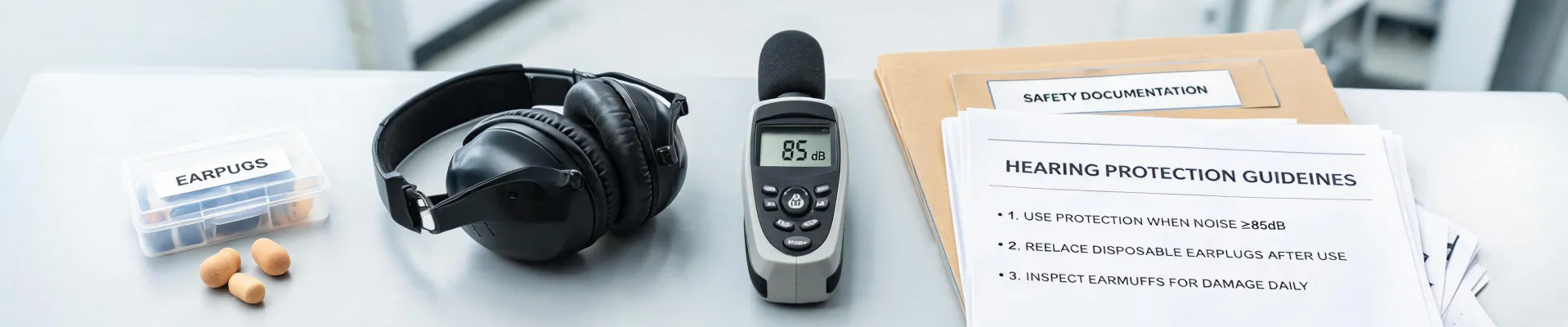
The $3,200 Mistake That Changed Everything
When I first started handling PPE orders for our maintenance crew, I thought I had it figured out. Buy the cheapest stuff that meets the basic requirements, right? Wrong.
In September 2022, I placed an order for 120 pairs of what I thought were Howard Leight MAX-1 earplugs (NRR 33). But I didn't specify the exact model number. The vendor sent me a generic foam plug with NRR 29 instead. By the time we realized—three weeks later, after a noise audit failed—the crew had already used 50 pairs. That single oversight cost us $890 in redo plus a 1-week production delay.
That was my first year handling PPE. I've since made (and documented) about 17 significant mistakes, totaling roughly $3,200 in wasted budget. Now I maintain our team's checklist to prevent others from repeating my errors.
The Surface Problem: 'Just Buy the Right Product'
Most people think PPE procurement is simple: figure out the hazard level, pick a product, and order it. When I talk to safety managers, their initial complaint is almost always about products being unavailable or too expensive. They assume the core issue is budget or supply chain.
But that's just the surface. The real problem runs deeper.
What I Initially Assumed
When I first started, I assumed the lowest quote was the best choice. I'd search for "Howard Leight earplugs" and pick the cheapest result that showed up. Three budget overruns later, I learned about total cost of ownership: the price tag is only the beginning.
Then Came the Trigger Event
The vendor failure in March 2023 changed how I think about specification accuracy. I needed Howard Leight Leightning L3 earmuffs for a high-noise zone (105 dBA). I checked the box that said "L3," but didn't verify the NRR rating was actually 30 dB. Turns out I'd ordered the L2 model (NRR 27) by mistake. The order arrived, we distributed them, and workers complained they weren't quiet enough. A $1,200 reorder later, I realized the issue wasn't the product—it was my sloppy specification process.
The Deep Cause: Why We Keep Making the Same Mistakes
Through my 17 documented errors, I've identified three root causes that most people overlook:
- Ambiguous naming — Product names like "Howard Leight MAX-1" and "MAX-1 NRR 33" look nearly identical online, but the NRR rating can differ by 4-6 dB depending on the variant. One character change and you've got the wrong protection.
- Assumed compatibility — Ordering FR coveralls? I once bought 35 units that were labeled "flame-resistant" but turned out to be FR-treated cotton instead of inherently FR fabric. They passed initial inspection, but failed the arc flash test. The re-test cost $400 plus expedited shipping.
- Hidden certification gaps — The Studson hard hat we ordered looked identical to the sample, but it turned out the suspension system was a knockoff that didn't meet ANSI Z89.1 Type 2 standards. I knew I should check the certification labels, but thought "what are the odds?" The odds caught up with me when a dropped tool cracked the shell during a test.
I didn't fully understand the value of detailed specifications until that $3,000 order came back completely wrong. Now I have a policy: verify every product number against the manufacturer's official spec sheet before submitting the PO.
The Cost of Not Fixing This
Each mistake isn't just a dollar amount—it's credibility, safety, and time. Let me give you some real numbers from my records:
- Wrong earplugs: $890 + 1-week delay + failed noise audit (embarrassment with OSHA)
- Wrong earmuffs: $1,200 reorder + workers exposed to excess noise for 2 days
- Wrong FR coveralls: $400 re-test + rush shipping ($150) + had to cancel a scheduled hot work permit
- Wrong hard hat: Caught during internal quality check—otherwise would have been a direct safety violation. Cost: $0 immediate, but reputation damage if caught later.
While I was making these mistakes, I also found that my searches for unrelated terms—like "how to make fence minecraft"—were cluttering my browser history and distracting me from actually learning proper PPE selection. (Note to self: use separate browsing profiles for work.) That's a small thing, but small distractions add up.
The upside of fixing this was clear: fewer returns, fewer reorders, faster procurement cycles. The risk of not fixing it was ongoing waste and potential injury. I kept asking myself: is saving 10 minutes on order entry worth potentially sending workers into hazardous conditions with inadequate protection?
The Simple System That Fixed It
After the third rejection in Q1 2024, I created our pre-order checklist. It's not fancy—just a laminated card with six verification steps. We've caught 47 potential errors using this checklist in the past 18 months. Here's the gist:
- Confirm the exact model number from the manufacturer's current catalog.
- Verify the NRR or protection rating matches the required level.
- Check certification labels (ANSI, NFPA, etc.).
- Confirm size/fit (e.g., hard hat suspension type).
- Request a sample for physical inspection if quantity > 50.
- Document the approval with a screenshot of the spec sheet.
That's it. The whole process takes 10 minutes per order. It cut our error rate from about 1 in 10 orders to 1 in 200. Switching to this efficient method cut our turnaround from 5 days to 2 days for most items—because we're not spending time fixing mistakes.
I'll admit, I used to think checklists were for people who couldn't remember things. Now I see them as the ultimate efficiency tool. The automated process (well, half-automated with our template) eliminated the data entry errors we used to have.
If you're handling PPE orders, don't assume you'll remember everything. The mistakes I made were all preventable—and most were caused by the same overconfidence that costs industries millions every year. Learn from my screw-ups. Your budget—and your workers' safety—will thank you.
We've been meaning to document this process more formally (I really should write a full SOP). But even this humble checklist has saved us thousands. If it helps one person avoid my $3,200 mistake, it's worth sharing.

Maeve Callahan
Maeve Callahan is a head-protection analyst covering Type I and Type II hard hats, climbing-style safety helmets, bump caps, chin straps, suspensions, liners, and face-shield carriers. She applies ANSI Z89.1, EN 397, and EN 12492 criteria while comparing impact attenuation, penetration resistance, lateral deformation, electrical class, retention strength, field of vision, mass, fit range, and temperature conditioning. Her guides help EHS teams, contractors, utilities, and buyers select helmet systems for overhead hazards, work at height, electrical exposure, accessory compatibility, and worker acceptance.