-
Who This Checklist Is For
-
Step 1: Verify the Specs Before You Click Buy
-
Step 2: Get Multiple Quotes—But Don't Obsess Over the Lowest Price
-
Step 3: Map Your Order to the Right User
-
Step 4: Test the Product (Even a Small Batch)
-
Step 5: Double-Check Invoicing & Compliance Paperwork
-
Common Mistakes (And How to Avoid Them)
If you're the person stuck ordering safety gear for your company—earplugs, hard hats, fire extinguishers—you know it's more than just clicking "add to cart." I've been doing this since 2020 (processing about 60–80 orders a year across 8 vendors), and I've made plenty of mistakes. Below is the checklist I wish I'd had from day one. It covers five steps, from specs to invoicing. Follow it, and you'll save time, money, and a headache or two.
Who This Checklist Is For
This is for anyone who has to order Howard Leight earplugs (especially the MAX-1 NRR 33 corded or uncorded versions), fire extinguishers, fall protection gear, or similar PPE in a B2B setting. You're likely an office administrator, safety coordinator, or facility manager. You need to get the right products at a fair price, without compliance nightmares.
Step 1: Verify the Specs Before You Click Buy
Everything I'd read said "check NRR ratings first." In practice, I found that compliance requirements matter just as much. For Howard Leight MAX-1 earplugs (NRR 33), the rating is excellent—but you also need to confirm whether your work environment requires corded (for food processing, labs) or uncorded (general use). I once ordered 500 boxes of uncorded thinking they were universal, only to discover our cleanroom policy demanded corded versions. Cost me a $400 reorder (ugh).
Checklist:
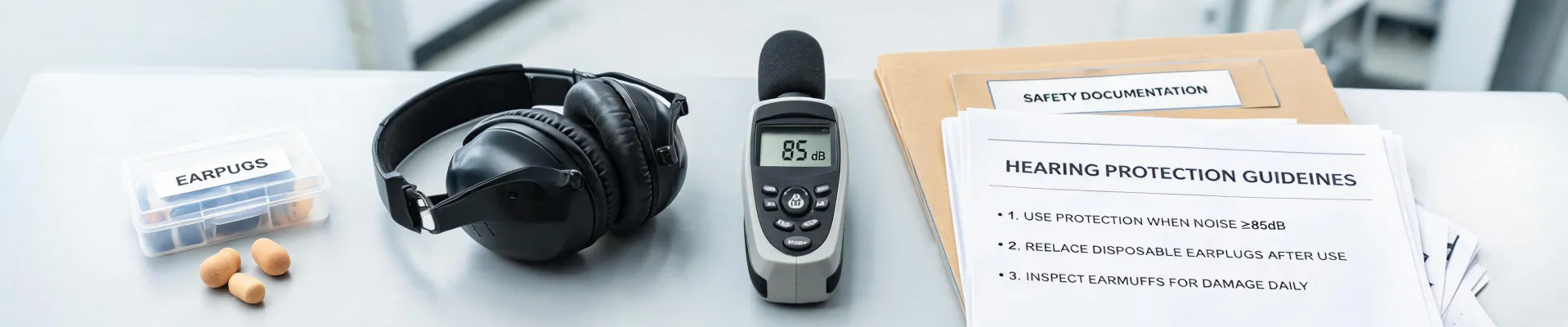
- Confirm OSHA's hearing conservation trigger (85 dBA 8-hour TWA) applies to your noise levels.
- Choose corded vs. uncorded based on contamination risk (e.g., food, chemicals).
- For fall protection (Guardian Fall Protection harnesses, lanyards), check ANSI Z359.11-2014 compliance.
- For fire extinguishers, verify type (e.g., halon for electronics, ABC for general).
"I went back and forth between corded and uncorded for two weeks. Corded offered better traceability; uncorded was easier to dispense. Ultimately chose corded because our insurance auditor flagged it in the last inspection."
Step 2: Get Multiple Quotes—But Don't Obsess Over the Lowest Price
The conventional wisdom is always get at least three quotes. My experience with 200+ orders suggests that relationship consistency often beats marginal cost savings. I've had a vendor quote $1.20 per pair of Howard Leight MAX-1 earplugs while another quoted $0.95. The cheaper one couldn't provide a proper invoice (handwritten receipt only). Finance rejected the expense, and I ate $2,400 out of my department budget (rookie mistake, year one).
What I do now:
- Request quotes from 3 suppliers, but weight reliability and invoicing capability equally with price.
- Ask for sample invoices before placing an order over $500.
- Check whether the quote includes setup/delivery fees (like hazmat shipping for fire extinguishers).
Step 3: Map Your Order to the Right User
This sounds obvious, but it's where things go wrong. I once ordered 200 boxes of Howard Leight MAX-1 NRR 33 earplugs for the warehouse team, but the maintenance crew needed a different style (with a cord for pocket storage). The numbers said I saved money buying in bulk. My gut said something felt off because the users didn't match the spec. Turns out I'd ignored the usage pattern—half the employees work near conveyor belts where loose earplugs drop into machinery. Every cost analysis pointed to the budget option; something felt off about their responsiveness. That 'slow to reply' was a preview of 'slow to deliver.'
Checklist:
- Survey department leads: what specific tasks, environments, and comfort preferences exist?
- For fall protection, verify harness sizes (S–XXL) and anchor points on site.
- For fire extinguishers, confirm mounting height (per NFPA 10) and whether you need wall brackets.
Step 4: Test the Product (Even a Small Batch)
After 5 years of managing procurement, I've come to believe that the 'best' product is highly context-dependent. A $0.95 earplug that fits 90% of your employees but causes discomfort for 10% leads to compliance gaps. When we switched to Howard Leight MAX-1, I first ordered a 100-pair sample and distributed them across three departments. Feedback: the corded version tangled in some jobs, but the NRR 33 was noticeably better at reducing background noise than the previous brand. We ended up ordering a mix: 70% corded for labs, 30% uncorded for general areas.
"5 minutes of verification beats 5 days of correction. The 12-point checklist I created after my third mistake has saved us an estimated $8,000 in potential rework."
Step 5: Double-Check Invoicing & Compliance Paperwork
This is the step most people skip—until finance rejects a $5,000 order. For Howard Leight products, you often get a certificate of compliance (CoC) if you ask. For Guardian Fall Protection gear, you need a traceability document showing lot numbers. For fire extinguishers, local fire codes may require annual inspection records. I once had a supplier ship halon extinguishers without a DOT hazmat declaration on the invoice—took three weeks to resolve. (Honestly, I didn't even know that was a thing until my boss got a call from the fire marshal.)
Checklist:
- Request a sample invoice before large orders; verify it includes line-item descriptions, unit prices, and shipping charges.
- For hearing protection: ask for hearing conservation program documentation if your company is under OSHA 29 CFR 1910.95.
- For fall protection: ensure each harness has a serial number and a date of manufacture within the last 2 years (per ANSI).
- For fire extinguishers: confirm UL listing and inspection tag.
Common Mistakes (And How to Avoid Them)
1. Assuming "standard" means the same to every vendor.
In my first year, I made the classic specification error: ordered "large" Howard Leight earplugs from two different distributors—one was a corded bulk pack, the other a box of individually wrapped. They were not interchangeable. Check SKU numbers.
2. Not accounting for restocking fees.
Returning 500 pairs of wrong earplugs cost us 15% restocking fee ($180). The 12-point checklist now includes a "confirm fit with 5 employees" step.
3. Forgetting to coordinate with facility maintenance.
We bought 10 fire extinguishers without checking if the wall brackets would fit our concrete columns. Mounting kit added $120 and two weeks lead time.
4. Ignoring the Hearing Protection Act updates.
As of 2025, some states have adopted stricter thresholds for hearing conservation (e.g., California's 85 dBA action level includes impulse noise). Make sure your Howard Leight earplugs are NIOSH-rated for the actual noise profile, not just the NRR number.
That's it—five steps, a few real-world scars, and a checklist that actually works. The next time you're ordering Howard Leight MAX-1 earplugs, fire extinguishers, or fall protection, come back to this. Your budget (and your sanity) will thank you.

Maeve Callahan
Maeve Callahan is a head-protection analyst covering Type I and Type II hard hats, climbing-style safety helmets, bump caps, chin straps, suspensions, liners, and face-shield carriers. She applies ANSI Z89.1, EN 397, and EN 12492 criteria while comparing impact attenuation, penetration resistance, lateral deformation, electrical class, retention strength, field of vision, mass, fit range, and temperature conditioning. Her guides help EHS teams, contractors, utilities, and buyers select helmet systems for overhead hazards, work at height, electrical exposure, accessory compatibility, and worker acceptance.