-
Howard Leight Max earplugs review: are they worth it?
-
Howard Leight earmuffs vs earplugs: which should you buy?
-
Carbon monoxide detector vs smoke detector: what's the difference?
-
Can you save money on safety vests?
-
Steel toe boots: how much should you budget?
-
How often should you replace Howard Leight earplugs and earmuffs?
I manage procurement at a 180-person manufacturing company. For seven years, I've owned the PPE budget—around $70,000 annually—and tracked every single order in our cost system. I've compared quotes from 20+ vendors, negotiated with most of them, and built a spreadsheet that tells me exactly what each worker costs per year in safety gear.
When safety managers or new procurement folks ask me about hearing protection, they usually start searching for "howard-leight" before they even finish the question. The name comes up that often. I get the same questions over and over. Here are my honest answers—based on actual invoices, and more than a few mistakes.
What this FAQ covers:
- Howard Leight Max earplugs review
- Howard Leight earmuffs vs earplugs
- Carbon monoxide detector vs smoke detector
- Safety vests: can you save money?
- Steel toe boots: what's the right budget?
- When to replace hearing protection
Howard Leight Max earplugs review: are they worth it?
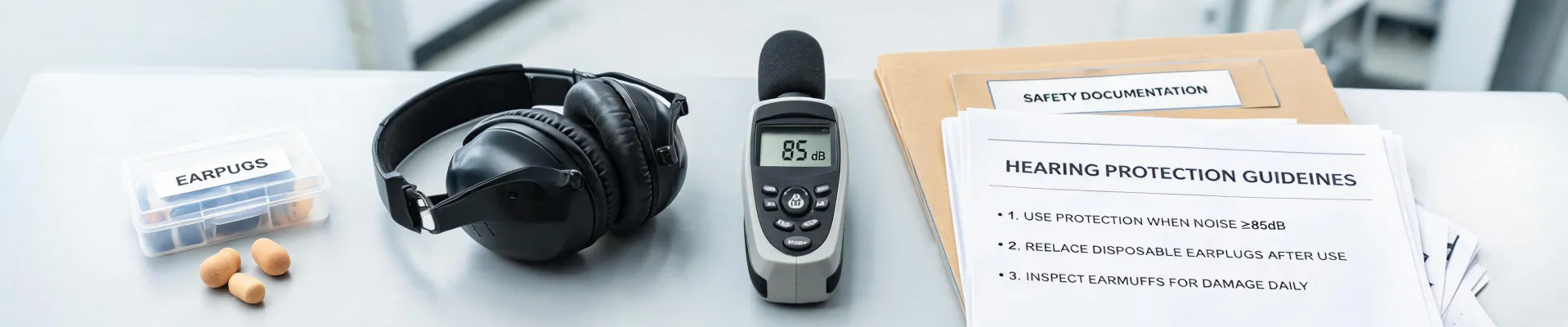
Short answer: yes, with a caveat. Howard Leight Max foam earplugs carry an NRR of 33—the highest rating you'll get from a foam plug. We order about 200 pairs per quarter. At volume, we pay roughly $0.15–$0.20 per pair. Compare that to the cost of one hearing loss claim, and there's no contest. Seriously. It's a no-brainer.
The caveat is fit. An earplug only works if it seals. We had an operator who couldn't get the Max plugs to fit—his ear canals were just a touch too narrow. We switched him to Howard Leight Laser Lite, same brand, slightly different shape. Similar protection level. Completely different compliance. That taught me to check fit before standardizing on a SKU. What I mean is, protection you don't wear isn't protection. It's a cost.
Pricing was accurate as of Q1 2025. The PPE market changes fast, so verify current rates before you lock in a budget.
Howard Leight earmuffs vs earplugs: which should you buy?
Both. But it depends on the job, and saying "just pick one" is how you waste money.
Earmuffs—like the Howard Leight Leightning L3—work well for short-duration tasks in high-noise areas. Workers can take them off quickly. Earplugs are the better call for full shifts, because they don't conflict with hard hats or respirators. A lot of our workers wear both, in fact: plugs underneath, muffs on top for really loud spots. That's a hearing protection setup that's hard to beat, and it doesn't require a manager hovering nearby.
Cost analysis gets interesting here. Earmuffs look expensive: $20–$40 per pair. But they're reusable. With proper cleaning and storage, a pair lasts 2–3 years. So the true cost per use is tiny compared to single-use plugs. I almost standardized on earplugs only, to slash this year's consumables spend. Then I actually ran the TCO numbers and realized our per-worker cost would've gone up. The "cheapest" solution wasn't the cheap option. It never is.
Carbon monoxide detector vs smoke detector: what's the difference?
I get this question from facility managers more than you'd think, so here's the simple version. A smoke detector senses smoke particles in the air—the early warning sign of a fire. A carbon monoxide detector senses CO, an invisible, odorless gas produced by incomplete combustion. Two different threats. Two different devices. That's it.
Do you need both? Yes. A smoke detector won't catch a faulty furnace, and a CO detector won't alert you to a fire. Check the certifications: UL 217 for smoke detectors, UL 2034 for CO detectors. Combo units exist, and they're fine if they carry both standards on the label.
This matters beyond your home. In 2024, our warehouse HVAC unit failed and the CO alarm went off at 2:00 AM. Building evacuated, system shut down, problem contained before anyone got sick. So glad we didn't go cheap on those detectors. They cost around $40 each. Cheapest insurance I've ever bought.
Can you save money on safety vests?
I understand why people try. A vest looks like a vest, right? But the entire purpose is the reflective fabric, and that fabric doesn't survive cheap manufacturing.
Look for the ANSI/ISEA 107 label. Class 2 covers most warehouse and roadside work; Class 3 is for high-speed traffic zones. The difference is the amount of reflective material. Can you tell it by eye? Honestly, not reliably. That's why the label exists.
We buy mid-range vests—$8 to $12 each—and replace them twice a year. That's about $24 per worker annually. A $3 vest that fades after a few washes is worse than no vest, because the worker believes they're visible when they're not. The $9 saving isn't worth that risk. Bottom line: this is false economy, and it's one of those places where I draw the line in the budget.
Steel toe boots: how much should you budget?
We budget $120 to $160 per employee per year for steel toe boots. That range gets you ASTM F2413-rated footwear from brands with decent reputations—not the cheapest, but a long way from luxury.
We tried cheap boots in 2023 to save $12 per pair. You can guess how this went. Three workers filed comfort complaints in the first week. One pair's sole separated after two weeks, which turned into a $1,200 replacement headache. That "cheap" option cost more in rework, time, and worker trust than we ever saved. Details matter in PPE.
Here's what actually works: a proper fit session. We spent one afternoon having workers try on different brands and sizes. Returns dropped by almost half. There's something satisfying about a process improvement that saves real money and keeps people comfortable. That's efficiency I can defend at any budget meeting.
How often should you replace Howard Leight earplugs and earmuffs?
Foam earplugs are single-use. Period. They lose their shape after one compression, and reusing them is an infection risk. At $0.15 a pair, just throw them out after every shift. We keep wall dispensers so workers grab fresh pairs without asking anyone. Simple.
Earmuff cushions and pads are a different story. They break down from sweat, oils, and UV light. Inspect them quarterly. Replace the cushions every 6–12 months depending on use. The entire earmuff usually needs replacing around the 2-year mark, though it varies by environment. If the headband gets loose, the seal breaks, and the NRR on the label no longer matters—it's not real protection anymore.
This is the question people don't think to ask, and it's the one that actually protects your budget. A broken earmuff is still a paid-for earmuff, but it's a liability. If you're not tracking replacement schedules, you're not managing your PPE spend. You're just hoping it holds up. In my experience, hope is not a procurement strategy.

Maeve Callahan
Maeve Callahan is a head-protection analyst covering Type I and Type II hard hats, climbing-style safety helmets, bump caps, chin straps, suspensions, liners, and face-shield carriers. She applies ANSI Z89.1, EN 397, and EN 12492 criteria while comparing impact attenuation, penetration resistance, lateral deformation, electrical class, retention strength, field of vision, mass, fit range, and temperature conditioning. Her guides help EHS teams, contractors, utilities, and buyers select helmet systems for overhead hazards, work at height, electrical exposure, accessory compatibility, and worker acceptance.