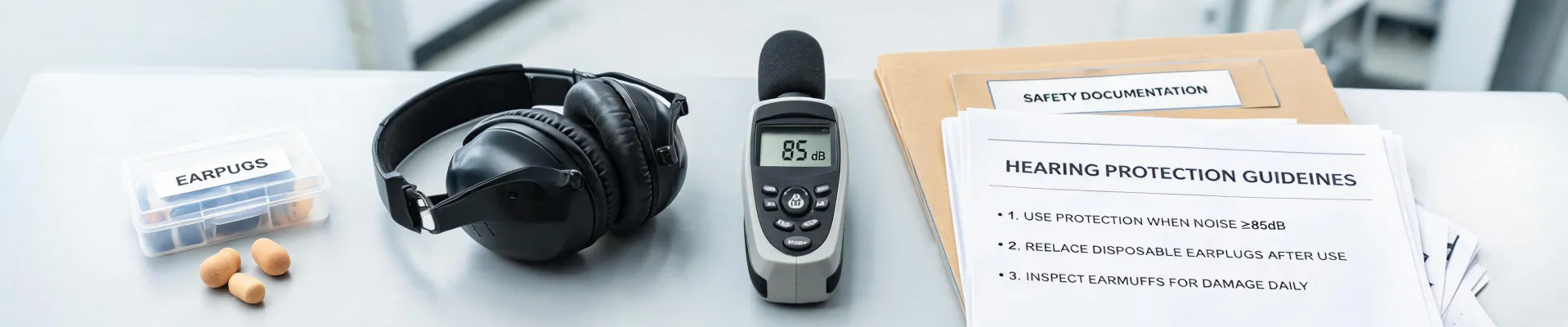
-
What I Compare Before I Approve an Earplug
-
Dimension 1: Attenuation Consistency—NRR Is a Lab Number, Not a Promise
-
Dimension 2: Comfort Is a Compliance Issue
-
Dimension 3: Supply Certainty—Why I'll Pay for Predictability
-
Dimension 4: The Rest of the Kit—Strauss Workwear, Lacrosse Rubber Boots, and Why Consistency Is Contagious
-
Routine Checks: How to Test Smoke Detector Battery (and PPE the Same Way)
-
So: Howard Leight Laser Lite or Generic?
I approve or reject safety gear for a living. For the past four years, I've been a quality/compliance manager at a PPE distributor, reviewing roughly 200 unique items a year. In 2024, I rejected just under 3% of first deliveries for spec or labeling issues. So when I compare Howard Leight Laser Lite earplugs to generic foam alternatives, I'm not reading a brochure. I'm standing on a receiving dock with a lot number in my hand.
This comparison is for anyone trying to decide whether the brand name is worth the price. I'll look at four dimensions: attenuation consistency, comfort, supply certainty, and the rest of the kit—workwear, boots, and maintenance habits. I'll also tell you where I think the cheap option is actually fine.
What I Compare Before I Approve an Earplug
I've reviewed earplugs that looked identical and performed very differently. The framework I use is simple:
- Attenuation consistency — does the NRR match reality from one box to the next?
- Comfort — will a worker keep it in for a full shift?
- Traceability — can I verify the source and lot?
- Cost of failure — what happens if a shipment is late or a batch is bad?
That last one is where budgets get wrecked.
Dimension 1: Attenuation Consistency—NRR Is a Lab Number, Not a Promise
OSHA 29 CFR 1910.95 requires a hearing conservation program when the 8-hour time-weighted average noise exposure equals or exceeds 85 dBA. The NRR on an earplug box is part of the math, but it comes from a standardized lab test, typically ANSI S3.19. Real-world attenuation is always lower. The question is, does a product get close to its label consistently?
The Howard Leight Laser Lite line publishes NRR ratings in the low 30s. Some versions are up to NRR 33. But the advantage isn't the number—it's that the foam behaves the same way every time. The low-pressure foam expands slowly and evenly. That consistency is what makes it predictable.
Generic alternatives can be fine for a while. Then a batch arrives that's visibly different. In 2023, we received 5,000 "equivalent" foam earplugs from a new supplier. The first 100 tested fine. The rest were stiffer in the middle, and recovery times were inconsistent. We rejected the lot. The vendor said it was "within industry standard." It wasn't.
Conclusion: If you need predictable protection, brand consistency matters more than the label. For a one-off job, generic might be fine. For a hearing conservation program, I want the product that behaves the same every time. I do not trust a label alone.
Dimension 2: Comfort Is a Compliance Issue
I didn't fully understand this until a 2022 audit. A crew had a supply of budget earplugs, but most were dangling around their necks. It wasn't laziness—the plugs hurt after twenty minutes. We switched to a softer foam, and usage jumped. The Howard Leight Laser Lite's low-pressure design is one of the reasons I approve it for long shifts.
I ran a blind test with our warehouse team once. Same style of earplug, branded versus no-name. Eight out of ten picked the Laser Lite as the one they'd wear all day. The price difference was pennies per pair.
The surprising conclusion here is simple: a slightly lower NRR that gets worn all shift protects better than a higher NRR that gets removed. The 'best' earplug in the lab is worthless if it sits in a pocket. Comfort is not a soft factor. It's a safety metric.
Dimension 3: Supply Certainty—Why I'll Pay for Predictability
The cheapest option on paper is often the most expensive one in reality. This is where the time-certainty argument kicks in. In March 2024, I approved an extra $400 for expedited shipping from an authorized distributor. We were up against a client's noise-control deadline and needed 50,000 Laser Lite earplugs on site. The budget option was a marketplace listing marked "ships in 2–3 weeks"—or rather, "estimated delivery," which is corporate speak for "maybe." The project couldn't wait for a maybe.
That $400 wasn't for speed. It was for certainty. The shipment arrived with correct lot codes and paperwork, and the deadline was met. No one remembers the deliveries that work—but everyone remembers the one that didn't.
When I need product specs, I start at the Howard Leight official website. It has current spec sheets, distributor locators, and compliance data. If a supplier can't provide the same documentation from their own stock, I move on. Traceability matters because foam earplugs degrade over time. A 'great deal' on expired or diverted stock is a false economy.
Conclusion: If your deadline is real, don't gamble. An uncertain cheap option is risk masquerading as savings.
Dimension 4: The Rest of the Kit—Strauss Workwear, Lacrosse Rubber Boots, and Why Consistency Is Contagious
Hearing protection doesn't work in a vacuum. I use the same logic for every piece of PPE I approve.
Strauss workwear is a good example. I don't buy it for the logo. I buy it because the spec sheet tells me exactly what I'm getting: fabric weight, seam construction, abrasion resistance. Cheap coveralls can look identical in a photo and fall apart after three washes. Oh, and read the care label—a dryer can ruin a $200 jacket in ten minutes.
Lacrosse rubber boots are another. In wet environments, a leaking boot is a hazard, not an inconvenience. We run sample checks on sole bonding and heel slip. Lacrosse has been consistent for us. A 10% cheaper no-name boot is not worth the phone call when someone's feet are wet and cold by day two.
Same framework: verified specs, known source, consistent quality.
Routine Checks: How to Test Smoke Detector Battery (and PPE the Same Way)
The question "how to test smoke detector battery" has a simple answer: press and hold the test button until the alarm sounds. If it doesn't sound, replace the battery. Do it on a schedule, not when the chirping starts at 2 AM.
PPE inspection works the same way. For earplugs, that means opening a fresh box, checking lot codes, rolling a few between your fingers, making sure the foam expands normally. For Strauss workwear, it's a seam-pull test and a look at the care label. For Lacrosse boots, it's a water test on sample pairs. None of it is hard. The hard part is making it routine.
I've learned this the hard way: 'we'll check it later' is how a smoke detector ends up without a battery. Same for PPE. Later is a dangerous time.
So: Howard Leight Laser Lite or Generic?
I went back and forth on this for weeks when I first started because I hate paying for a name. Here's where I landed.
Choose Howard Leight Laser Lite earplugs when:
- You're running a hearing conservation program with regular noise exposure.
- Workers wear plugs for long shifts and need something comfortable enough to keep in.
- You need lot traceability and reliable supply for compliance audits.
- A late delivery or a bad batch would cost more than the price difference.
Choose a generic option when:
- It's a one-time task with low exposure.
- The user knows how to fit and replace earplugs correctly.
- You're not under audit pressure, and the risk of inconsistency is acceptable.
That's not a cop-out. It's a cost-of-failure decision.
The best earplug is the one that's actually worn, from a source you can verify, delivered by someone who keeps their word.
At least, that's been my experience over the last four years of rejecting things that weren't good enough.
Maeve Callahan
Maeve Callahan is a head-protection analyst covering Type I and Type II hard hats, climbing-style safety helmets, bump caps, chin straps, suspensions, liners, and face-shield carriers. She applies ANSI Z89.1, EN 397, and EN 12492 criteria while comparing impact attenuation, penetration resistance, lateral deformation, electrical class, retention strength, field of vision, mass, fit range, and temperature conditioning. Her guides help EHS teams, contractors, utilities, and buyers select helmet systems for overhead hazards, work at height, electrical exposure, accessory compatibility, and worker acceptance.