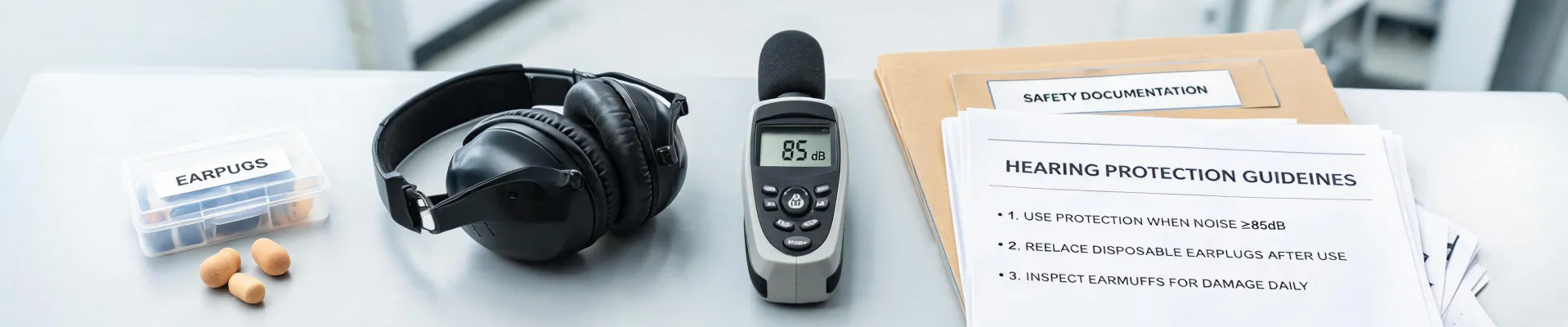
A fence is not complicated. You dig holes, set posts, attach panels, and suddenly you've got a boundary. But the gear you choose while building it can make the difference between a weekend project and a week of ringing ears and sore feet.
I'm the person who handles PPE orders for a small landscape crew. I've been doing it for about seven years, and I've personally made and documented 14 purchasing mistakes totaling roughly $9,700 in wasted budget. Not a number I'm proud of. It's why I keep a checklist now.
Let's get one thing out of the way: there's no single right gear setup. The right earplugs, the right boots, and the right fence type depend on your scenario. So before you buy anything, ask yourself—and whoever's selling you stuff—'what's not included?' That one question has saved me more money than any discount code.
Now the scenarios.
Scenario 1: The weekend fence builder
This is the most common one. You're building a fence in your own backyard. You've got a circular saw, a rented auger, maybe a nail gun. The noise comes and goes, but when it's there, it's loud.
I'd start with Howard Leight MAX-1 foam earplugs. They're rated NRR 33, they're soft, and cheap enough to leave a box in the truck. I keep a box in my garage. The foam expands slowly, so it fits better than a lot of generic plugs.
One thing the NRR number doesn't tell you: the real-world rating is usually closer to half the number. OSHA's hearing conservation threshold is 85 dBA over an 8-hour average, but noise spikes matter too. If it sounds loud, protect.
For boots, don't overbuy. I used to think a $250 boot was 'safer.' Then after two seasons, I realized a $150 pair with a slip-resistant sole did the same job for a weekend project. If you're going to be on your feet for a solid 10 hours, pay more for comfort. If you're not, save the money.
As of early 2025, a box of 200 Howard Leight MAX-1 earplugs is around $15-25 on public online listings. A decent pair of work boots with slip-resistant soles is $120-180. Those are ranges, not quotes. The total cost includes shipping, rework, and the stuff you didn't know you needed.
And yes, you need hearing protection every time the auger runs. I skipped it once in 2022 for 'just one hole.' The ringing wasn't gone until the next morning. That was a dumb trade for five minutes of noise.
Scenario 2: Running a crew that builds fences for a living
This is where I made my biggest mistakes.
In my first year doing purchasing, I bought the cheapest box of earplugs I could find. They sat in the truck. Then I bought Howard Leight MAX-1 because they were a known name, and they were way better. But I still had crew members who didn't wear them.
Why? Because they couldn't hear each other. One guy running a post-hole auger couldn't hear the spotter's direction, so he stopped wearing them. That's a bigger safety problem than not having earplugs at all.
Here's the counterintuitive advice: Don't default to the highest NRR for everyone. If the job is loud but you still need to hear voices or backup alarms, overprotection is a real issue. A worker who is isolated by earplugs will just take them off. The better approach is to offer a choice: foam earplugs for continuous high noise, and earmuffs for short, very loud tasks. Let people match protection to the task.
It took me three years and about 60 project calls to understand that compliance is about fit, not attenuation. When I compared a box of generic earplugs and a box of Howard Leight MAX-1 side by side, I finally understood why the good ones got used. The foam springs back slower, so they seat better. That little difference matters more than the NRR number.
One communication failure stands out. I said, 'Get earplugs that block out enough noise.' The crew heard 'get the strongest possible.' Result: a 200-pair case of NRR 33 plugs that mostly sat unused because the guys couldn't hear my warnings. That's $480 of waste, plus two days of redesigning our safety kit.
For boots, I now buy two models—one for wide feet, one for narrow, both with oil-resistant soles. It costs more up front. It costs far less than a sprained ankle from an ill-fitting boot during a week of fence post setting.
The bottom line for this scenario: a vendor that lists every fee up front—even if the total looks higher—usually costs less in the end. Same goes for your own gear budget.
Scenario 3: Installing a pet safe wireless fence
This is a different animal. You're not hammering posts or sawing panels. You're laying a wire around your yard and setting up a transmitter. Noise is usually not the main hazard—unless you use a powered edger to bury the wire or a mallet to drive stakes.
If you're putting in a pet safe wireless fence, don't wear NRR 33 foam earplugs the whole time. Seriously. You need to hear the collar's warning beep when you test the boundary. Overprotecting here makes as little sense as not protecting at all.
What I recommend: keep a pair of Howard Leight MAX-1 foam plugs in your pocket. When you're about to run an edger or hammer ground stakes, put them in. When you switch to testing the fence, take them out. It's a 30-second habit.
For footwear, lightweight work boots or rubber boots are usually enough. You're walking wet grass and dirt, not carrying posts. Don't buy a $200 logger boot for this job. Buy a $100 boot with good grip and move on.
The installation rule is simple: read the manual before you dig, mark the boundary flags, avoid sharp splices, and test the collar at the furthest point. Also, ask what's in the box. Some wireless fence kits don't include enough boundary wire for a large yard. The quote looks cheaper, but then you're buying an extra $60 wire spool. As of early 2025, wireless fence kits run roughly $150-400 on public online listings, and extra boundary wire is $25-60.
How to tell which scenario you're in
If this is a one-time project in your backyard, you're scenario 1. Buy the Howard Leight earplugs NRR 33, a mid-price pair of mens work boots, and spend the rest of your budget on a good auger rental.
If you're managing a crew, you're scenario 2. Build a hearing protection station with a few options. Track what gets used. Ask your crew what they hate about the current gear. The answer will surprise you.
If you're laying a wire for a pet, you're scenario 3. You don't need a huge hearing protection setup. You need the discipline to wear earplugs for the loud parts and take them out for the testing parts.
Still unsure? Count your hours. If the project is less than four full days, you're probably scenario 1 or 3. If you're doing this every week, you're scenario 2. And if you can't hear someone speaking in a normal voice while the equipment is running, you need hearing protection, not another debate about NRR numbers.
I've learned the hard way that the gear that gets used is the gear that fits the moment. The Howard Leight MAX-1 foam earplugs are a good default for the loud moments. The right work boots are the ones you don't think about at the end of the day. The right fence is the one that works for your pet and your property—and the one whose total cost you actually know before you start.

Maeve Callahan
Maeve Callahan is a head-protection analyst covering Type I and Type II hard hats, climbing-style safety helmets, bump caps, chin straps, suspensions, liners, and face-shield carriers. She applies ANSI Z89.1, EN 397, and EN 12492 criteria while comparing impact attenuation, penetration resistance, lateral deformation, electrical class, retention strength, field of vision, mass, fit range, and temperature conditioning. Her guides help EHS teams, contractors, utilities, and buyers select helmet systems for overhead hazards, work at height, electrical exposure, accessory compatibility, and worker acceptance.