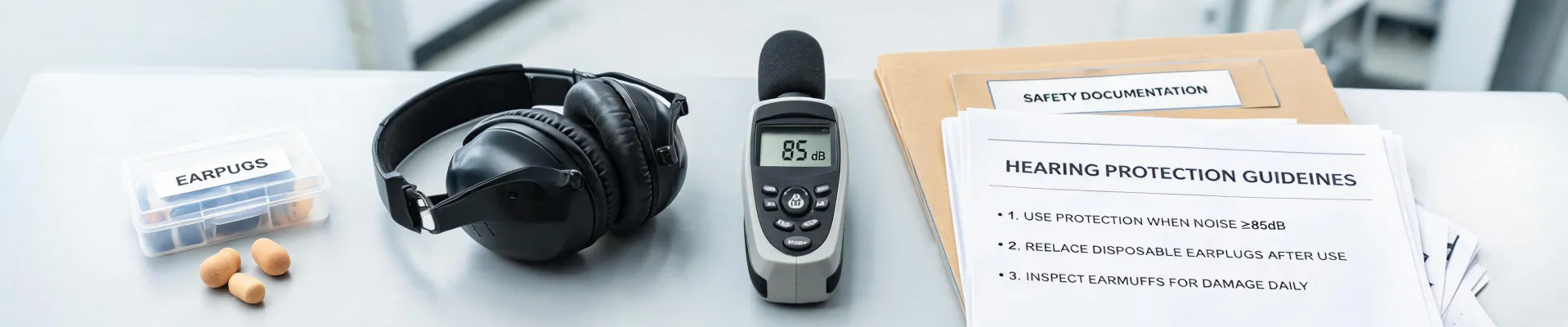
I'm not an audiologist or a safety consultant. I'm a fence and deck contractor who's been doing residential installations since 2017 — and in my first year, I made the classic mistake: treating hearing protection as optional.
Six years and a few too-close calls later, I've landed on a system that works. This is a comparison of the two main types of hearing protection I've used on the job: Howard Leight Laser Lite disposable foam earplugs and over-the-head earmuffs. I'll break them down the way I actually judge things — noise reduction, comfort through a full day, practicality (including what you can carry on a plane), and cost per use.
Dimension 1: Noise Reduction — NRR 33 vs What You're Actually Getting
Start with the numbers:
- Howard Leight Laser Lite foam earplugs: NRR 33
- Typical passive earmuffs: NRR 22 to 30
The Laser Lite sits at the top of the passive hearing protection range. That NRR 33 is as good as it gets without going electronic. But here's what the spec sheet doesn't tell you: the number only counts if the protection is worn correctly.
For foam earplugs, correct wear means rolling the plug down into a tight cylinder, pulling your ear up and back to straighten the ear canal, inserting it deep enough to stay put, then waiting 20-30 seconds for the foam to expand. Simple, but it takes practice. I'd bet most people on a job site — myself included when I started — get maybe NRR 20-25 of actual protection because the plugs aren't seated right.
Earmuffs are more forgiving. Put them on, adjust the headband, confirm the seal, done. But even a well-fitted muff rarely beats a well-fitted foam plug on raw numbers. And if you wear safety glasses with thick frames, the muff's seal breaks where the frame passes through — and you silently lose a chunk of the rated protection.
For context, OSHA's hearing conservation standard (29 CFR 1910.95) requires a hearing conservation program when average noise levels hit 85 dBA over an 8-hour shift. A circular saw runs around 95-110 dBA at the operator's ear. Without protection, you can blow through your entire safe daily noise dose in under an hour.
So on raw noise reduction, the Laser Lite wins. But only if you learn to insert it properly. That's a bigger "if" than the marketing makes it sound.
Dimension 2: All-Day Comfort on Real Fence Jobs
This is where the comparison stops being theoretical. Two jobs from my own schedule:
Wrought iron fence: burst noise, muffs win
Cutting wrought iron with an angle grinder is one of the sharpest, most piercing noises I've experienced on a site. The work happens in bursts — cut, fit, weld, check, move. When the grinder stops, the noise drops fast.
For that rhythm, I prefer muffs. They flip up or come off easily between cuts, no rolling or inserting, and they're ready the second noise starts. Not the most comfortable for hours, but ideal for short, repeated exposures.
Cedar fence pickets: continuous noise, foam plugs win
The cedar fence pickets job was a different story. Cutting pickets with a circular saw, then hammering and nailing for hours, created a constant roar. I wore muffs that day. Big mistake.
By noon, my ears were sweating. The pressure where the muffs pushed against my safety glasses was a steady ache. I kept yanking them off to relieve the pressure — and eventually, I stopped putting them back on.
Switching to the Howard Leight Laser Lite foam plugs fixed that. Once they're seated right, they're essentially invisible. No headband, no sweat build-up, no glasses interference. I've worn them 6-8 hours straight without thinking about them.
Part of me wants to say foam plugs are the answer to everything. Another part knows muffs have a real place — the wrought iron job proved it. I resolve it with both in the truck. But for 6+ hours of constant noise, foam plugs win every time.
This approach worked for me because I do residential fence and deck projects with 8-10 hour days. If you're on a commercial site with 12-hour shifts, your mileage may vary. I can only speak to my own context.
Dimension 3: Practicality — Pockets, Travel, and the Pepper Spray Question
Foam earplugs have one massive practical advantage: they live in your pocket.
Muffs live in your truck. They get thrown around. The headband loosens. And somehow, they're never where you left them when you need them. I once spent a week wearing a cracked, rattly pair of muffs because the backup pair was buried under a tarp.
That portability changed everything. I've never once forgotten to bring foam earplugs to a job. They're in my tool bag, the truck console, my vest pocket, and my carry-on for flights.
Travel is worth a quick note. Can you carry pepper spray on a plane? No. The TSA prohibits it in carry-on, period. In checked bags, it's only allowed in containers of 4 oz (118 ml) or less with a safety cap to prevent accidental discharge. I learned this when a screener pulled a small can out of my carry-on and dropped it into the confiscation bin. So glad I didn't argue — apparently, some travelers get fined for that.
Earplugs are the exact opposite. I fly with a box of Laser Lites and TSA doesn't look twice. It's a small perk, but it matters when you sleep on flights and show up ready to work.
Dimension 4: The Real Cost of Getting It Wrong
Here's the part I wish someone had shown me before my first fence season.
One June day in 2021, I left my earplugs on the kitchen counter. One-day job, about 60 cedar pickets, circular saw. I told myself a few hours wouldn't matter. It did.
By the end of the day, my ears were ringing — not a faint hiss, a pulsing tone that stuck around for three days. I got lucky; no permanent damage that I know of. But it was the wake-up call I needed.
Here's the cost math I run now:
- A 200-count box of Howard Leight Laser Lite earplugs runs about $30-35 — roughly 18 cents per pair (prices seen from Amazon and industrial suppliers, early 2025).
- A decent pair of earmuffs costs $25-40.
- Hearing damage is permanent. Tinnitus alone can cost you sleep, focus, and peace of mind — a lifetime bill, not a one-time fix.
Eighteen cents. That's the price of protecting your ears for a full workday. The idea that skipping it saves money is pure fiction.
There's also a business side I didn't expect: clients notice. When I show up wearing proper hearing protection, it tells them I'm careful. The discipline that makes me put in earplugs is the discipline that makes me set fence posts in concrete properly instead of filling the hole with dirt. Cut corners on your own safety, and clients are right to wonder what else you're cutting corners on.
Bottom Line: Which Should You Pick?
After six years of loud work, here's my honest verdict:
Choose Howard Leight Laser Lite foam earplugs if:
- You face long stretches of continuous noise — fence installs, decking, roofing, full-day cutting.
- You wear safety glasses or a hard hat.
- You want hearing protection that fits in a pocket and never gets left behind.
- You run a small crew and want a disposable, hygienic option you can hand out by the box.
Choose earmuffs if:
- You move in and out of noisy areas constantly and need quick on/off.
- Foam in your ear canals genuinely bothers you.
- You work in cold weather and can use them as ear warmers.
My actual recommendation: keep both in your vehicle. Box of Laser Lites in the cab, muffs on the passenger seat for quick tasks.
And if you're wondering whether the Howard Leight Laser Lite disposable foam earplugs live up to the reputation — yes, they do. At 18 cents a pair, you're getting some of the highest passive noise reduction available in a foam plug. Just learn the roll, pull, insert, and wait. Ten seconds of technique is the difference between industry-leading protection and a false sense of safety.

Maeve Callahan
Maeve Callahan is a head-protection analyst covering Type I and Type II hard hats, climbing-style safety helmets, bump caps, chin straps, suspensions, liners, and face-shield carriers. She applies ANSI Z89.1, EN 397, and EN 12492 criteria while comparing impact attenuation, penetration resistance, lateral deformation, electrical class, retention strength, field of vision, mass, fit range, and temperature conditioning. Her guides help EHS teams, contractors, utilities, and buyers select helmet systems for overhead hazards, work at height, electrical exposure, accessory compatibility, and worker acceptance.