-
What exactly is the Howard Leight Max earplugs NRR 33 specification?
-
Howard Leight MAX vs. Laser Lite—which disposable foam earplugs should I choose?
-
How do I know my earplugs are actually working?
-
When does a fire extinguisher need recharging? Where do I find fire extinguisher recharge near me?
-
What's the best fire extinguisher for a car?
-
Why is my smoke detector beeping every 30 seconds, and how do I get it to stop?
I run the emergency fulfillment desk at a safety equipment distributor. Eight years in, I've handled 200+ rush orders—like the plant manager who needed 150 pairs of Howard Leight Max earplugs by 7 AM for an OSHA visit, or the warehouse supervisor whose fire extinguisher gauge read empty three hours before a fire marshal inspection.
Because I take those calls, I also hear a ton of everyday safety questions. Here are the ones that come up most often, answered straight.
What exactly is the Howard Leight Max earplugs NRR 33 specification?
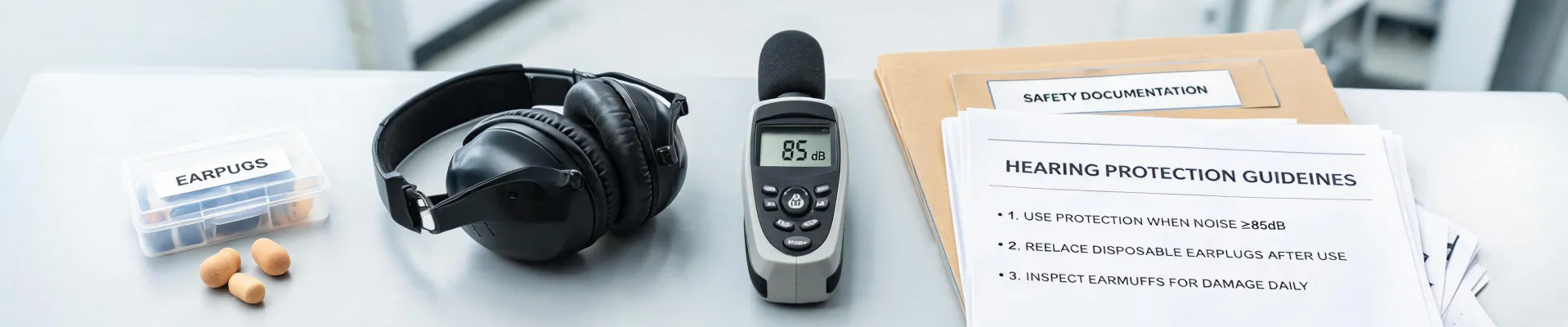
NRR stands for Noise Reduction Rating. It measures how many decibels a hearing protector blocks under EPA-standardized lab tests. The Howard Leight MAX earplug has an NRR of 33—the highest rating available in the U.S. In theory, that takes a 100 dB work environment down to 67 dB at the eardrum.
But here's what I tell every customer asking for "maximum protection": real-world attenuation is way lower than the label. NIOSH recommends derating foam earplugs by 50%, so you're realistically getting around 16 dB of protection from NRR 33 plugs. And if the fit is wrong, you're getting even less than that. I've watched plenty of workers who think they're wearing earplugs correctly when the plug isn't sealing at all.
The MAX is a slow-recovery foam earplug. You roll it into a tight cylinder, reach over your head to pull your ear back, insert it, and hold it for 30–40 seconds while it expands. It's tapered, so it fits a decent range of ear canal sizes. (Should mention: the MAX is the bigger, higher-rated sibling of the Laser Lite—more on that below.)
If you're working in noise at or above 85 dBA over an 8-hour shift, OSHA requires a hearing conservation program. NRR 33 plugs like the MAX are designed for those higher-exposure scenarios—but the fit matters more than the number on the box.
Howard Leight MAX vs. Laser Lite—which disposable foam earplugs should I choose?
I get this one about three times a week. Here's the side-by-side:
- Howard Leight MAX: NRR 33, larger body, slow-release foam, about 60 seconds to fully expand.
- Howard Leight Laser Lite: NRR 32, slimmer profile, bright colors for high visibility, same slow-release foam.
If I remember correctly, the bulk pricing gap was only a few cents per pair at our last supplier update (as of January 2025, at least). So the choice comes down to fit and use case, not price.
Everything I'd read when I started in this industry said highest NRR wins, period. Watching actual workers across hundreds of orders, I found something different: the best earplug is the one that gets worn correctly, all shift long. Workers with smaller ear canals often find the MAX too bulky. The Laser Lite fits slimmer canals better, and those bright colors mean supervisors can spot compliance from across the room—worth way more than 1 dB of lab-tested difference.
So: choose the MAX for punishing noise levels; choose the Laser Lite when comfort and visibility matter most. Both are solid—the fit is what makes or breaks them.
How do I know my earplugs are actually working?
This is the question people never think to ask. It's tempting to assume that if the earplug is in your ear, it's protecting you. But a loose plug can cut real protection to nearly zero.
Try the hand-cup test. With earplugs inserted, cup your hands over your ears. If your breathing sounds loud and your voice sounds muffled, you probably have a good seal. Take your hands away—the noise should jump back up noticeably. No change? Then the plug isn't seated right. Re-roll and re-insert.
For formal verification, fit-testing equipment is the gold standard. We've set that up for a few large clients; the gear costs a few hundred dollars, but when you're protecting hundreds of ears, it pays for itself fast.
When does a fire extinguisher need recharging? Where do I find fire extinguisher recharge near me?
Any use means recharge. Even a one-second squeeze changes the internal pressure—you no longer have a full extinguisher. Other red flags: the gauge needle is out of the green zone, the pin is missing, or there's visible rust, corrosion, or physical damage.
Recharging is not a DIY project. (Seriously, don't mess with a pressurized cylinder.) Search "fire extinguisher recharge near me" and you'll get a list of local fire safety service companies. Look for certified technicians, and call your local fire department's non-emergency line if you need a referral. That tip saved a client of ours in 2024 who had 30 extinguishers to service and no idea who to trust.
The recharge itself typically takes one or two business days. And before you commit, compare the cost to replacement: a 5-lb ABC extinguisher costs about $15–25 to recharge, while a new one runs $30–50 (based on typical service rates, as of January 2025). When the gap is that narrow, replacement often makes more sense—especially for units past 12 years, which NFPA 10 says need hydrostatic testing or retirement anyway.
What's the best fire extinguisher for a car?
A 2.5-lb or 5-lb ABC dry chemical extinguisher. ABC covers ordinary combustibles (paper, wood), flammable liquids (gasoline, oil), and electrical fires—the three things you're most likely to face on the road.
Most people overlook the mounting location. If the extinguisher is buried under cargo in the trunk, it's useless when your engine starts smoking. Bolt it to the trunk floor or get a seat-mount bracket within reach. I remember a driver back in 2022 who lost his car because he couldn't safely get to the extinguisher in his trunk—he got out fine, but the car didn't.
Size matters too: a 5-lb unit is the sweet spot for passenger vehicles. Big enough for a real engine fire, small enough to secure properly. A 2.5-lb unit is fine for quick access but runs out fast against a spreading fire.
But then again, if you drive an EV, a standard ABC unit may not handle a lithium-ion battery fire. For thermal runaway, your safest move is to pull over, get out, and call 911. Don't fight a battery fire with equipment that isn't rated for it.
Why is my smoke detector beeping every 30 seconds, and how do I get it to stop?
First, know the sounds. A continuous loud alarm means smoke or carbon monoxide is detected—get out and call 911. A chirp every 30–60 seconds is the low-battery or end-of-life signal. That's the one driving you crazy.
To fix it:
- Take the detector down.
- Replace the battery (most use 9V, some use AA).
- Press the test button to confirm it beeps once.
- Remount it and listen for chirps over the next few hours.
Still chirping? Check the manufacture date printed on the back—most detectors last about 10 years, and the chirp is their way of retiring. Dust inside the sensor can also cause false alerts; blow it out with compressed air. And don't forget the backup battery on hardwired units; I dealt with a facility in 2023 where five detectors chirped in unison because their backup 9V batteries were stale.
Bottom line: replace the battery first, and if that doesn't stop it, replace the detector. A new one runs $15–30—worth every penny for the sleep alone.

Maeve Callahan
Maeve Callahan is a head-protection analyst covering Type I and Type II hard hats, climbing-style safety helmets, bump caps, chin straps, suspensions, liners, and face-shield carriers. She applies ANSI Z89.1, EN 397, and EN 12492 criteria while comparing impact attenuation, penetration resistance, lateral deformation, electrical class, retention strength, field of vision, mass, fit range, and temperature conditioning. Her guides help EHS teams, contractors, utilities, and buyers select helmet systems for overhead hazards, work at height, electrical exposure, accessory compatibility, and worker acceptance.