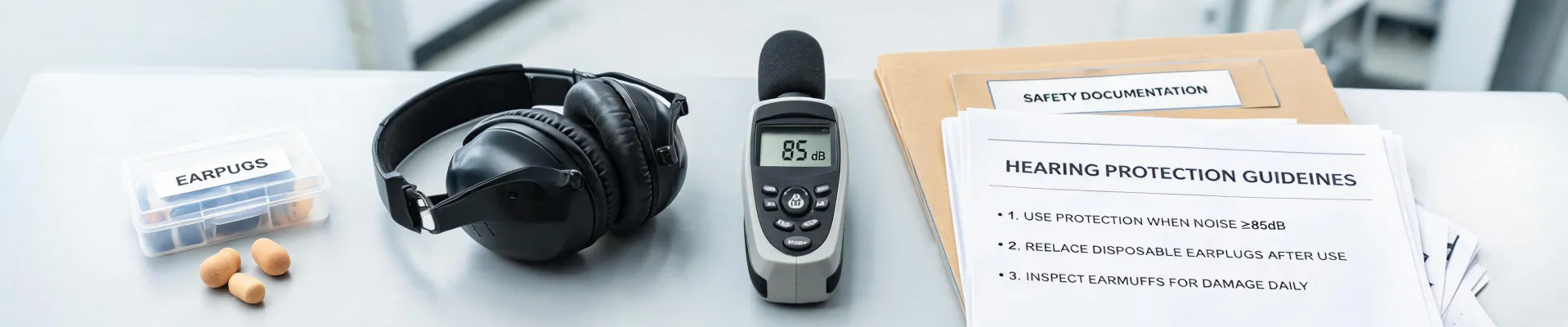
The Wake-Up Call
I've been handling safety equipment orders for seven years. In that time, I've documented fourteen significant mistakes, totaling roughly $4,700 in wasted budget. The hearing protection one was the worst, and not just financially.
In September 2022, I was doing a routine walkthrough of our fabrication shop. I had my Howard Leight Max foam earplugs in—those yellow cylinders with NRR 33 on the box, the highest rating you can get from a disposable plug. If you'd asked me that day if my ears were safe, I'd have said absolutely.
That night, my ears were ringing. Not painfully, just a low, persistent whine in both ears. I told myself it was fatigue. It didn't stop for three days. When I finally got a hearing test, the audiologist pointed at my audiogram and didn't sugarcoat it: "This notch at 4,000 hertz is noise damage. It's permanent."
The most frustrating part of hearing protection: I knew the risks. I knew noise-induced hearing loss is irreversible. But I honestly believed that NRR 33 meant maximum protection, and that the number on the box was all I needed to understand.
I was wrong about almost everything. Not about the product—about how hearing protection actually works.
The Surface Problem: "My Earplugs Aren't Working"
When people search for "howard leight max earplugs nrr" or "earplugs not blocking noise," the assumption is always the same: the product isn't good enough. The next step is upgrading. Electronic earmuffs. Custom-molded plugs. Something that costs $400 and promises more. I went down that road too, dropping $890 on custom-molded electronic earplugs in 2023.
It didn't help. Because the problem wasn't the product. The surprise? The $0.30 foam earplug I'd been wearing for years was actually capable of protecting me perfectly. I simply wasn't using it right.
The Real Problem: NRR 33 Is a Lab Number, Not a Guarantee
Here's the uncomfortable truth that's not printed on any box: the Noise Reduction Rating comes from laboratory testing. Perfect conditions, trained technicians, flawless insertion. Real life is messier. Sweat, dust, movement, time pressure—all of it degrades real-world performance.
That's why NIOSH recommends derating hearing protection to estimate realistic exposure reduction. For foam earplugs, the guidance typically puts real-world attenuation at roughly half the lab rating—so an NRR 33 plug might realistically deliver around 13–16 dB, depending on the estimation method. That's not a knock on Howard Leight. Every foam earplug gets derated similarly, no matter the brand. It's a limitation of the rating system, not a product defect.
The Fitting Mistake
For three years, I inserted foam earplugs completely wrong. I knew, in a vague way, that there was a technique—the box mentions it, the website has a video. But I'd think, "what are the odds? It's a blob of foam. How much technique could it really need?"
That thought is exactly how hearing gets damaged. Proper foam plug insertion requires:
- Rolling the plug into a tight, crease-free cylinder.
- Reaching one hand over your head and pulling the opposite ear up and back to straighten the ear canal.
- Inserting the plug fully, then holding it while the foam expands—about 20 seconds.
Done right, the plug sits deep enough that you can barely see it from the outside. If it's sticking out of your ear like a little yellow chimney, it's not seated properly. The protection difference between correct and "good enough" insertion can be 10 to 15 dB. At 100+ dBA, that's the difference between safe and not safe.
The odds caught up with me when my audiogram showed the notch. I finally watched Howard Leight's four-minute fitting video after the OSHA scare in 2024. It showed me every single thing I'd been doing wrong. Nobody—not the distributor, not the safety consultant, not a single product page—had ever walked me through it.
The Reuse Delusion
I also treated foam earplugs as reusable. I'd keep the same pair for days, sometimes longer, stuffed in a shirt pocket between uses. The foam degrades with reuse—it loses its slow-recovery memory, compresses unevenly, collects grease and dirt. After a few insertions, the attenuation drops noticeably, and you don't even feel the difference.
Foam earplugs are single-use. That's not a marketing conspiracy. It's a functional requirement.
The math makes it a no-brainer: a box of Howard Leight Max foam earplugs runs around $20 for 200 pairs, based on online pricing I checked in early 2025. Ten cents a pair. You can wear a fresh pair every single workday for under $5 a month. I used to carry one crusty pair around for a week to save... ten cents.
The Cost of Getting It Wrong
I'm a numbers guy, so let me lay out the actual price of my ignorance.
Health. Noise-induced hearing loss is cumulative and incurable. OSHA sets the hearing protection action level at 85 dBA over an 8-hour shift. At 100 dBA—typical for metal fabrication and heavy industry—your permissible exposure time drops to just 2 hours. Without effective protection, you're damaging your ears every single day, and the damage doesn't heal. Tinnitus, the ringing that got my attention, is often the only warning before a permanent audiogram dip appears.
Money. I spent $890 on custom-molded earplugs that didn't fix anything because the real problem was technique. I spent another $380 on premolded plugs that had the same flaw. $1,270 total, and my actual protection level didn't improve by a single decibel.
Compliance. We got flagged during an OSHA inspection in early 2024 because our noise exposure assessment showed inadequate hearing protection—workers were wearing earplugs, but ineffectively. The potential fine was around $15,000. We avoided it by implementing a training program that should've existed from day one.
All of that, because I trusted a box label more than the basic physics of how foam plugs work.
The Fix: It's Boring, and That's the Point
Here's what actually fixed it for our shop, in order of importance:
- Fresh earplugs, every shift. We put a dispenser box of Howard Leight Max at the workshop entrance. Grab a pair going in, toss it going out. No cost burden, no tracking, no arguments.
- Make the fitting video part of onboarding. It's four minutes long. Every new hire watches it and demonstrates proper insertion once before they start. That's it. The whole training.
- Only then consider an upgrade. After fixing technique and freshness, if your environment still needs more attenuation, look at earmuffs or double protection. But in our shop, correctly fitted NRR 33 foam plugs handle the majority of tasks comfortably.
- Keep a checklist. I maintain a one-page hearing protection checklist on our safety board now. It covers correct fit, fresh pair, double protection when needed, and stock rotation. It came directly from my own mistakes, and it's caught multiple potential issues since.
The Same Pattern Is Everywhere in Safety Equipment
I started with earplugs, but the pattern—buying the thing before understanding the problem—shows up in every safety category. And it's especially hard on small businesses and individual buyers, because you don't have a corporate safety department guiding you.
My friend bought a fire extinguisher for car use. Smart idea. He got a compact unit, mounted it in the trunk, and never checked the pressure gauge for two years. It was dead weight the whole time. A fire extinguisher for car emergencies is worth having, but only if you check it monthly, know which fire classes it covers, and actually have a plan for using it.
Same with an aluminum fence around a property. People buy one for safety and security, but the real protection depends on gap spacing, height, and installation quality. A decorative aluminum fence with wide gaps looks secure but is remarkably easy to defeat. You don't need a "better" fence—you need to match the product to the specific risk you're trying to solve.
And pepper spray? The number of people who ask "is pepper spray legal in nyc" after buying it from an out-of-state website is too high. In NYC, pepper spray is legal under specific conditions—you must be 18+, buy from an authorized New York State retailer, and follow possession rules. But the online purchase is easy, and the legal tangle it creates can turn a self-defense tool into a criminal possession problem. Nobody checks the law until after they've made the purchase. Exactly like I didn't check the fitting instructions until after my hearing was damaged.
When I was starting out in this role, the vendors who treated my $200 orders seriously are the ones I still buy from today—now that my orders are much bigger. Small doesn't mean unimportant; it means potential. But it also means you're often navigating safety decisions alone. That's precisely when you need to slow down and ask the basic questions.
Bottom Line
The equipment was never the problem. I spent seven years buying safety gear for money and three years wearing the best-rated earplugs on the market, all while my hearing was quietly getting worse.
Don't be me. Watch the fitting video. Throw away your crusty old earplugs. And if you're buying safety gear for a small team or just for yourself, don't settle for "the box says NRR 33, good enough." Ask the questions. Check the instructions. Verify the legal context.
The $20 box of Howard Leight Max earplugs is honestly the cheapest and best insurance I've ever bought. The ten-cent foam plug is remarkable technology. But it only works if you use it the way it was designed to be used.
I learned that the hard way so you don't have to.

Maeve Callahan
Maeve Callahan is a head-protection analyst covering Type I and Type II hard hats, climbing-style safety helmets, bump caps, chin straps, suspensions, liners, and face-shield carriers. She applies ANSI Z89.1, EN 397, and EN 12492 criteria while comparing impact attenuation, penetration resistance, lateral deformation, electrical class, retention strength, field of vision, mass, fit range, and temperature conditioning. Her guides help EHS teams, contractors, utilities, and buyers select helmet systems for overhead hazards, work at height, electrical exposure, accessory compatibility, and worker acceptance.