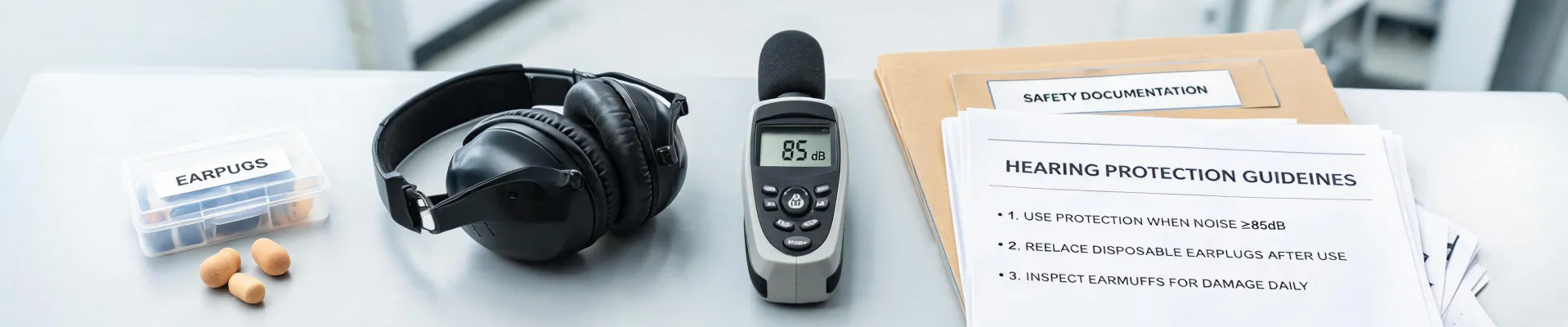
The Phone Call That Starts Every Hearing Loss Story
In March 2024, 36 hours before a plant shutdown, a safety manager called me in a panic. The annual audiograms were back, and three more workers had significant threshold shifts.
"We bought good earplugs," she said. "Howard Leight, high NRR. What else can we do?"
I hear some version of this question a lot. It's not because the product failed. It's because the program was built around a number printed on a box. NRR is important. It's just not the whole story.
The Problem You Think You Have: Not Enough NRR
When exposure measurements come back too high, the first move is usually "get a higher NRR." That's tempting. It's also the oversimplification that keeps causing hearing loss.
NRR stands for Noise Reduction Rating. It's a lab number, measured under ideal conditions with a perfect fit and a trained user. In the real world, protection drops. A worker who misses a tiny fold in the foam, inserts it too shallowly, or takes it out to talk has already lost most of the benefit.
It's tempting to think you can just compare NRR numbers. But identical specs don't guarantee identical results. The more useful question is: did this worker get a personal fit that they can wear comfortably for a full shift?
The Real Problem: Fit, Comfort, and Behavior
Why do workers take earplugs out? Usually because they're uncomfortable, or because they can't hear what they need to hear. Once they're out, the protection is gone.
Think of a wood fence around a noisy compressor. It might block some sound, but sound wraps around and leaks through gaps. If the gate is open, the fence does nothing. An earplug with a poor seal is the same open gate.
If the only option is one size and one material, you're asking a workforce with different ear canals to live with pressure, irritation, or muffled communication for eight hours. Some will accept it. Many won't.
Then there's the communication problem. In many plants, workers need to hear machine changes, coworkers, and alarms. When earplugs make that impossible, they'll "forget" to wear them. Electronic earmuffs Howard Leight Impact Sport models are a strong middle ground: they amplify speech and suppress dangerous impulse noise.
For steady noise, the Howard Leight Laser Lite soft foam earplugs are a common choice. But foam only works when inserted correctly. Roll the plug into a tight crease, pull the ear up and back, insert, and hold while the foam expands. I've watched experienced workers skip the roll and push foam into the ear like a plunger. That's not a product problem. It's a training and verification problem.
And don't assume consumer products are a substitute. Eargasm earplugs are designed for concerts and conversations. They preserve music clarity and look cool, but they're not engineered for 8-hour industrial exposures. If a worker brings them from home, that's a clue: your approved options aren't comfortable enough.
Higher NRR doesn't matter if the earplug is sitting in a pocket.
What This Costs You
Occupational hearing loss is permanent. It's also invisible until it shows up on an audiogram. The delay makes it easy to postpone.
Under OSHA's hearing conservation standard (osha.gov), once noise averages 85 dBA or higher over an 8-hour shift, you need a program: exposure monitoring, audiometric testing, training, and access to hearing protectors. A citation under 29 CFR 1910.95 can turn a quiet compliance file into a loud legal problem.
But the bigger cost is human. A worker with preventable hearing loss often struggles at home, not just at work. There's also the productivity cost: workers who can't hear alarms move slower, ask more questions, and make more mistakes.
One case of hearing loss can cost more than a year's supply of earplugs. And that's before you count turnover and morale.
What Actually Works
Looking back, I should have pushed for fit testing much earlier. At the time, we trusted the NRR on the box and assumed the training stuck. It didn't. If I could redo that decision, I'd put fit testing at the beginning, not after a failed audiogram. But given what we knew then, the choice seemed reasonable. That's exactly how hearing loss programs drift: by degrees.
Here's what I'd do differently:
- Fit-test every worker. A personal attenuation rating takes minutes and shows whether the protector actually seals. If it doesn't, try another type.
- Offer more than one solution. Laser Lite foam for continuous high noise. Impact Sport electronic muffs for intermittent noise. Maybe a no-roll foam option for workers who can't get the technique right.
- Train with a checklist. Roll, pull, insert, hold. Watch each worker do it. Repeat the training every six months.
- Treat it as a system. Re-measure noise when the process changes. Re-test hearing annually. Review fit results and adjust.
The upside of offering electronic muffs is better worker acceptance. The risk is relying on a lower NRR in extreme noise. The answer is measurement: only use them in areas where exposure allows. We don't guess with respirators; we fit-test. Hearing protection should get the same respect.
In the March 2024 case, we didn't rip out the whole program. We added options, retrained the crew, and started fit testing. The fix wasn't exotic. It was honest measurement and better choices.
A Final Word
Howard Leight has been a trusted name in hearing protection for decades. It's a Honeywell brand with a long product line, and there's a reason safety managers keep coming back to it. But no brand can fix a program that ignores fit, comfort, and behavior.
The question isn't "what has the highest NRR?" It's "what will this worker wear correctly for the whole shift?" When you answer that, the audiogram takes care of itself.
Maeve Callahan
Maeve Callahan is a head-protection analyst covering Type I and Type II hard hats, climbing-style safety helmets, bump caps, chin straps, suspensions, liners, and face-shield carriers. She applies ANSI Z89.1, EN 397, and EN 12492 criteria while comparing impact attenuation, penetration resistance, lateral deformation, electrical class, retention strength, field of vision, mass, fit range, and temperature conditioning. Her guides help EHS teams, contractors, utilities, and buyers select helmet systems for overhead hazards, work at height, electrical exposure, accessory compatibility, and worker acceptance.