-
The 'Best' Answer Depends on the Noise
-
Scenario A: Continuous Noise, No Communication Needed
-
Scenario B: Intermittent Noise or Need for Situational Awareness
-
Scenario C: Multi-Hazard Workplaces and PPE Compatibility
-
How to Identify Your Scenario
-
The Counterintuitive Part
-
Before You Order: Quick Checklist
The 'Best' Answer Depends on the Noise
I've been ordering personal protective equipment for a manufacturing group for seven years. I've made 11 documented PPE procurement mistakes that cost roughly $18,000 in wasted budget. The most expensive lesson? There is no universal 'best' Howard Leight hearing protection. It depends on the noise level, the workers, and everything else they are wearing.
Before I recommend anything, I ask two questions: How loud is it, and does the person need to hear anything unsafe?
Based on that, I put most buyers into three scenarios:
- Scenario A: Continuous high noise, no need for conversation, no other headgear conflicts.
- Scenario B: Intermittent noise, or workers need to hear signals, voices, or alarms.
- Scenario C: Multi-hazard environments where hearing protection has to coexist with chemical gloves, hard hats, respirators, or fire safety equipment.
Scenario A: Continuous Noise, No Communication Needed
In a machine hall with constant press noise and no need to talk, foam earplugs are usually the right call. Howard Leight Max foam earplugs with NRR 33 are one of the highest attenuation options I know. But the highest NRR only works if people wear them correctly.
In September 2018, I ordered 4,000 pairs of Howard Leight Max for a plant. The numbers said NRR 33 was the obvious choice. My gut said the operators wouldn't insert them properly. I went with the numbers anyway. Result: boxes of earplugs sat in the storage area because rolling and inserting foam plugs takes two free hands and a little practice. The product wasn't bad. My training plan was.
Why does this matter? Because a perfect spec on paper is worthless if the user gets an acoustic seal. The question isn't 'which earplug has the highest NRR?' It's 'will your team insert them correctly, every shift?'
For European compliance, look for the Howard Leight by Honeywell EN 352 mark. EN 352 is the European hearing protector standard, and it is not identical to NRR. The package will show an SNR value based on EN 352 test methods. I've seen buyers confuse NRR 33 with an SNR rating—always verify which standard applies in your country. I checked the labels in our storage room in February 2025, and the EN 352 mark is right there on the box.
Scenario B: Intermittent Noise or Need for Situational Awareness
Now flip the scenario. Workers on a loading dock, a shooting range, or a maintenance crew need to hear warnings, instructions, or each other, but the noise sometimes spikes. That's where earmuffs Howard Leight Impact Sport shine.
The Impact Sport model amplifies quiet sounds while limiting loud impulses. It's not a bulletproof suit; the NRR is around 22 dB. But the real-world protection can be better than a higher-rated plug that people rip out because they feel isolated. I have mixed feelings about electronic earmuffs: they cost more, they need batteries, and the padding wears out. On the other hand, workers actually wear them because they can still hear a supervisor or a truck backing up. Don't hold me to exact battery life—every supplier quotes different numbers—but budget for replacements.
I made a rushed decision here, too. Had 2 hours to place an order before a maintenance shutdown. Normally I would have distributed samples to a few mechanics and asked for feedback. There was no time, so I bought based on a colleague's recommendation. The muffs worked. But if I'd had time, I would have caught two issues: the headband clashed with some hard hats, and one mechanic needed custom gel pads for long shifts.
Scenario C: Multi-Hazard Workplaces and PPE Compatibility
This is the scenario that catches most safety buyers off guard. Hearing protection doesn't exist in a vacuum. If your crew is also using chemical-resistant gloves, a wet chemical fire extinguisher, hard hats, or respirators, every item has to fit into the same workday.
Let's take a simple example: what are nitrile gloves? They're synthetic rubber gloves used for chemical handling and general tasks. They give great dexterity and avoid the latex allergy problem. But some workers don't realize that a slick glove surface can make foam earplug insertion harder. If you don't train the dry-finger technique, workers give up and wear the earplugs halfway. The glove didn't fail. The integration failed.
Similarly, if you're buying fire safety equipment for a kitchen or cooking area, a wet chemical fire extinguisher is the correct match for oil and grease fires—not a standard dry chemical unit. In the U.S. that's usually a Class K extinguisher; in Europe it's often classified as Class F. I learned this after my first fire extinguisher order got flagged by an inspector. The extinguisher was fine for a paper fire. It was wrong for the deep fryer.
The point is not to memorize every product category. It's to ask what hazards exist in the same place at the same time. Think about it in terms of boundaries. An invisible fence for dogs is meant to keep a pet inside a yard. It works because the boundary is clear. Hearing protection is the same: the 'boundary' is the noise dose, and the protector has to match that boundary. Searching 'invisible fence for dogs' won't help you protect a worker's hearing, but it does remind me that a solution only works when it matches the problem.
Here's the thing: no supplier can hand you a universal 'industrial safety kit.' You need to define your noise, your chemical exposure, your fire risk, and your PPE compatibility before you compare prices.
How to Identify Your Scenario
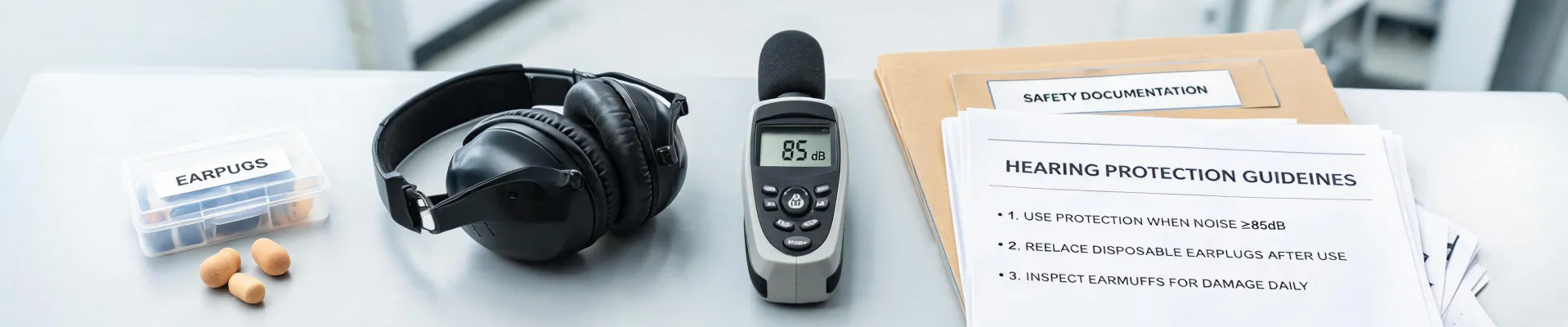
Don't rely on my article—or a search engine—to know your worksite. Walk around with a noise meter. If you don't have one, borrow or rent one. The point is to measure, not guess.
Three steps I now use on every new project:
- Measure the exposure. OSHA's hearing conservation standard (29 CFR 1910.95) requires protection when average noise reaches 85 dBA over 8 hours. That's the point where you need a program, not just a box of earplugs.
- Test before you buy. A two-week trial with five workers will tell you more than a spec sheet. Check for fit, comfort, communication, and compatibility with glasses, hard hats, respirators, and yes, gloves.
- Check the label. For U.S., use NRR. For Europe, use EN 352. Per FTC guidelines (ftc.gov), marketing claims need to be substantiated—so I trust the standard label over the brochure.
The Counterintuitive Part
If you ask me, the biggest mistake isn't choosing the wrong brand. It's chasing the highest attenuation number. A worker who takes off a high-NRR earmuff to talk to a supervisor gets no protection during that conversation. A slightly lower-rated electronic muff that stays on the head all shift may be the safer choice. Look, I'm not saying NRR is useless. I'm saying it's only part of the picture.
In my opinion, the best Howard Leight product for your site is the one your workers will wear correctly, for the full time they're exposed. That might be a disposable foam earplug. It might be an Impact Sport earmuff. It might be a combination of both for different zones.
And if you're a small company trying to buy safety gear, don't let a supplier make you feel silly for asking. The vendors who treated my $300 first order seriously are the ones I still order from today on $20,000 purchase orders. Small doesn't mean unimportant. It means you're building the same risk management systems the big companies have—just with fewer resources.
Before You Order: Quick Checklist
- Noise levels measured, not guessed.
- Target protection based on OSHA/NIOSH or your local regulations.
- EN 352 or NRR label checked for the country where the product is used.
- Samples tested with actual PPE: hard hat, glasses, respirator, gloves.
- Workers trained on insertion, care, and when to replace.
- Fire and chemical hazards reviewed, including the correct extinguisher type for the risk.
That's the process I wish I'd used in 2018. It won't make the decision automatic—because it's never one-size-fits-all. But it will keep you from buying a solution to the wrong problem.

Maeve Callahan
Maeve Callahan is a head-protection analyst covering Type I and Type II hard hats, climbing-style safety helmets, bump caps, chin straps, suspensions, liners, and face-shield carriers. She applies ANSI Z89.1, EN 397, and EN 12492 criteria while comparing impact attenuation, penetration resistance, lateral deformation, electrical class, retention strength, field of vision, mass, fit range, and temperature conditioning. Her guides help EHS teams, contractors, utilities, and buyers select helmet systems for overhead hazards, work at height, electrical exposure, accessory compatibility, and worker acceptance.