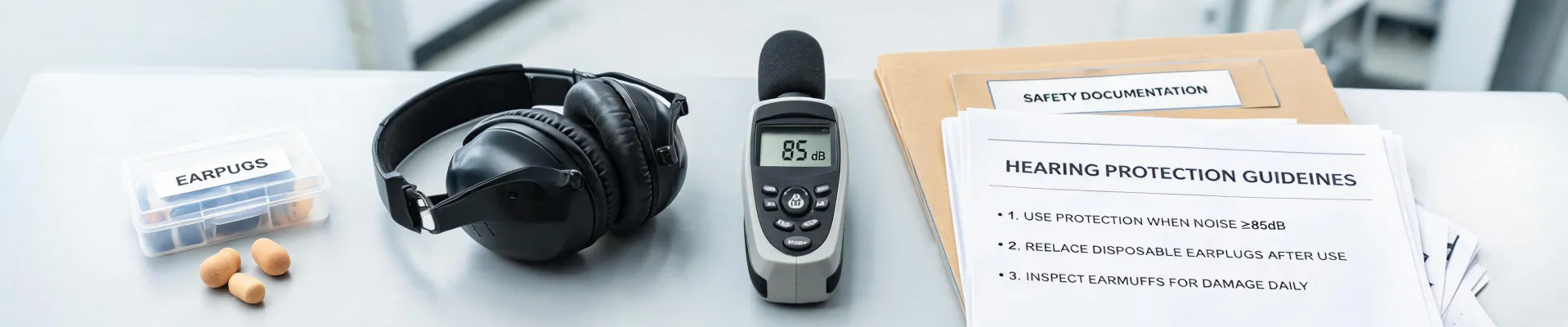
The total cost of a cheap earplug
Here's what you need to know: unit price is the part of the cost you can see. It's also the least reliable part. Total cost of ownership includes fit testing, training, replacement rates, worker acceptance, compliance documentation, and the cost of a hearing loss claim. The cheap earplug can be the most expensive earplug in the building. When I read Howard Leight Max Lite earplugs reviews, I look for two things. First, comfort. Second, the NRR. Max Lite has an NRR of 33, and if the product is going to be worn for a full shift, comfort is not a soft metric—it's a TCO metric. If workers take them out because they hurt, the NRR listed on the box is irrelevant. Most reviews focus on comfort and noise reduction, which is useful. But as a buyer, I need more: How do they fit across different ear canal sizes? Do workers re-use them or toss them? What's the actual replacement rate on the floor? The review section is a starting point, not a substitute for a trial order. Before a full roll-out, I order a small batch and let a cross-section of employees wear them for a week. That trial is cheaper than a full program switch. Honestly, a $50 trial order has prevented more than one bad decision. We also use Howard Leight Laser Lite foam earplugs in higher-noise areas. The bright green color makes compliance checks easier. I can walk the floor and see whether someone is actually wearing protection. That sounds trivial, but it has saved us a ton of time at audit time.Cheap vs. high-quality: a common misconception
People assume expensive hearing protection costs more because it's a premium brand. Actually, it costs more because it's tested, documented, and accepted by workers. The causation runs the other direction: high-quality PPE costs more to make because the manufacturer is solving for the worst case. When you buy a $0.12 earplug that wasn't fit-tested, you're not saving $0.12—you're buying risk. Here's a real example. A few years ago, I approved a change to a generic foam earplug because it was about $200 cheaper per case than the Howard Leight product we'd been ordering. The samples passed a basic spec check. The first fit-testing round did not. We had a 14% failure rate, which meant more training, more re-tests, and more worker frustration. When I added up the labor, the re-testing, and the delays, that 'savings' cost us close to $1,900. I don't have the exact invoice anymore, but the lesson stuck. I also learned never to assume 'same NRR' means same performance. The assumption is that two earplugs with NRR 33 are interchangeable. They're not. Attenuation is measured in a lab under ideal conditions. Real-world protection depends on fit, training, and whether the worker can tolerate the plug. That's why I read reviews and ask to see the data, not just the spec sheet. This is also where the FTC guidelines matter. According to FTC advertising guidelines (ftc.gov), product claims have to be truthful and substantiated. So if a supplier tells me 'this is just as good as Howard Leight' without attenuation data from an accredited lab, I treat that as a marketing claim, not a specification. The packaging should show ANSI S3.19 test values. If it doesn't, I pass.What liquid chemical exposure teaches you about PPE
I get asked the same question in almost every safety review:Which PPE can protect you from liquid chemicals?The answer is never one product. It's a system—chemically resistant gloves, splash goggles, face shields, aprons, and the correct respirator—selected from the chemical's SDS. The same logic applies to hearing protection. You don't ask which single item fixes noise exposure. You ask what the exposure is, what the protection is rated for, and whether the worker will actually wear it. The SDS tells you the required glove material, breakthrough time, and whether a respirator is needed. If someone asks me which PPE can protect you from liquid chemicals, my first answer is: which chemical, what concentration, and what task? The same is true for noise: what's the decibel level, how long is the exposure, and what is the worker doing? I'm not being dramatic when I say PPE isn't like buying hog wire fence panels or stair railing. I've ordered those too. For a fence panel, you need a tape measure and a site plan. For stair railing, you need a code check and a mounting schedule. For PPE, you need to know the hazard, the standards, and the real-world failure modes. When procurement treats earplugs like fence panels, the lowest quote wins—and the company eats the difference later.
Let me respond to the objection
I hear the same argument from other procurement people: 'All foam is the same. You're overthinking a commodity.' Respectfully, no. The specs look similar and the purchase price is small, but that's exactly why TCO matters more, not less. It's easy to skip the thinking when the line item is small. That's how a $200 'savings' becomes a $1,900 rework and a compliance risk. Another version of the objection is that TCO is overkill for a low-cost item. That's fair for a single order. But a hearing protection program repeats. If you buy 10,000 pairs a year, a one-cent price difference is $100. A 5% fit-test failure is hours of retraining. Scale changes the math. If you want to avoid my mistakes, here's the short version of how I evaluate a hearing protection purchase now:- Calculate TCO, not unit price. Include fit testing, training, replacement, and audit hours.
- Check the attenuation data. I look for ANSI S3.19 values on the box or technical sheet.
- Ask the safety team for worker feedback. Comfort is not a soft metric; it's a compliance metric.
- Verify vendor claims. Per FTC guidelines (ftc.gov), claims must be substantiated—so ask for the report.
- Keep a documented basis for the choice. When an auditor asks why you chose one plug over another, 'because it was cheap' is not a defensible answer.
Bottom line
So, would I recommend Howard Leight? Based on my experience, yes—but not because of the name. The NRR 33 rating is backed by data, the products are comfortable enough that workers don't fight them, and the compliance documentation is easy to track. If you're comparing Max Lite, Laser Lite, or another Honeywell option, compare the whole cost, not just the price per case. My position hasn't changed: buying PPE on unit price is a false economy. The cheap option isn't cheap if it doesn't perform. The right option controls the total cost of the outcome you're trying to prevent. That's the review that matters.
Maeve Callahan
Maeve Callahan is a head-protection analyst covering Type I and Type II hard hats, climbing-style safety helmets, bump caps, chin straps, suspensions, liners, and face-shield carriers. She applies ANSI Z89.1, EN 397, and EN 12492 criteria while comparing impact attenuation, penetration resistance, lateral deformation, electrical class, retention strength, field of vision, mass, fit range, and temperature conditioning. Her guides help EHS teams, contractors, utilities, and buyers select helmet systems for overhead hazards, work at height, electrical exposure, accessory compatibility, and worker acceptance.