-
There's No 'Best' Hearing Protection—Only the Right Fit for Your Workplace
-
What NRR Really Tells You (and What It Doesn't)
-
Scenario A: Continuous High-Noise Environments
-
Scenario B: Intermittent Noise + Communication Needs
-
Scenario C: Workers Who Keep Taking Them Out
-
How to Figure Out Which Scenario You're In
-
Bottom Line
There's No 'Best' Hearing Protection—Only the Right Fit for Your Workplace
If you've ever stood in front of a shelf of earplugs and earmuffs, trying to decide which one to buy for your crew, you know the frustration. Every product promises noise reduction. Every box has a rating. But none of them tell you which one your workers will actually keep in their ears past lunchtime.
The truth is, hearing protection isn't a one-size-fits-all purchase. What works for a crew sitting under 100 dB of stamping press noise isn't the same thing that works for maintenance techs who need to hear radios and alarms.
In my role coordinating PPE supply for industrial clients, I've processed 200+ hearing protection orders—including 47 rush jobs in the last year alone. Some of the costliest mistakes I've seen happen when purchasing decisions are made at a desk, without ever asking the crew. We lost a $12,000 contract in 2023 because a client felt our advice was too generic—she polled her crew, and they disagreed with our blanket recommendation. That's the moment we switched to scenario-based advice.
What NRR Really Tells You (and What It Doesn't)
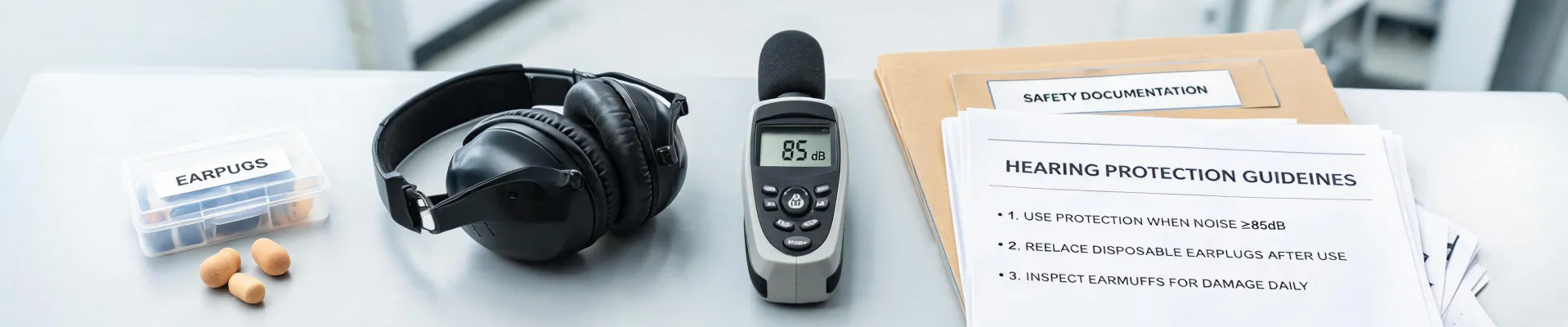
When you're choosing the type of hearing protection you use, the first number everyone looks at is NRR—Noise Reduction Rating. It's a lab-tested figure that indicates how many decibels the product can block under ideal conditions. Howard Leight foam earplugs, for example, carry up to 33 NRR, among the highest you can get.
Here's the catch: real-world protection is almost always lower. NIOSH recommends derating NRR by 50% when estimating actual on-the-job protection. That means a 33 NRR earplug realistically delivers around 16–17 dB in practice (as of 2025, at least—NIOSH has maintained this guidance for years).
NIOSH recommends derating the labeled NRR by 50% when estimating real-world protection levels for workers.
People assume a higher NRR always means better protection. Actually, that logic falls apart the moment a worker's ears start hurting. If a plug is uncomfortable, it's coming out. And an earplug sitting in a pocket protects at exactly 0 dB.
Scenario A: Continuous High-Noise Environments
Think stamping presses, engine rooms, sawmills—operations running at 95+ dB for a full eight-hour shift. Maximum attenuation is the priority.
The right fit: high-NRR foam earplugs like Howard Leight Max (NRR 33).
Roll-down foam earplugs are the workhorse here for good reasons:
- They expand to fit varying ear canal shapes, so sizing issues are rare.
- They're disposable—no cleaning, no storage, no hygiene problems.
- They're inexpensive enough to stock in bulk, making replacement painless.
The one non-negotiable is proper insertion. I've seen safety managers hand out foam plugs without any training and then blame the product when compliance numbers don't improve. Workers need to learn the roll-insert-hold technique: roll the plug into a tight cylinder, pull the ear up and back, insert, and hold until it expands.
In March 2024, a plant manager called 36 hours before a corporate audit. He'd ordered 200 pairs of Howard Leight foam earplugs, but nobody on the floor knew how to fit them correctly. We sent a trainer with fit-testing equipment, and the audit passed—but it was closer than it should have been. Missing that deadline would have triggered a $50,000 penalty clause on a client contract.
Scenario B: Intermittent Noise + Communication Needs
Now consider maintenance crews, airport ground staff, or a supervisor who walks through noisy zones but spends most of the shift in quieter areas. These workers need hearing protection, but they also need to hear conversations, radios, and safety alarms.
Foam earplugs are a poor fit here. Workers constantly remove and reinsert them, plugs get lost, and the "what?" game gets old fast.
The right fit: banded earplugs or over-the-head earmuffs.
Banded plugs sit on a lightweight band that hooks around the neck between uses. Earmuffs are even easier to push aside when a worker needs to hear. Howard Leight makes both, so compatibility with other PPE is straightforward.
One thing to watch: if workers wear hard hats in these zones, make sure the earmuffs are compatible with the helmet. Some models mount directly onto the hat's slots. And if electrical hazards are present, the hard hat should be a Class E hard hat (rated for up to 20,000 volts)—not just any helmet with a muff clamped on. I've flagged this during more than one rush PPE order. It's easy to overlook and hard to explain in an incident report.
Electronic earmuffs are worth a mention. They amplify normal conversation while cutting high-level noise—a genuine game-changer for teams that need to communicate. The trade-off is higher cost, so it's a budget decision, not a default. Plus, workers tend to wear them more consistently because they don't feel cut off from their surroundings.
Scenario C: Workers Who Keep Taking Them Out
This is the one that drives safety managers crazy. You bought good products. You trained everyone. You posted the posters. And compliance sits at 60% on a good day.
Here's what I've concluded after years of watching this pattern: it's rarely a discipline problem. It's a fit-and-comfort problem.
One client's crews were ignoring the standard foam plugs. When I compared what those workers were doing side by side with the product spec, the pattern finally clicked: the plugs were too large for a subset of the crew. Two hours into a shift, they genuinely hurt. Those workers weren't lazy—they were uncomfortable.
The fix has three parts:
- Stock multiple sizes and types. Howard Leight offers foam plugs in regular and smaller sizes, plus low-pressure options for sensitive ears.
- Let workers choose between plugs and muffs. Giving workers agency boosts compliance more than any poster campaign.
- Use fit testing. Verify the selected product creates a proper seal for each person—opinion becomes data.
I'm not an audiologist, so I can't speak to medical-grade hearing assessments. What I can tell you from a supply-chain perspective is this: the extra cost of stocking two or three protector types is trivial compared to the cost of an OSHA citation or a hearing loss claim. And honestly, I'll gladly tell a client when they need an audiologist instead of another box of earplugs. Saying "this isn't my area" has earned more trust than any upsell ever did.
(Should mention: one crew we supplied preferred earmuffs because the foam plugs matched the color of debris on their workbench—they kept confusing the two. Simple mix-up, took us a week to spot. Ask workers what's wrong before assuming they don't care.)
How to Figure Out Which Scenario You're In
Most workplaces are a mix. A fabrication shop might have Scenario A on the production floor, Scenario B for supervisors and forklift drivers, and Scenario C for a handful of workers silently struggling with the wrong fit for months.
To determine what you actually need, work through this:
- Measure your noise levels. If you haven't done a noise survey, start there. You can't choose protection without knowing the hazard.
- Watch what workers actually do. Walk the floor unannounced. Are plugs on the floor? Hanging from lanyards? That tells you more than any compliance report.
- Ask workers directly. One-on-one, not in a group safety meeting. "What do you hate about these?" You'll get honest answers.
- Bring in a specialist when needed. A certified industrial hygienist can do quantitative fit testing and turn assumptions into measurements.
If you're still unsure which scenario applies, take the most conservative route: start with good foam plugs, train on insertion, and measure compliance after 30 days. Then adjust based on what the data tells you.
Bottom Line
Choosing hearing protection isn't about grabbing the highest NRR off the shelf. It's about matching the product to your noise environment, your crew's tasks, and their comfort.
Howard Leight's range covers all three scenarios: Max foam earplugs at 33 NRR for continuous high-noise work, banded and muff options for communication-heavy roles, and multiple sizes to solve fit issues. But the brand only matters if the product actually gets worn.
So the real question is this: are you buying hearing protection for the spec sheet, or for the person wearing it?

Maeve Callahan
Maeve Callahan is a head-protection analyst covering Type I and Type II hard hats, climbing-style safety helmets, bump caps, chin straps, suspensions, liners, and face-shield carriers. She applies ANSI Z89.1, EN 397, and EN 12492 criteria while comparing impact attenuation, penetration resistance, lateral deformation, electrical class, retention strength, field of vision, mass, fit range, and temperature conditioning. Her guides help EHS teams, contractors, utilities, and buyers select helmet systems for overhead hazards, work at height, electrical exposure, accessory compatibility, and worker acceptance.