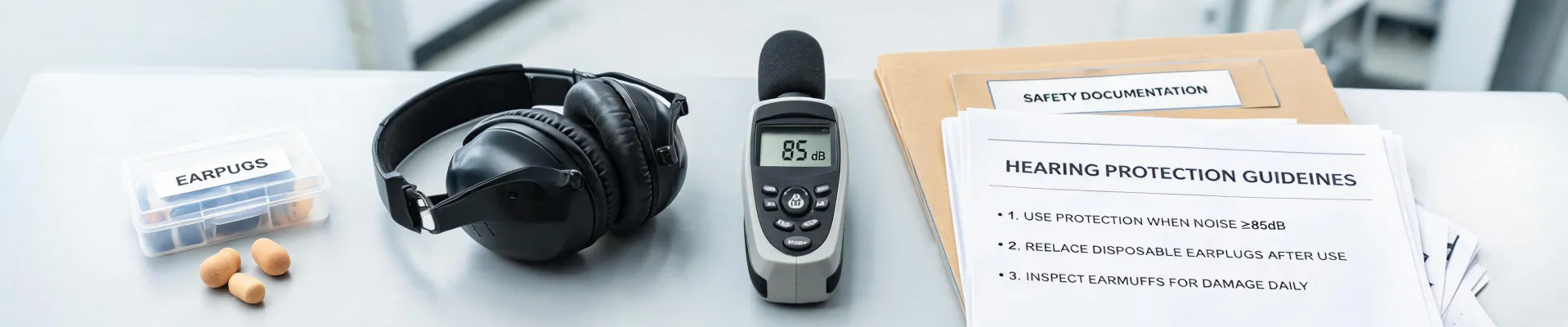
I manage purchasing for a 50-person company—everything from office supplies to safety equipment. That means I order hearing protection, invisible fence collars for the warehouse dog, combustible gas detectors for maintenance, and yes, I've even had to figure out why a fire alarm randomly goes off at 2 AM (spoiler: it's usually a low battery or a spider in the sensor). But the most common question I get from my team is: earplugs or earmuffs?
We use Howard Leight products almost exclusively—partly because of the Honeywell backing, partly because the NRR 33 rating on the Max earplugs is industry-leading. But when I needed to equip a new shift with hearing protection, I compared two options side by side: the classic Howard Leight Max earplugs (NRR 33) and the Howard Leight Impact Sport Bluetooth earmuffs. Here's what I learned.
Why Compare? Two Very Different Tools
When I looked at the datasheets, the specs told me one thing. But seeing them in use told me another. I set up three comparison dimensions:
- Protection consistency – Can you trust the NRR in real-world conditions?
- Comfort & compliance – Will people actually wear them?
- Cost & logistics – What does it mean for a small buyer?
Let's go dimension by dimension.
Dimension 1: Protection Consistency – Earplugs Win on Paper, Earmuffs Win in Practice
The Max earplugs boast an NRR 33—the highest passive rating you can get. On paper, that's unbeatable. But here's the catch: that rating assumes perfect insertion. When I watched our warehouse team put them in, maybe 60% got it right. The rest had gaps, which means actual protection dropped to around NRR 20-25.
With the Impact Sport earmuffs, there's no insertion technique. Just put them on. The NRR is 26, but that's achievable by almost everyone. I compared our Q1 noise exposure logs (we monitor via dosimeters) and the earmuff users had more consistent attenuation across the shift.
"When I compared the earplug and earmuff noise samples side by side, I finally understood why real-world protection matters more than a lab number." – Me, after the data came in
Dimension 2: Comfort & Compliance – Depends on the Job
For a 30-minute task, foam earplugs are fine. For an 8-hour shift, the earmuffs won out—especially the Impact Sport's padded headband. But here's the surprise: the Bluetooth feature on the Impact Sport changed behavior. People actually wanted to wear them because they could listen to music or take calls (safely, with ambient sound amplification). Compliance went from "I'll take them off when the supervisor leaves" to "I keep them on all shift."
That said, the earmuffs are bulky. If you're working under a hard hat or in tight spaces, earplugs are the only option. My experience is based on 50 employees in a warehouse and light assembly environment. If you're in confined spaces, your mileage will differ.
Dimension 3: Cost & Logistics – Small Buyers Need to Watch Out
This is where being a small buyer really matters. I once ordered 200 pairs of Max earplugs from a new vendor because they were $22 cheaper per case. They shipped them loose in a box—no proper invoice, just a handwritten receipt. Finance rejected the expense. I ate $400 out of my department budget. Now I verify invoicing capability before any order, no matter the size.
For Howard Leight Max earplugs (NRR 33), you can buy in packs of 200 or 500. Most distributors will sell to a small company without a minimum. The cost per pair is around $0.30–$0.50. For the Impact Sport Bluetooth earmuffs, you're looking at $60–$90 per unit. That's a big upfront cost, but they last for years if you replace the foam pads.
Here's a lesson I learned the hard way: I assumed 'same product from different sources' meant identical service. I was wrong. One distributor had a $500 minimum order for free shipping. Another didn't. Always ask about minimums and shipping before you commit.
So Which One Should You Choose?
When I consolidated our hearing protection last year, I ended up buying both:
- Go with earplugs if: You need disposable, low-cost protection for short tasks, or your workers are in confined spaces. The Max earplugs are perfect for visitors and occasional use.
- Go with earmuffs if: You have 8-hour shifts, need consistent protection regardless of insertion skill, and want to boost compliance with Bluetooth features. Small companies with fewer than 20 people might find the upfront cost easier to swallow than ongoing disposable purchases.
And if you're like me—buying everything from invisible fence kits to combustible gas detectors—keep a list of distributors who treat small orders seriously. The vendors who processed my $200 hearing protection orders with a smile are the ones I now use for $20,000 annual contracts. Small doesn't mean unimportant. It means potential.
Pricing data as of January 2025. Verify current rates with your distributor.

Maeve Callahan
Maeve Callahan is a head-protection analyst covering Type I and Type II hard hats, climbing-style safety helmets, bump caps, chin straps, suspensions, liners, and face-shield carriers. She applies ANSI Z89.1, EN 397, and EN 12492 criteria while comparing impact attenuation, penetration resistance, lateral deformation, electrical class, retention strength, field of vision, mass, fit range, and temperature conditioning. Her guides help EHS teams, contractors, utilities, and buyers select helmet systems for overhead hazards, work at height, electrical exposure, accessory compatibility, and worker acceptance.