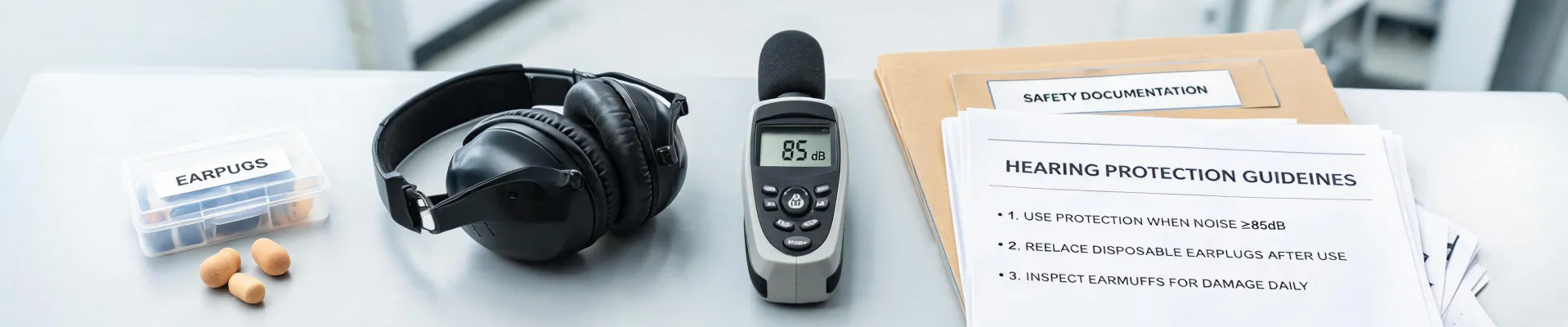
I was packing up to leave the office on a Thursday afternoon when my phone rang. The caller ID said "Plant Manager." That's never a good sign at 4:47 PM on a Thursday.
"OSHA just called," he said. "Walkthrough Monday morning. They're looking at our hearing protection program."
I sat back down. "How bad?"
"Bad enough. They reviewed our noise map during a phone screening. We've got 8-hour TWA readings over 85 dBA on half the floor, and our PPE inventory doesn't match up."
That's how I ended up with 72 hours to reassess our entire hearing protection setup — and the education I got in those three days changed the way I buy PPE for good.
The Call at 4:47 PM
Let me be honest: our hearing protection program was not a point of pride. We had a dispenser of generic foam earplugs that nobody liked wearing, a drawer of earmuffs that had been sitting there since 2019 (this was back in January 2024, at least), and zero documentation connecting our PPE choices to the actual noise hazards on the floor.
In my role coordinating PPE procurement for a 200-person manufacturing facility, I should have known better. But when you're juggling safety shoes, gloves, safety glasses, and every other request that lands on your desk, hearing protection tends to become an afterthought. It's just earplugs, right?
Wrong.
That night, I pulled up our noise survey results. The grinding station: 98 dBA. Press area: 95. Assembly line: hovering around 88–90 dBA. We were squarely in OSHA's "feasible controls required" territory, and the protection we had on hand wasn't adequate for a single one of those zones.
The Research: MAX, Impact Pro, and the Loop Question
I called three safety suppliers Friday morning and asked two questions: "What do you stock for high-noise areas?" and "What can you get here by Sunday?"
That's when the real education started.
The Howard Leight MAX earplugs came up first. They carry an NRR of 33 — the highest noise reduction rating available for a foam earplug. I'd seen the name in catalogs for years but never stopped to understand why it mattered. An NRR of 33 means the plug reduces noise by 33 decibels under lab conditions. Real-world protection often lands around half of that, depending on fit, but it's still the benchmark for serious noise exposure.
I spent Friday night reading how other safety managers reviewed the MAX before committing. The recurring theme: fit is everything. If workers don't insert them correctly — roll the plug down, pull the ear up, hold for 20-30 seconds — the NRR number is fiction. That's not a knock on the product; it's a knock on anyone who thinks handing out earplugs is the same as protecting hearing.
For the grinding and press areas, the MAX was the obvious choice. For the assembly line, I went a different route: the Howard Leight Impact Pro earmuffs. These are electronic muffs with an NRR of 31, and they've been a game-changer for us. They amplify ambient sound — speech, fork truck alarms, machine warnings — while still protecting against impulse noise. Workers can hear each other without shouting. That's the whole point: if people can communicate, they actually keep the muffs on.
The "How Do Loop Earplugs Work?" Question
One side quest from that weekend: one of our newer shift leads asked whether those popular consumer earplugs — Loop — would work on the floor. I'd seen the phrase "how do loop earplugs work" in searches before, so I actually looked it up properly.
Loop earplugs use a resonator channel design that filters sound instead of fully blocking it. They reduce volume while keeping conversation intelligible. They're genuinely good for concerts, commuting, or drowning out office chatter. They are not, however, rated for industrial noise exposure under OSHA. They don't carry an NRR rating, and if a compliance officer spots them on a workbench next to a grinder, you're going to have a bad day.
That's a red flag I hadn't thought about before: consumer hearing protection and industrial hearing protection are separate categories, and the difference isn't marketing. It's the rating.
The audit prep also forced me to re-examine our other PPE while I was at it. Safety shoes: we'd been buying static-dissipative boots for the electronics area, but we also needed puncture-resistant soles for the fabrication side — two different categories, one vendor. And body armor? That's a non-issue for a manufacturing floor (we're not a security firm), but the exercise of asking "what exactly is this protecting against?" is the right one for every PPE category.
Two Quotes, One Lesson About Trust
Here's where things got interesting.
Supplier A — the one who answered the phone first — quoted an attractive base price. "Best price per pair in the industry," the email said. I asked about delivery. "Standard ground, 5-7 business days." I needed Sunday. "We can expedite, but that's extra."
How much extra? That took another call. Then a follow-up. Then a vague number that "depended on final weight." By Friday afternoon, I still didn't have a total price.
Supplier B quoted a base price about 18% higher. But the quote itemized everything: unit price, handling, shipping, and an expedite option with a fixed price for 48-hour delivery. No guessing. No caveats.
When I compared the two side by side, I finally understood why transparency matters more than the sticker price. Supplier A's total would have been around $1,280 with no delivery guarantee. Supplier B: $1,540, guaranteed in hand by Sunday afternoon.
The $260 difference bought me certainty. Worth every penny.
It took me 3 years and about 40 rush orders to learn this lesson: the vendor who lists all fees upfront — even if the total looks higher — usually costs less in the end. The alternative is paying $48 here and $75 there while your deadline slides out of reach.
The Audit
Monday morning came faster than expected (it always does). The compliance officer walked the floor, checked our noise map against our PPE inventory, and randomly pulled a few earplugs from the dispenser to verify they matched the matrix.
We passed. No citations.
The officer actually commented that our program was "more thoughtful than most" for a facility our size. That comment was worth more than the $1,540 we spent, honestly.
Bottom Line: What I'd Tell Another Safety Manager
We spent about $4,200 on hearing protection last year — earplugs, muffs, replacement pads, training materials. That sounds like a lot, until you compare it to what a single OSHA citation costs, or what one workers' comp claim for noise-induced hearing loss sets you back.
Three things I'd tell anyone building a hearing protection program:
- Match the protection to the noise map, not the budget. If you have zones above 95 dBA, buy earplugs like the Howard Leight MAX (NRR 33) or comparable rated products. Don't buy cheaper, lower-rated plugs and hope for the best. You'll end up paying for it in corrective actions down the line.
- Ask for total cost, itemized, in writing. Shipping, handling, expedite fees — all of it. If a supplier won't put a number on it, that's a deal-breaker.
- Know the difference between consumer and industrial protection. Loop earplugs are fine for a concert. They are not fine for a factory floor. Check for the rating, not just the brand.
I have mixed feelings about rush fees, by the way. Part of me still thinks they're a money grab. Another part — the part that watched how much chaos a 72-hour turnaround created — understands why they exist. What I won't accept is hiding them until after I've signed the PO.
Saved $260 on that first quote? It sounded good on paper. It would have cost us the audit, and possibly one of our workers' hearing.
I'll take transparency over a discount any day.

Maeve Callahan
Maeve Callahan is a head-protection analyst covering Type I and Type II hard hats, climbing-style safety helmets, bump caps, chin straps, suspensions, liners, and face-shield carriers. She applies ANSI Z89.1, EN 397, and EN 12492 criteria while comparing impact attenuation, penetration resistance, lateral deformation, electrical class, retention strength, field of vision, mass, fit range, and temperature conditioning. Her guides help EHS teams, contractors, utilities, and buyers select helmet systems for overhead hazards, work at height, electrical exposure, accessory compatibility, and worker acceptance.