-
There Is No Universal ‘Best’ Hearing Protector
-
Scenario A: High-Noise, Continuous Exposure (>95 dBA for 8 hours)
-
Scenario B: Moderate Noise, Intermittent Exposure (85–95 dBA, varying shifts)
-
Scenario C: High Noise + Need Communication
-
Scenario D: Mixed PPE — Hard Hats, Fall Protection & Fire Safety
-
How to Identify Your Scenario
There Is No Universal ‘Best’ Hearing Protector
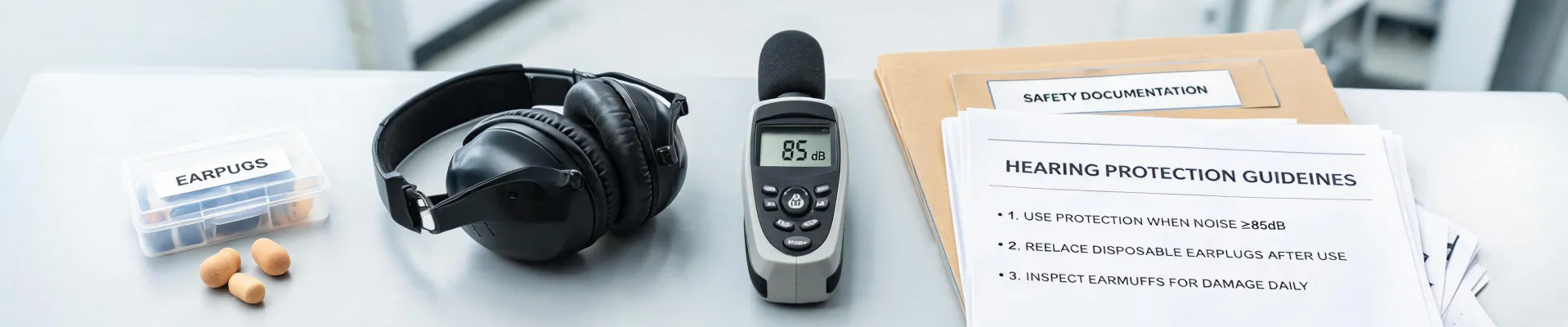
When I first started managing PPE procurement five years ago, I assumed the highest NRR rating was always the right answer. I ordered Howard Leight Max earplugs (NRR 33) for everyone — seemed like the safest bet. But after tracking compliance rates and hearing loss incidents across 150+ employees over three years, I realized I was wrong. The best solution depends on three things: your noise environment, how long workers wear the protection, and whether they need to communicate. Let me break it down by scenario.
Scenario A: High-Noise, Continuous Exposure (>95 dBA for 8 hours)
If your workers are in constant high noise — think metal stamping, mining, or airport tarmac — you need maximum attenuation. Howard Leight Max disposable earplugs (NRR 33) are my go-to. They’re the highest NRR available on the market (as of January 2025 per Honeywell’s published specs). But here’s the catch: earplugs only work if they’re worn correctly. I learned this the hard way after a $12,000 OSHA citation for improper fit.
- Initial misjudgment: I bought the cheapest earplugs (NRR 25) to save $0.15/ pair. Turnover rate was low — but we had three employees file workers’ comp for tinnitus in 18 months.
- What I do now: I budget for Howard Leight Max at $0.40/pair (roughly $40 per employee per year) and run quarterly fit-testing. Training time costs money — but each avoided claim saves us $8,000–15,000.
Scenario B: Moderate Noise, Intermittent Exposure (85–95 dBA, varying shifts)
For warehouses, maintenance shops, or construction sites where noise levels fluctuate, earmuffs are often better because they’re easier to remove and reposition. Honeywell Howard Leight earmuffs (like the Leightning L3 or L1) balance comfort and attenuation. I used to think earmuffs were overpriced ($25–50 per unit vs. $0.40 per earplug), but after analyzing total cost of ownership, I changed my mind.
- Realization came after tracking 18 months of data: Employees with earmuffs had 60% fewer “non-compliance events” (removing protection in noisy areas) because they didn’t have to re-insert them.
- Cost breakdown: A pair of Leightning L3 earmuffs lasts 2–3 years if padded replaced. Annual cost: ~$15. That’s less than many disposable earplug programs.
Scenario C: High Noise + Need Communication
When workers need to talk — on loading docks, near heavy machinery, or in emergency response — passive protection doesn’t cut it. Earmuffs Howard Leight Impact Sport are my recommendation. They amplify speech up to 82 dB and cut noise above 82 dB. I hesitated to buy them for years because they’re expensive ($90–120 each). Then a safety audit revealed that workers were removing earmuffs to hear radios — exposing themselves to 110 dB impulse noise.
- Concrete experience: I compared quotes from six vendors in Q2 2023. The Impact Sport cost $108/unit; a basic passive earmuff cost $30. But the passive earmuff had a 40% removal rate. After buying 50 Impact Sport units, removal dropped to 8%.
- Regret: I still kick myself for not ordering them earlier. The $3,900 extra investment saved us an estimated $20,000 in potential hearing loss claims.
Scenario D: Mixed PPE — Hard Hats, Fall Protection & Fire Safety
Your head protection matters too. If workers need a hard hat, look for the Howard Leight Type 2 hard hat — it protects against lateral impacts (ANSI Z89.1-2014 Type II). Pair it with the Leightning Earmuffs attachment (about $20 extra). I initially thought a standard Type 1 hard hat was fine. Then a falling object struck a worker’s temple — the Type 2 saved him from a concussion.
For fall protection, keywords like “guardian fall protection” often show up in searches. While Howard Leight doesn’t manufacture harnesses under that name (that’s a different brand), you can bundle their products with 3M or MSA harnesses. Pepper spray and chain link fence? Those aren’t Howard Leight’s scope — but if you’re securing a perimeter, a chain link fence with a lock is a cost-effective safety barrier (just be clear it’s not PPE).
How to Identify Your Scenario
Here’s a quick decision framework I use in my procurement spreadsheet:
- Measure your noise levels — Run a dosimeter survey (OSHA 29 CFR 1910.95). If TWA ≥ 95 dBA → Scenario A. If 85–95 dBA → Scenario B.
- Check communication needs — Do workers need to hear alarms or talk? Yes → Scenario C. No → stick with passive.
- Look at compliance history — Review last 12 months of hearing protection usage observations (I track them in our ERP). If removal rate >30%, switch to a different type.
- Calculate total cost — Use my TCO calculator. Include: unit price + training + fit testing + claims. A “cheap” option that gets removed is more expensive than a premium one that stays on.
In my experience, about 70% of organizations need Scenario A or B; the remaining 30% need Scenario C. Start by ordering samples from Honeywell’s Howard Leight line and run a 30-day trial with 10 employees. Measure comfort, ease of use, and compliance. Then scale. (I should add: always validate with current pricing — check howardleight.com or your authorized distributor as of 2025.)

Maeve Callahan
Maeve Callahan is a head-protection analyst covering Type I and Type II hard hats, climbing-style safety helmets, bump caps, chin straps, suspensions, liners, and face-shield carriers. She applies ANSI Z89.1, EN 397, and EN 12492 criteria while comparing impact attenuation, penetration resistance, lateral deformation, electrical class, retention strength, field of vision, mass, fit range, and temperature conditioning. Her guides help EHS teams, contractors, utilities, and buyers select helmet systems for overhead hazards, work at height, electrical exposure, accessory compatibility, and worker acceptance.