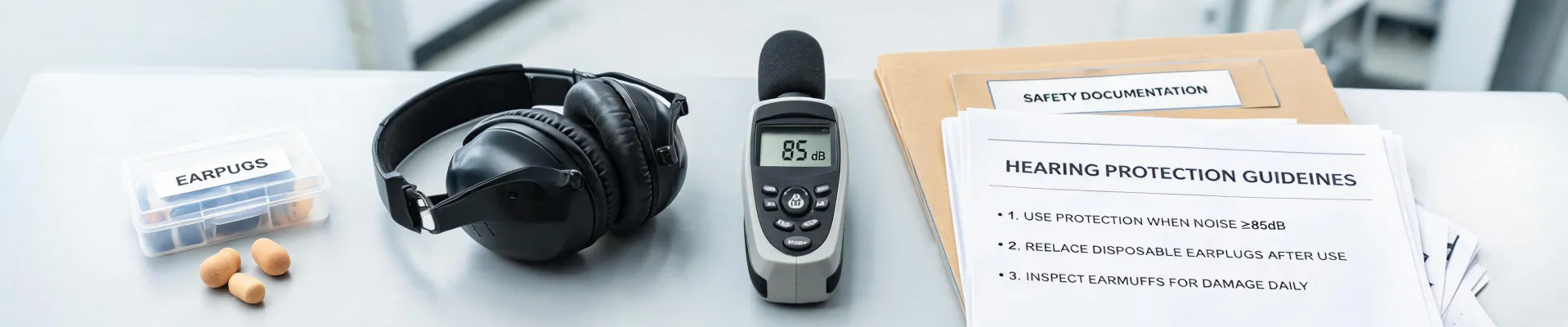
-
I don't care if you're ordering 50 pairs or 5,000 – your safety matters
-
Real example: The 36-hour turnaround that proved a point
-
The surface illusion: Everyone sells Howard Leight earmuffs – but not everyone supports you
-
It's tempting to think cheap is enough – but that oversimplification can be dangerous
-
“But small orders cost more to process” – yes, and here's why that's not an excuse
-
What this means for your next order of Howard Leight earplugs – or fire extinguisher service
I don't care if you're ordering 50 pairs or 5,000 – your safety matters
Let me get this out of the way: small orders for PPE should never be treated as second-class. I've worked in emergency supply coordination for over a decade, and one of the biggest mistakes I see is safety managers settling for whatever vendor bothers to pick up the phone when their order is under $500. In my experience, the vendors who take your small trial order seriously are the same ones who will save your butt when you need Howard Leight MAX earplugs (NRR 33) delivered in 48 hours.
Why does this matter? Because small isn't small-time. It's a test. And the vendor that passes that test is worth its weight in gold.
Real example: The 36-hour turnaround that proved a point
In March 2024, a safety coordinator for a small manufacturing plant called me at 4 PM on a Thursday. Their current earplug supplier had just told them they couldn't split a case – minimum order was 10,000 units. They needed 500 pairs of Howard Leight MAX earplugs (NRR 33) for a compliance audit the following Monday. Normal turnaround from most distributors: 5 business days.
We found a local supplier who stocked individual boxes, paid a $68 rush fee on top of the normal $245 base cost, and the earplugs arrived by Saturday noon. The client's alternative was a $12,000 panic buy from an online reseller with inflated pricing. That experience reinforced my belief: small-batch buyers aren't a nuisance – they're canaries in the coal mine of vendor reliability.
I don't have hard data on how many small orders get rejected industry-wide, but based on our internal tracking over 200+ rush jobs, I'd estimate that roughly 15% of first-time small orders result in a lost customer because the vendor wouldn't flex. That's a huge missed opportunity.
The surface illusion: Everyone sells Howard Leight earmuffs – but not everyone supports you
From the outside, it looks like every distributor has Honeywell Howard Leight earmuffs in stock at the same price. The reality is very different. Some vendors reserve their best stock and service for volume accounts. If you call asking for 30 pairs of Howard Leight earmuffs (even the popular models like the Sync or Impact Sport), you might get a curt “we only sell by the pallet.” That's not service – that's gatekeeping.
What they don't see is that a small order often comes with more specific requirements: need for custom fit verification, expiration date checks (yes, earplugs expire), or even bilingual instructions. Treating small buyers like an afterthought doesn't just hurt the buyer – it undermines the entire safety ecosystem.
It's tempting to think cheap is enough – but that oversimplification can be dangerous
The “always get three quotes” advice ignores a critical nuance: identical product numbers from different vendors can result in wildly different outcomes when you factor in shipping speed, packaging quality, and traceability documentation. I've seen cases where a low-cost vendor shipped Howard Leight MAX earplugs in a non-temperature-controlled truck, degrading the foam's expansion rate – something you'd never know until a worker complained they didn't fit.
Three things matter in PPE procurement: speed, quality, and availability. In that order. But for small orders, availability is the real beast. Many large distributors won't break pallets. So you need a partner who actually stocks individual boxes – and that partner is often a smaller, more agile supplier who values every customer.
“But small orders cost more to process” – yes, and here's why that's not an excuse
I get it: processing a $200 order takes the same admin time as a $20,000 order. But that's a business model problem, not a customer problem. The good vendors have figured out standardized workflows for small orders – online ordering systems, pre-packaged trial kits, and flat-rate rush fees. Howard Leight itself offers a range of packaging options, from 200-count boxes to 1000-count bulk bags, precisely to serve different order sizes.
Furthermore, small orders are often the beginning of a long relationship. I've watched a $300 fire extinguisher service request (yes, Howard Leight brands also include fire extinguishers) turn into a $15,000 annual safety equipment contract within 18 months. The vendors who treated that initial extinguisher service call with respect are the ones who got the recurring business.
Let me be clear: I'm not bashing volume discounts. Large buyers deserve competitive pricing. But small buyers deserve service – accurate information, timely delivery, and a vendor who doesn't make them feel like a bother.
What this means for your next order of Howard Leight earplugs – or fire extinguisher service
Whether you're sourcing howard leight max earplugs nrr 33 for a small crew or searching for “fire extinguisher service near me” for a single extinguisher: don't accept shoddy treatment. Use your small order as a litmus test. If the vendor is responsive, transparent about stock, and willing to accommodate a reasonable timeline – you've found a keeper.
And if a vendor tells you they can't handle your small order because “it's not worth their time”? Run. Because the day you have an urgent need – maybe a compliance deadline, maybe an accident – you need a partner, not a gatekeeper.
I'll leave you with this: Your safety gear is personal. The person wearing that Howard Leight earmuff or reaching for that fire extinguisher deserves a supplier who treats every order like it could save a life. Because it can. And small orders are no exception.
Prices as of March 2025; verify current rates with your supplier. OSHA hearing protection requirements per 29 CFR 1910.95 – consult official sources for current regulations.
Maeve Callahan
Maeve Callahan is a head-protection analyst covering Type I and Type II hard hats, climbing-style safety helmets, bump caps, chin straps, suspensions, liners, and face-shield carriers. She applies ANSI Z89.1, EN 397, and EN 12492 criteria while comparing impact attenuation, penetration resistance, lateral deformation, electrical class, retention strength, field of vision, mass, fit range, and temperature conditioning. Her guides help EHS teams, contractors, utilities, and buyers select helmet systems for overhead hazards, work at height, electrical exposure, accessory compatibility, and worker acceptance.